
Rankings Vs. Visibility: Why Rankings Don’t Always Mean Visibility Anymore
If you still think a #1 ranking means you are winning, you’re costing yourself more than you know. Rankings are a position. Visibility is whether people actually see you, across devices, SERP features, and the reality of modern search today. The rankings vs. visibility battle still lingers.
You can rank #1 with all your blog posts and money pages, but never get clicks. Search is changing, and we’re changing with it. There are a few considerations you must bear in mind, as AI and search continue to evolve.
Some crucial questions you may already be asking are:
- Are you ranking, or are you being seen?
- What does “position one” even mean when results pages change by device and intent?
- How many times do you appear without earning the click?
- Which search visibility metrics tell the truth when rankings look stable?
Do you still feel confused by rankings vs visibility? Don’t worry. I will unpack why SEO visibility vs. rankings are currently splitting in practice, what to watch next, and what to change.
What Does Ranking Mean Now That Search Has Changed?
For a long time, “ranking” was the cleanest shortcut we had for judging SEO performance. It felt simple. If you ranked higher, you were more visible. With visibility, you would get more clicks. If you got more clicks, results would follow.
That mental model is still floating around, which is why rankings still get so much attention. The problem is that the search environment that made this model reliable has shifted.
Why Rankings Used to Be a Reliable Measure
Traditionally, rankings were understood as your position on a mostly static results page. You searched for a keyword, you saw a list of links, and your job was to move your page up that list.
This model made sense because the experience was consistent. Most people saw the same page layout. The competition happened in one main place. And success was measured with a straightforward question: “Are we moving up?”
In that world, reporting was simple, too. Track a keyword, report a position, celebrate improvements. Rankings were treated as the scoreboard. Not anymore, you don’t do that.
We discuss this in more detail in our article: How to market a countertop business or any professional service-based business as all.
How Do Search Results Actually Appear Now?
Search results are no longer a static list of ten blue links. What someone sees can change based on device, location, intent, and even timing. SERP features like local packs, featured snippets, and “people also ask” blocks compete directly with organic results for attention.
This is why two people can search the same query and walk away with completely different experiences. One might see your page. The other might never scroll far enough to notice it.
At this point, ranking position stops being a reliable proxy for exposure. A more useful way to think about visibility is how much of the available demand you are actually capturing across relevant searches, not where a page sits for one query.
This framing is often used in modern SEO tooling and reflects how visibility shows up in practice rather than how rankings are traditionally reported.
What Does Visibility Actually Look Like in Practice?
Once rankings stop being the primary signal, visibility starts to look less like a single position and more like a pattern.
It is not about where a page appears once. It is about how often, where, and in what context a brand shows up when it actually matters.

If Rankings Are Not Enough, What then Counts as Visibility?
Visibility is about presence across queries, formats, and surfaces, not just a ranking for one keyword.
That includes:
- Appearing for related searches, not just exact matches
- Showing up in different result formats, not only standard listings
- Being visible at multiple points in the decision process
A page can rank well and still be easy to miss. At the same time, a page can rank slightly lower and still earn consistent attention if it appears frequently across relevant searches.
This is where the difference between being present and being chosen becomes clear. Presence is exposure. Being chosen depends on relevance, context, and timing.
What Signals Actually Influence Real Visibility?
Rankings track position. Visibility is about exposure and attention. Those are not the same thing, especially now that Google’s results shift based on context like location, device, and query meaning.
In practice, three forces tend to decide whether you are actually seen.
(i) Does the page match the search intent, not just the keyword?
Intent is the job behind the query. It is what the searcher is trying to accomplish in that moment.
Two pages can mention the same keyword and still be competing in different worlds.
- “Best project management tool” usually signals comparison intent
- “ClickUp vs. Asana” signals evaluation intent
- “How to set up ClickUp for marketing” signals implementation intent
If your page answers the wrong job (intent), it can still rank occasionally, but it will not consistently surface when it matters. Google’s own explanations of how search works emphasize relevance to the user’s query and context, not simple keyword matching.
(ii) Is the content structured in a way that earns attention on the results page?
Even if you rank, the results page is crowded. It is not just ten organic links competing fairly.
SERP features like featured snippets, knowledge panels, shopping units, maps, and “people also ask” can pull attention away from classic organic results.
Studies and analyses of SERP layouts show that the more feature-heavy a results page becomes, the more organic click behavior changes.
This is also where zero-click behavior matters. When Google satisfies the query directly on the results page, users may not click any website at all. SparkToro and Similarweb’s 2024 study highlights how often searches end without a click to the open web.
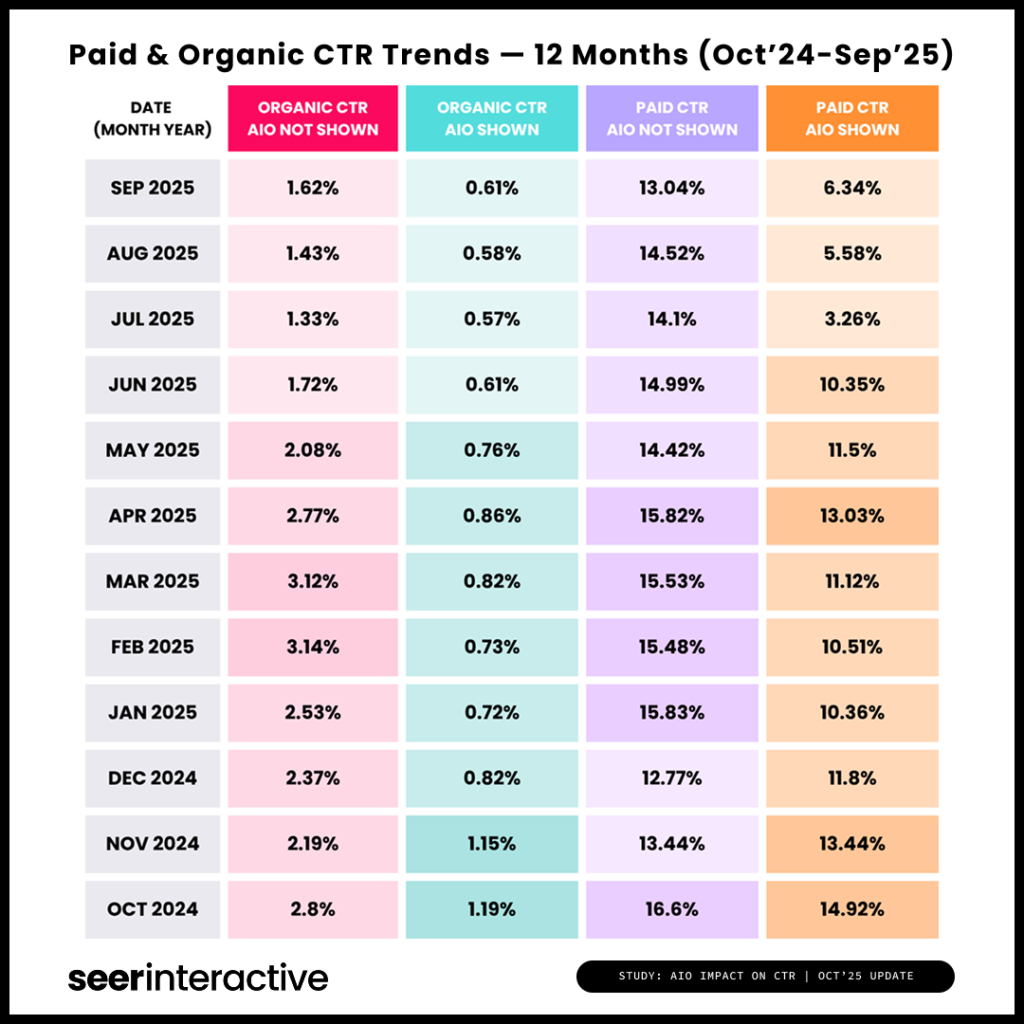
Add AI Overviews to that mix, and the gap can widen further. Seer Interactive’s reporting shows significant CTR declines on queries where AI Overviews appear, which means “ranking” can stay stable while clicks fall.
The image above shows you exactly what organic search looks like now that the AI Overview is in the picture. Source: Seer Interactive’s reporting
Being “ranked” is not the same as being noticed. Visibility is affected by what else sits above you, around you, or replaces the need to click.
(iii) Does the page exist in context, or is it isolated?
Visibility compounds when you are not relying on a single page to do all the work. In practice, pages tend to perform better when they are part of a topic system:
- A main page that establishes the core topic
- Supporting pages that answer related questions
- Internal links that help search engines and humans understand how the pieces connect
This matters because modern search rewards relevance and usefulness across many signals. Google’s guidance around creating helpful, people-first content reinforces the idea that content should be made to genuinely help users, not just to rank for a term.
When pages are isolated, they might rank briefly, but they struggle to maintain visibility across variations of the same intent.
Simple way to spot this: If you only show up for one query but disappear for closely related ones, you likely have a page problem and a context problem.
You’ll find more interesting details on this subject in our article about how to design a functioning website for a professional service business. It’s not just about the design of your website but the overall page architecture.
(iv) Why visibility can improve even when rankings look unchanged
Once you factor in intent, SERP layout, and topical context, it makes sense that visibility moves unevenly.
You might see:
- Impressions rise because you are appearing more often
- CTR falls because the page is competing with more SERP features
- Traffic holds steady while conversions improve because you are matching intent better
That is not random. That is what modern search looks like.
How Does This Play Out in a Real Scenario?
Consider two pages targeting the same general topic.
One ranks first for a single keyword but appears nowhere else. The other ranks fifth yet appears consistently across related searches and variations (including being referenced in the AI Overview).
On paper, the first page looks more successful. In practice, the second page captures more attention, more familiarity, and often more opportunity.
That is visibility at work.
Once visibility is understood as a pattern rather than a position, it becomes clear why traditional ranking reports fall short, and why different metrics and a different mindset are needed to evaluate performance accurately.
Rankings Vs. Visibility: How Should SEO Performance Be Evaluated If Rankings Alone Are Not Enough?
If rankings are incomplete, performance needs to be read across patterns, not points.
A) Are you visible across intent clusters, not just single keywords?
Instead of tracking one keyword at a time, look at how often your site appears across a group of related searches that reflect the same intent.
This shows whether you are:
- Consistently present when the topic comes up
- Visible beyond exact-match queries
- Building recognition across a problem space
This is where visibility actually compounds.
B) Does visibility translate into engagement and outcomes?
Visibility without response is noise. Useful evaluation connects visibility to:
- Impressions paired with click-through behavior
- Engagement signals that suggest relevance
- Outcomes like leads, sign-ups, or qualified traffic
This helps explain why traffic can stay flat while performance improves, or why rankings rise without meaningful results.
C) Are rankings being used as context, not the goal?
Rankings still matter, but only as supporting evidence.
They are most useful when:
- Diagnosing sudden changes
- Comparing performance within a stable SERP
- Validating improvements after structural or content changes
They become misleading when treated as success on their own.
D) Are you measuring consistency instead of spikes?
Short-term gains can look impressive and disappear just as quickly. More reliable performance shows up as:
- Steady impressions across time
- Repeated visibility for related searches
- Gradual improvement across multiple pages
Consistency signals systems working, not tactics landing.
Continue Learning About Search Visibility and SEO Performance
If this changed how you think about rankings and visibility, there’s more context worth exploring.
- Check out how visibility connects to meaningful SEO metrics
- Read more about how I think about SEO performance and measurement
- Start a conversation about visibility beyond rankings
Or, if you’d rather keep learning quietly:
Get occasional updates on how search, visibility, and SEO are changing. One short email per week. No selling. Just clear thinking about what’s shifting and what actually matters.
Are rankings still important for SEO?
Yes, rankings are still important, but they should be treated as context rather than the end goal. They help diagnose changes and trends, but on their own they do not explain whether your content is actually being seen, chosen, or producing meaningful outcomes.
Want to learn more about SEO and how you can do more than just rank your pages? We have a very detailed blog on SEO for home service businesses and any business at all.
Frequently Asked Questions about SEO Visibility Vs. Rankings
What is the difference between rankings and search visibility?
Rankings describe where a page appears for a specific query at a specific moment. Search visibility reflects how often and where your content appears across relevant queries, formats, and contexts, and whether people are realistically exposed to it during their decision-making process.
How can I measure visibility if rankings are not enough?
Visibility is better measured by combining signals like impressions, click-through behavior, coverage across intent-related queries, and engagement trends. These metrics help reveal whether your content is consistently appearing and earning attention, even when individual keyword rankings fluctuate.
Why do some pages rank well but bring little traffic?
This often happens when a page ranks for low-intent queries, appears below dominant SERP features, or does not align closely with what searchers actually want. In those cases, rankings exist, but real visibility and interest remain limited.
Does visibility matter more than rankings for conversions?
Visibility matters more because conversions depend on being present at the right moment, for the right intent, with the right message. A lower-ranked page that consistently appears for relevant searches often drives better outcomes than a top-ranked page seen rarely or ignored.
How does modern search change how rankings should be interpreted?
Modern search introduces personalization, SERP features, AI-generated answers, and device-based variation. This means rankings are no longer universal or static. They must be interpreted alongside visibility, context, and intent to understand what performance actually looks like.