
Business Website Content Strategy: Why Random Blog Posts No Longer Make Sense For Business Websites
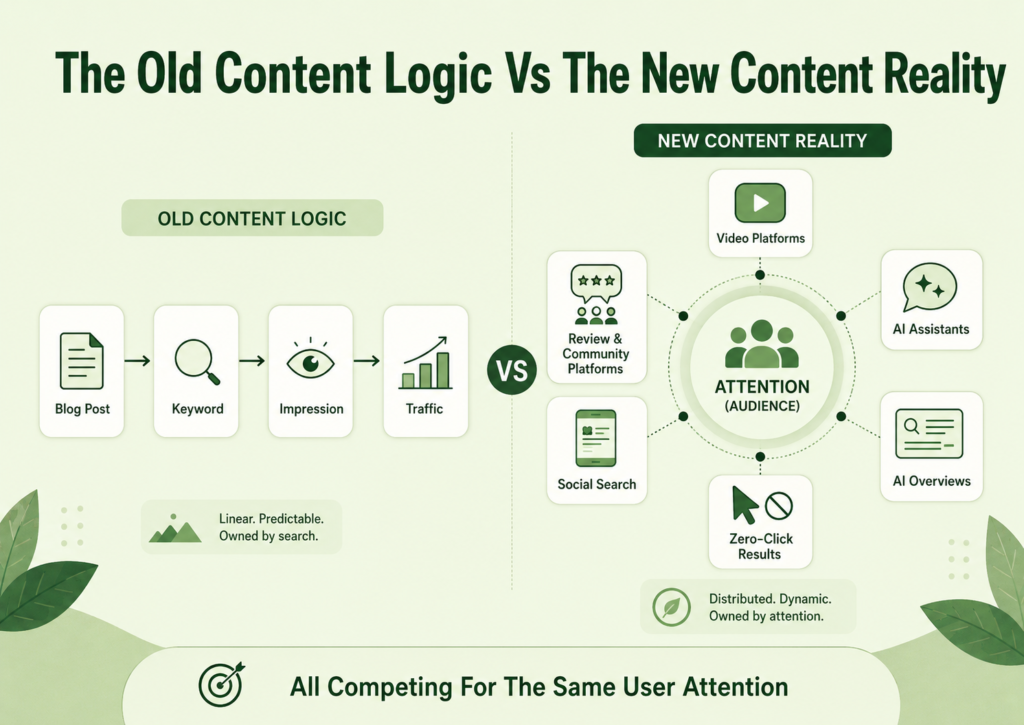
For a long time, business owners were told the same thing:
Publish more blog posts.
- More blogs would mean more keywords.
- More keywords would mean more impressions.
- More impressions would mean more traffic.
- And somehow, that traffic was supposed to become business.
But that logic is not as strong as it used to be.
People now learn from YouTube. They compare options with AI tools. They get quick answers from search results without clicking anything. They check reviews, social posts, Reddit threads, videos, and AI summaries before they ever land on a business website—if they even ever do.
So if your business is still publishing random blog posts just to chase impressions, I think that strategy needs to be questioned.
The problem is not blogging itself but a lazy business website content strategy.
Business websites don’t need more content for the sake of looking active. They need content that helps the right buyers find them, trust them, compare their options, and take the next step.
That is the shift this article is about.
People Still Need Answers, But They Do Not Always Need Your Blog
I don’t think the right argument is that people no longer read.
That is just untrue.
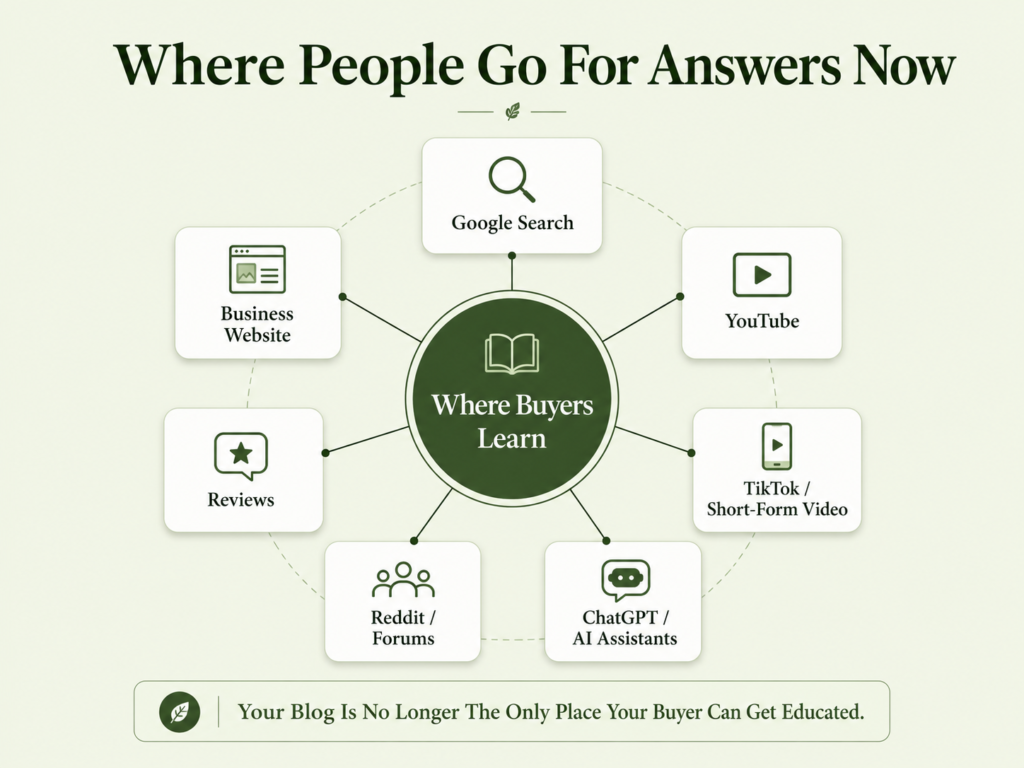
People still read when the content is worth reading. They still search, compare, research, and take time to understand things before making decisions. But the way they get those answers has changed.
Sometimes, reading a blog post is still the best format. But sometimes, the buyer wants to see the thing in action. They want a tutorial. They want a walkthrough. They want visual proof. They want someone to explain it quickly in a way that feels easier to process.
That is why video has become such a serious part of the content journey.
Pew Research found that YouTube remains one of the most widely used online platforms among U.S. adults, with 84% saying they use it. Google/BCG research also found that video influences shoppers throughout the purchase journey, not just at the awareness stage. Wyzowl’s 2026 report says 91% of businesses now use video as a marketing tool, while 93% of video marketers consider it important to their overall strategy.
That tells you something important. The internet did not stop needing content; it just stopped depending on blog posts alone.
So if your business is still expecting broad how-to blogs to carry the full discovery, education, and trust-building journey, that business may be working from an old content model.
Today, the same buyer may watch a video, ask an AI tool, skim search results, check reviews, compare examples, and only then visit a website.
That does not make the website useless; it means the website has to work harder. It has to give the right buyer something worth staying for.
AI Search Is Eating The Easy Informational Queries
This is where the pressure on random blog posts gets even stronger.
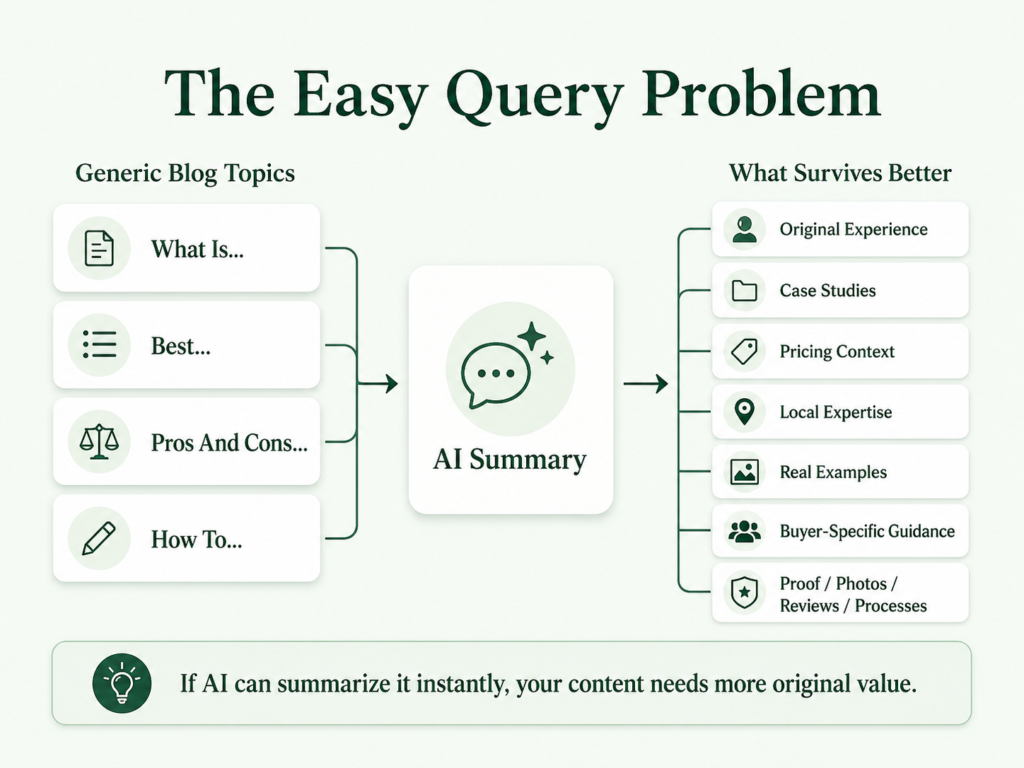
For years, many businesses treated broad informational topics as easy SEO opportunities. They created posts around questions like:
- What Is X?
- How Does X Work?
- Best X For Y
- Pros And Cons Of X
- X Vs Y
- Basic Beginner Guides
- Simple Definitions
- Generic How-To Posts
Those topics are not automatically bad. Some of them can still be useful when they are written with real depth, examples, proof, and buyer context.
But the weak versions of those posts are in trouble.
Because if someone can ask ChatGPT, Gemini, Claude, Perplexity, or another AI tool and get a clear summary in seconds, your blog post cannot survive by being just another summary.
That is the part business owners need to understand.
AI is not only changing how people search. It is moving into the same research and comparison moments that blogs used to own.
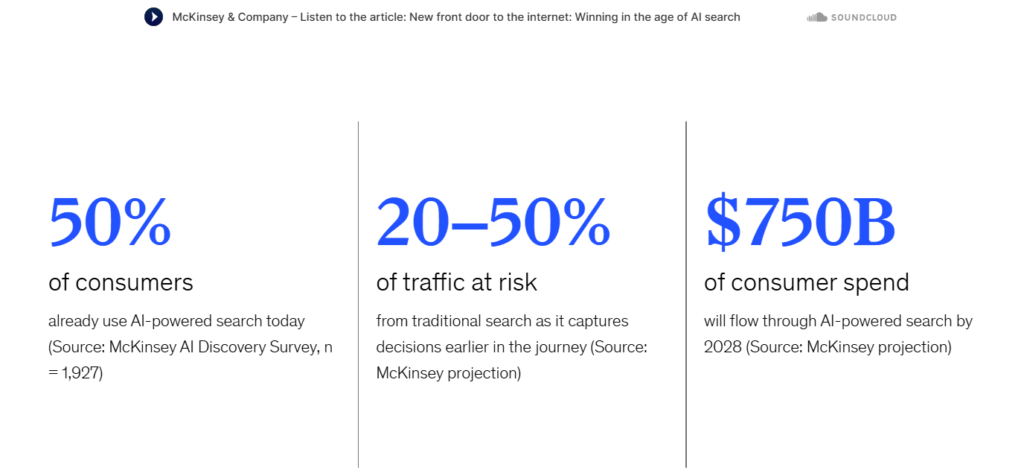
McKinsey describes AI search as a new front door to the internet, and says half of consumers now use AI-powered search. It also estimates that AI search could influence up to $750 billion in revenue by 2028.
Adobe’s 2025 survey of 5,000 U.S. consumers found that 39% had already used generative AI for online shopping, and the top task was research, used by 55% of respondents. Gartner also predicted that traditional search engine volume would drop 25% by 2026 as AI chatbots and virtual agents take more search activity.
That should change how we think about website content.
If AI tools are already helping people research products, compare options, understand services, and get fast explanations, then a business blog has to offer something more useful than a rewritten answer to a common question.
- It needs a stronger substance.
- It needs your process.
- Your examples.
- Your proof.
- Your pricing context.
- Your service experience.
- Your comparison logic.
- Your local insight.
- Your honest point of view.
That is what makes the content harder to replace.
So no, informational content is not useless. But broad informational content with no original value is becoming weaker.
If AI can summarize the answer in seconds, your blog post needs to do what a quick AI answer cannot do well: help the right buyer understand why your business is worth trusting.
Why More Impressions Do Not Always Mean More Business
This is another place where the old content logic starts to break.
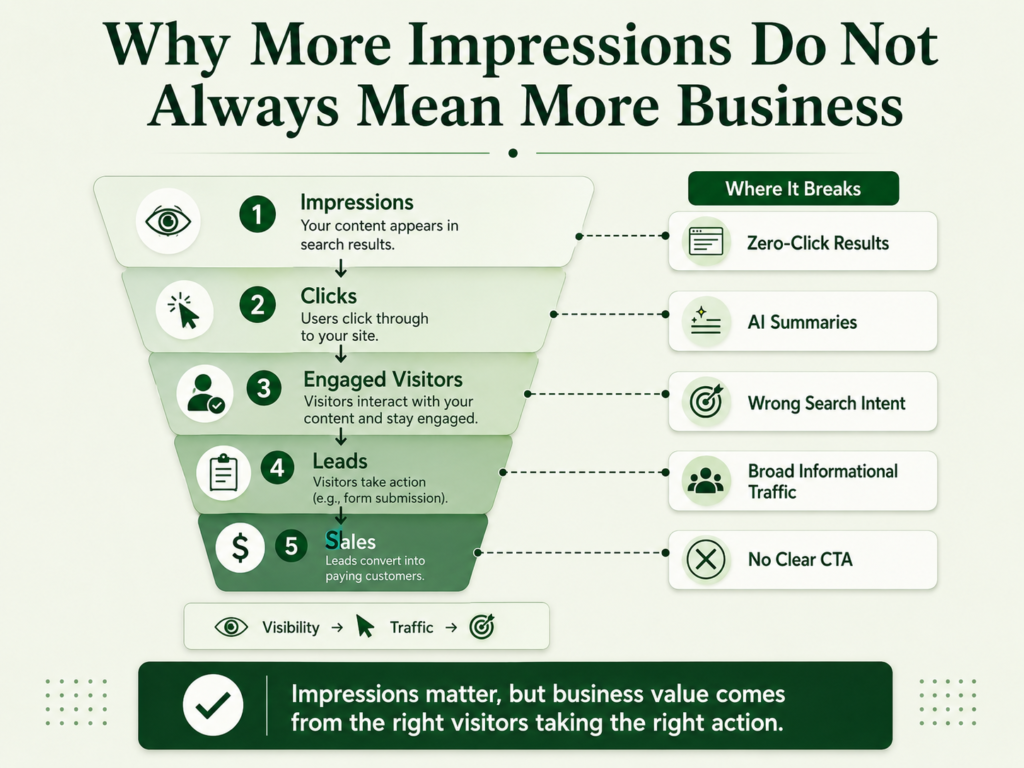
A lot of business owners still treat impressions like proof that their content is working. And I understand why. When you open Google Search Console and see that a page is getting more impressions, it feels like progress.
But impressions alone can be misleading.
A page can show up in search without getting meaningful clicks. It can get clicks from people who are only looking for a quick answer. It can attract visitors who are not ready to buy, not in your service area, or not looking for the kind of help your business actually provides.
So when we talk about website content today, we have to separate three things:
- Visibility
- Traffic
- Business Value
They are not the same.
SparkToro’s 2024 zero-click search study found that 58.5% of U.S. Google searches and 59.7% of E.U. Google searches ended without a click to the open web. That means many searches never become website visits at all.
AI summaries add another layer to this problem. Pew Research found that when users encountered a Google AI summary, they clicked a traditional search result in 8% of visits. When they did not encounter an AI summary, that number was almost twice as high, at 15%.
There is also early academic research showing how this can affect informational publishers. A 2026 study on Google AI Overviews and Wikipedia estimated that exposure to AI Overviews reduced daily traffic to English Wikipedia articles by about 15%.
That does not mean every business website will lose traffic in the same way. A local service page, a product page, or a high-intent comparison page is not the same as a Wikipedia article.
But the direction is clear enough to pay attention to.
Search results are becoming better at answering questions before the user clicks. AI summaries can satisfy simple informational intent inside the results page. And broad blog posts are more exposed to that shift because they often target the kinds of questions search engines and AI tools can answer quickly.
That is why your business website needs to stop judging content by impressions alone.
A page should not only ask: “Did people see this in search?”
It should also ask:
- “Did the right people click?”
- “Did they stay?”
- “Did they understand the offer better?”
- “Did they move closer to calling, booking, requesting a quote, or trusting the business?”
Because more impressions do not automatically mean more business, and traffic that never turns into trust, leads, or sales is not a strong enough reason for you to keep creating random content.
Why Random Blog Posts Are A Weak Strategy For Business Websites
This is where business owners need to bring the conversation back to their own website.
Because the issue is not just that Google is changing. It is not just that AI search is growing. It is not just that people are watching more videos.
The real issue is that your business website does not need content just to look active. It needs content that helps the right person move closer to action.
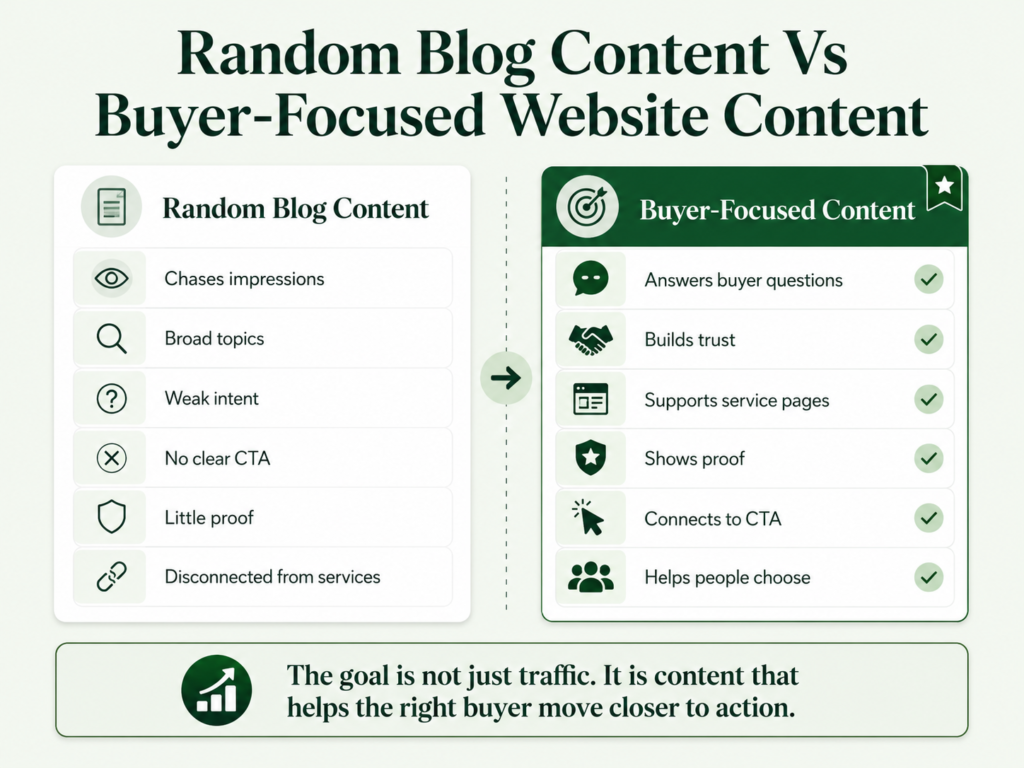
That is why random blog posts are becoming a weaker strategy for business websites. Not because every blog post is useless, but because too many blog posts are created without a real business purpose.
A random blog post usually fails because it does one or more of these things:
- Targets Broad Informational Keywords
- Attracts Visitors Who Are Not Ready To Buy
- Does Not Connect To Any Service Page
- Does Not Answer Real Buyer Objections
- Does Not Show Proof
- Does Not Help Visitors Compare Their Options
- Does Not Build Trust In The Business
- Does Not Lead To A Quote Request, Call, Booking, Demo, Or Inquiry
- Exists Only Because Someone Said, “We Need A Blog”
That is not a content strategy.
That is publishing for the sake of publishing.
Google’s own SEO Starter Guide does not frame SEO as “just rank more pages.” It explains SEO as helping search engines understand your content and helping users find your site and decide whether they should visit it. Google’s helpful content guidance also keeps pushing the same idea: content should be useful to people, not created mainly to manipulate rankings.
That matters because a business website has a different job from a media website.
A business website is not trying to win every possible click on the internet. It is trying to attract the right people, answer the right questions, build trust, and move those people toward a useful next step.
For 95 Green Shark, this is especially important because the goal is not generic content volume. The direction is more specific: helping countertop shops, stone fabricators, kitchen and bath businesses, cabinetry companies, and home improvement businesses build content around service pages, material pages, local search, buyer trust, and quote-ready leads.
That is the difference.
A random blog post may bring traffic but a strong business content asset should help someone understand:
- What You Offer
- Who You Help
- Why They Should Trust You
- How Your Process Works
- What Makes You Different
- What They Should Do Next
If users can get generic answers from AI tools, videos, search snippets, and social platforms, your website has to become more specific, more useful, more proof-driven, and more tied to buyer action.
That is where random blog posts fall short. They may create impressions, but they often fail to create movement.
The Kind of Content That Business Websites Actually Need Now
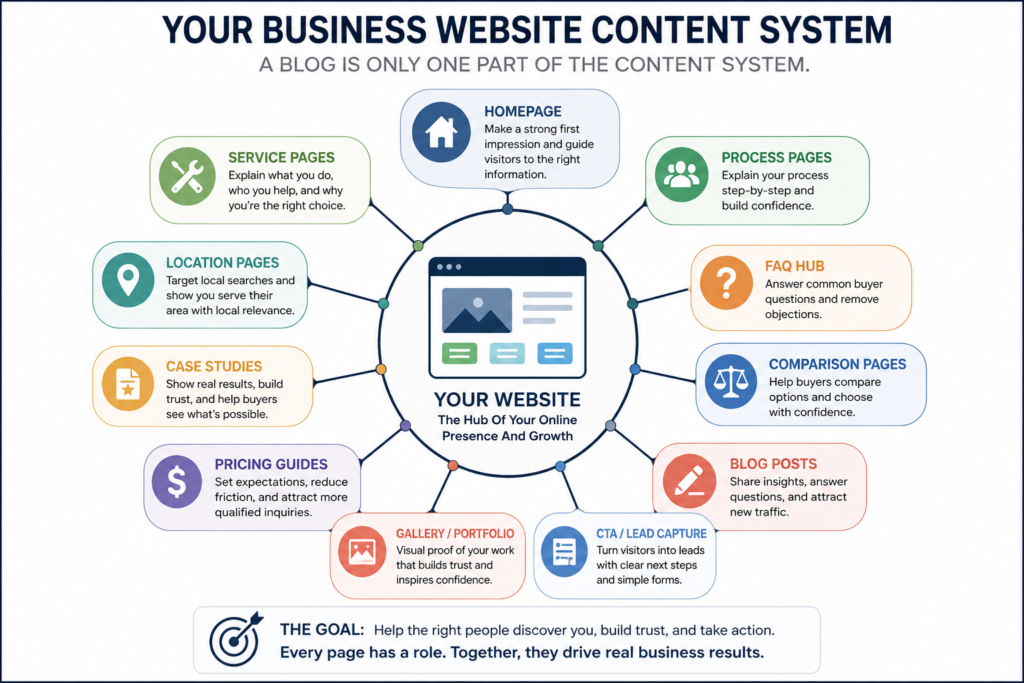
So what should business websites create instead? Not just more blog posts but better content assets.
That is the practical shift your business needs. If random blog posts are becoming weaker, the answer is not to stop creating content. The answer is to build the kind of content that supports how people actually discover, compare, trust, and contact businesses now.
Google’s own SEO Starter Guide explains SEO as helping search engines understand your content and helping users find your site and decide whether they should visit it. Google also keeps pointing creators toward helpful, reliable, people-first content instead of content created mainly for search engines.
That matters because a business website needs pages that make the offer clearer, not just posts that make the blog look active.
The content assets that matter now include:
- Service Pages That Explain What You Do Clearly
- Location Pages That Support Local Search And Service Areas
- Product Or Material Pages That Help Buyers Compare Options
- Pricing Or Cost Guides That Set Better Expectations
- Comparison Pages That Help People Choose With Confidence
- Process Pages That Explain How Working With You Actually Works
- Case Studies That Show Proof, Not Just Claims
- Project Gallery Pages That Turn Completed Work Into Trust Assets
- FAQ Hubs That Answer Real Buyer Questions
- Buyer Education Pages That Make The Decision Easier
- Landing Pages Built Around A Specific Offer Or Campaign
- Review And Proof Pages That Reduce Doubt
- Sales Enablement Content Your Team Can Use In Conversations
- Carefully Chosen Blog Posts That Support Real Buyer Intent
This is the difference between publishing and building a content system.
Publishing says, “We need something new on the blog.” However, a content system asks, “What does the buyer need to understand before they trust us enough to take action?”
For service businesses, this matters even more. A countertop shop, stone fabricator, kitchen and bath company, cabinetry business, or home improvement service provider does not just need random traffic.
It needs the right people finding the right pages at the right stage of their decision. That is why service pages, material pages, location pages, quote-request pages, and proof-driven content often carry more business value than another broad blog post.
The future of website content is not endless publishing. It is building the right page types around the buyer journey.
When Blog Posts Still Make Sense For Your Business Website
This is where I want to be very clear. I am not saying that business websites should stop blogging.
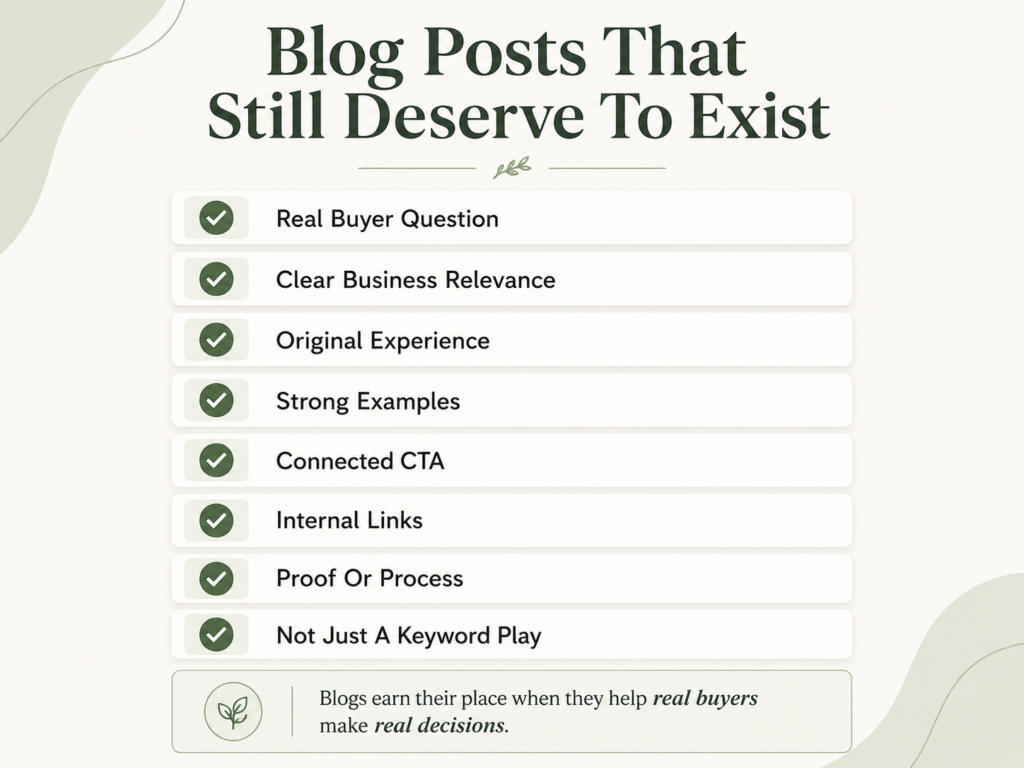
That would be too extreme, and honestly, it would be wrong. Blog posts can still be useful. They can still rank. They can still support buyer education. They can still help people understand a service, compare options, and move closer to making a decision.
The problem is not the blog post but the reason behind the blog post. A blog post still makes sense when it has a clear job to do.
For example, blog posts are still useful when they:
- Answer Specific Buyer Questions
- Come From Real Experience
- Connect Naturally To A Service Or Product
- Support Internal Linking
- Help Sales Teams Explain Something Better
- Show Process, Proof, Opinion, Or Expertise
- Give Examples That A Generic AI Answer Cannot Easily Replace
- Help The Right Visitor Understand Something Before Contacting The Business
That is the difference.
A weak blog post says, “Let us publish something because we need content.” A strong blog post says, “This is a question our buyers actually ask, and answering it well can help them trust us, understand the offer, and take the next step.”
Google’s helpful content guidance supports this direction. It encourages content that is helpful, reliable, and people-first, rather than content created mainly to attract search engine traffic.
This matters even more now because AI tools are already part of how people research and compare. McKinsey reports that half of consumers use AI-powered search today, and Adobe found that 39% of surveyed U.S. consumers had used generative AI for online shopping, with research being the top use case.
So if AI can already help people summarize, compare, and research, your blog post needs to add something more grounded.
- Experience.
- Proof.
- Examples.
- Process.
- Pricing context.
- Location context.
- A strong point of view.
That is why I keep coming back to this line: Blogs are not dead. Lazy blog strategy is.
The New Rule For Business Website Content
Business websites do not need more content just to look active. They need content systems.
The goal is not to win random impressions from people who may never buy. The goal is to help the right buyer find you, understand what you offer, trust your process, compare their options, and take the next step.
That is why the best content now has to be specific, useful, proof-driven, and connected to a real business outcome.
Google’s own guidance keeps pointing in that direction too: create helpful content for people, and make it easier for both users and search engines to understand what your site offers.
So the new rule is simple: If a piece of content cannot help the right buyer find you, trust you, understand you, compare you, or contact you, it probably should not be a priority.
Blog posts are not dead. But the era of publishing random posts and hoping impressions turn into business is fading fast.
See how AI-assisted website design can turn a content strategy into a practical publishing workflow.