

How To Market A Countertop Business: A Complete Guide To Visibility, Leads, And Sales
Marketing a countertop business requires more than posting finished kitchens on social media, running occasional ads, or creating several website pages with different city names.
You need a connected system that helps homeowners, contractors, designers, builders, and other potential buyers find your business, evaluate your materials and completed work, request a quote, and receive the follow-up needed to move the project forward.
That system may include a conversion-focused website, local SEO, Google Business Profile optimization, service and material content, paid advertising, reviews, project-based social content, and reliable lead tracking.
The opportunity within the wider home-improvement market remains substantial. The Joint Center for Housing Studies of Harvard University expects annual homeowner spending on improvements and repairs to reach approximately $523 billion in early 2027, even as industry growth slows.
That figure does not mean every countertop shop will automatically receive more projects. It means homeowners are continuing to spend significant amounts on their properties while countertop businesses compete for a share of that demand.
The shops that win more of the right projects will not necessarily be the ones posting most frequently or buying the most website traffic. They will be the ones who make it easier for suitable buyers to find them, understand what they offer, trust their work, and take the next step.
A homeowner may first search for quartz countertops in their city, compare several local fabricators, read reviews, examine completed kitchens, study the differences between materials, and look for information about pricing or installation.
A contractor or designer may care more about production capacity, turnaround times, communication, material access, and whether the shop can support repeat projects.
In both cases, one advertisement is rarely responsible for the entire decision.
Your search visibility may introduce the business. Your website may explain the offer. Your project gallery may demonstrate capability. Your reviews may reduce uncertainty. Your quote process may capture the opportunity. Your follow-up may determine whether that opportunity becomes an estimate and, eventually, a sale.
This is why one marketing channel cannot permanently compensate for weaknesses elsewhere.
More website traffic will not solve a confusing quote process. Strong Google rankings will not rescue a website that gives buyers little reason to trust the shop. Paid advertising will continue wasting money when campaigns attract people outside the service area or send every visitor to a generic homepage. Even a qualified inquiry can be lost when nobody responds promptly or follows the project through the sales process.
A countertop marketing strategy must therefore answer four connected questions:
- Visibility: Can the right buyers find your business?
- Trust: Does what they find give them confidence in your work?
- Conversion: Can they easily request the appropriate next step?
- Follow-Up: Can your team turn that inquiry into a consultation, estimate, and sale?
This guide explains how to strengthen each part of that system. You will see how countertop websites, SEO, Google Business Profile, content, advertising, reviews, social media, lead qualification, automation, and performance tracking work together—and how to identify the part of your current marketing that is preventing better opportunities from moving forward.
Table of Contents
The Countertop Customer Journey
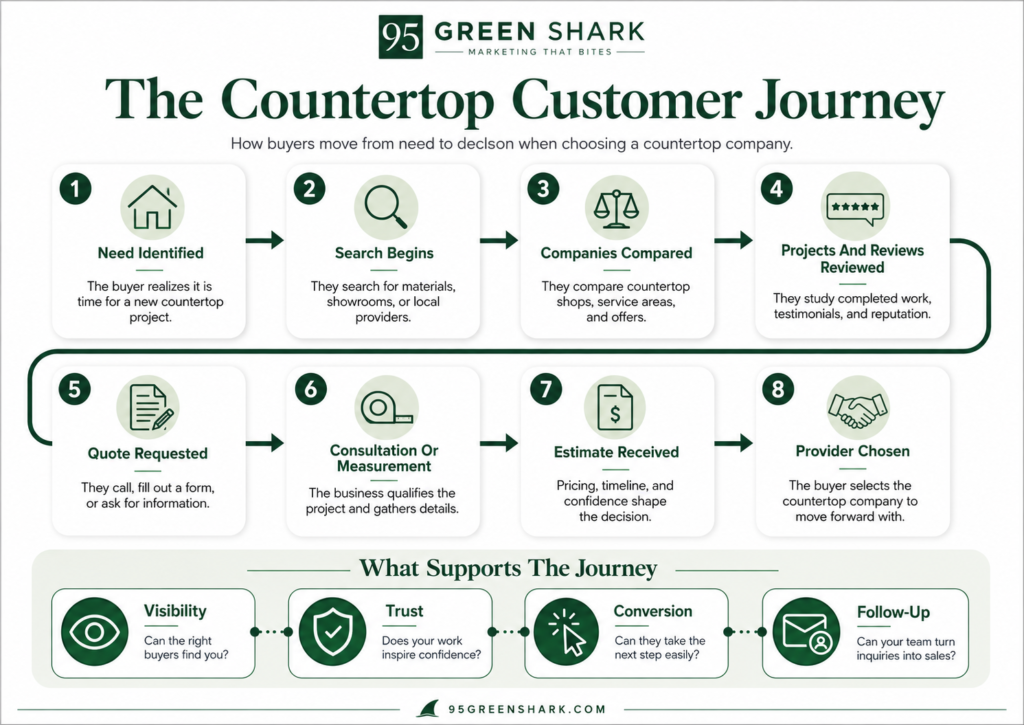
Before choosing a marketing channel, it helps to understand the journey a potential customer may take:
- The buyer identifies a need. A kitchen feels outdated, a countertop is damaged, a new build reaches the selection stage, or a remodel is ready to move forward.
- The buyer searches for materials or local providers. They may search for quartz, granite, quartzite, countertop installers, local showrooms, fabricators, or answers to planning questions.
- The buyer compares countertop businesses. They examine service areas, materials, reviews, experience, completed work, processes, and perceived professionalism.
- The buyer reviews projects and testimonials. Real installations and detailed customer experiences help the buyer judge whether the business can handle a similar project.
- The buyer requests information or a quote. They may call, complete a form, upload measurements, request an estimate, or ask about showroom availability.
- The buyer schedules a consultation or measurement. The business begins qualifying the opportunity, confirming project details, and guiding material or design decisions.
- The buyer receives an estimate. Price, material availability, timeline, communication, and confidence in the company influence what happens next.
- The buyer selects a provider. The final decision reflects the complete experience, not simply the first advertisement or search result they encountered.
Every step creates an opportunity for your marketing to move the buyer forward or give them a reason to choose another shop.
The rest of this guide begins with the system behind that journey: how visibility, trust, conversion, and follow-up work together to market a countertop business effectively.
What Is Countertop Business Marketing?
Countertop business marketing is the coordinated process of attracting the right buyers, helping them understand their material and project options, giving them enough confidence to make contact, and following each qualified inquiry through consultation, estimate, and sale.
It includes the website, search visibility, advertising, content, reviews, project photography, local profiles, lead capture, and follow-up systems used to move potential customers towards a purchasing decision.
However, countertop business marketing is not defined by the number of platforms a shop uses. It is defined by how well those activities work together to produce suitable project opportunities.
That distinction matters because promotion and marketing are not the same thing.
Promotion is an individual activity. A shop may post photographs of a new quartz installation, pay to boost a Facebook post, run a Google advertisement, send an email, or add a new city page to its website. Each activity may create attention, but attention alone does not mean the business has an effective marketing system.
A marketing system connects the activity to a defined audience, a relevant message, a suitable destination, a clear next step, and a measurable business result.
For example, a countertop shop might run an advertisement promoting kitchen countertop installation. A complete system would also ensure that:
- The advertisement reaches homeowners within a profitable service area.
- The message reflects the type of project the shop wants.
- The visitor lands on a page about kitchen countertop installation rather than a general homepage.
- The page shows relevant materials, completed projects, reviews, and service information.
- The visitor can request a quote or schedule a consultation easily.
- The business records where the inquiry came from.
- Someone qualifies and follows up with the lead.
- The eventual estimate and sale are connected to the original campaign.
Without those connections, the shop may be active online without knowing whether its marketing is attracting the right projects.
Marketing Activity Is Not The Same As A Marketing Outcome
Website visits, social media reach, advertising clicks, search impressions, and video views can help show whether people are seeing a business. They do not, by themselves, show whether the marketing is producing commercial value.
A countertop shop ultimately needs to understand whether its marketing is generating:
- Calls from people within its service area.
- Quote requests for services it actually provides.
- Showroom or material-selection appointments.
- Opportunities that meet its project requirements.
- Measurements and consultations.
- Estimates.
- Closed projects.
- Profitable revenue.
A campaign that produces 100 inquiries may be less valuable than one that produces 20 inquiries if most of the first group falls outside the shop’s service area, wants materials the business does not supply, or expects work below its minimum project size.
This is why learning how to market a countertop company requires more than learning how to increase traffic. The real objective is to create a reliable path between visibility and suitable sales opportunities.
Who Is The Business Trying To Reach?
A countertop shop may serve several audiences, and those audiences do not all choose fabricators or installers in the same way.
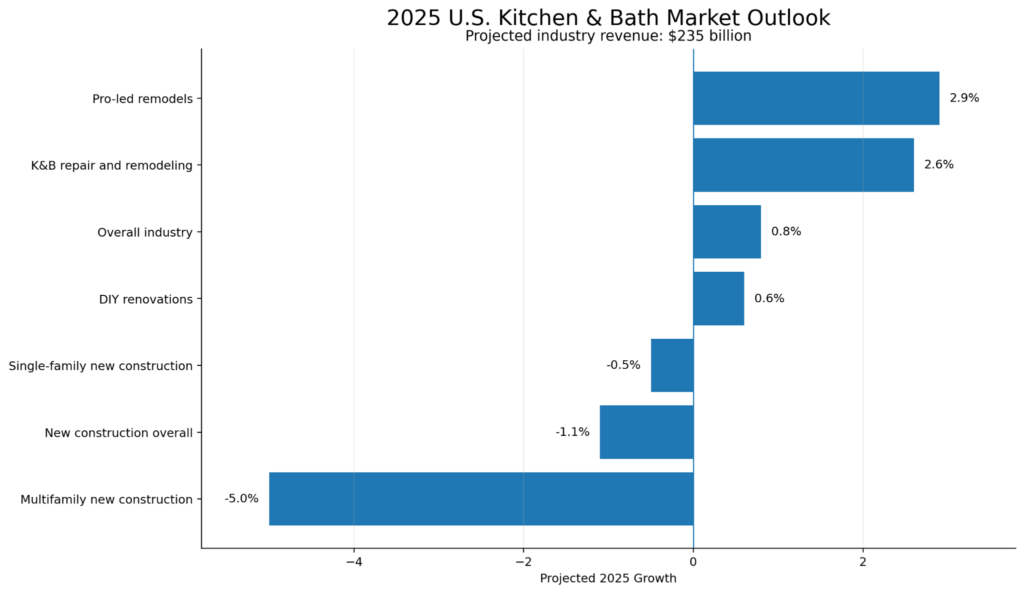
The wider kitchen and bath industry includes designers, contractors, builders, specifiers, and other professionals who collaborate across different parts of a project. NKBA’s 2025 Kitchen & Bath Market Outlook projected professionally led kitchen and bath remodels to grow by 2.9%, compared with just 0.6% growth for DIY projects.
That difference reinforces an important point for countertop shops: many projects are influenced by more than the homeowner alone. Builders, remodelers, kitchen and bath designers, interior designers, contractors, and other trade professionals may all help shape material choices, timelines, specifications, and final purchasing decisions.
Your marketing may therefore need to educate homeowners while also giving professional partners the technical information, project evidence, and process clarity they need to recommend or work with your shop.
A countertop marketing guide, therefore, needs to account for audiences such as:
- Homeowners: Usually need help understanding materials, cost factors, timelines, installation, maintenance, and what to expect from the process.
- Kitchen And Bath Remodelers: May value reliable scheduling, clear communication, product knowledge, and the ability to coordinate countertop work with the wider renovation.
- Builders: Often need predictable turnaround, production capacity, consistent specifications, and support across several projects or homes.
- Contractors: May focus on measurements, scheduling, installation reliability, pricing, and avoiding delays to other trades.
- Interior Designers: May prioritize material selection, color, finish, edge details, visual continuity, samples, and confidence that the finished work will match the design intent.
- Architects: May need technical information, performance details, specifications, documentation, and evidence that the shop can execute complex requirements.
- Property Managers: Often care about durability, turnaround, repeatability, budget control, and reducing disruption across occupied or rental properties.
- Commercial Buyers: May evaluate production capacity, compliance, scheduling, documentation, installation logistics, and the ability to deliver consistent work at scale.
These audiences may all purchase countertops, but they require different reasons to trust the same business.
A homeowner may be persuaded by a detailed kitchen gallery, understandable material comparisons, reviews, and a simple quote process. A builder may be more interested in capacity, trade experience, project coordination, turnaround, and repeat-order reliability. A designer may want evidence of detailed vein matching, unusual material knowledge, and successful collaboration on visually demanding projects.
That means one general page, one advertisement, or one message cannot always serve every potential customer equally well.
An effective strategy may require separate service pages, audience pages, project examples, campaigns, proof, and calls to action. Google’s people-first content guidance supports this audience-led approach: content should satisfy the needs of the people it is intended to serve instead of existing primarily to attract search traffic.
For a homeowner, the next step may be to request an estimate. For a designer, it may be to discuss a specification. For a builder, it may be to open a trade relationship. The marketing should make each of those paths clear.
That is the foundation of countertop business marketing: understand who the business wants to reach, what each audience needs to know, what proof will earn their confidence, and how the business will move their interest towards a measurable outcome.
What Makes Countertop Marketing Different From General Local Marketing?
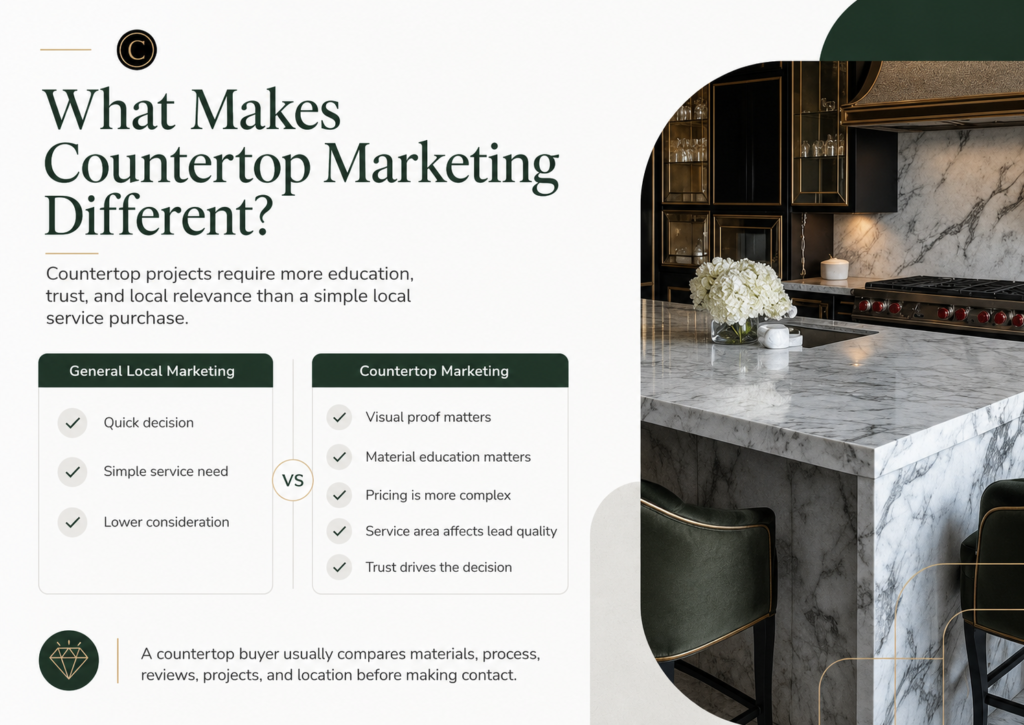
Countertop marketing is different from general local marketing because the purchase is visual, local, consultative, material-dependent, and usually requires more consideration than a simple service call or low-cost purchase.
A person looking for an inexpensive local service may choose a provider after checking availability, location, price, and a few reviews. A homeowner planning a full kitchen countertop project may compare materials, colors, completed installations, fabricators, reviews, project processes, estimated costs, service areas, and installation capabilities before contacting anyone.
That longer evaluation process changes what the marketing must accomplish.
It cannot merely make the shop visible. It must also educate the buyer, demonstrate relevant experience, reduce uncertainty, and make the company feel capable of handling a project that affects the appearance, function, cost, and timeline of a larger renovation.
Several characteristics of the countertop industry create this difference.
1. Buyers Want To See Completed Installations
Countertops are highly visual. Buyers want to understand how a material, color, pattern, edge profile, sink, and backsplash may look when combined in a real room.
A photograph of an isolated slab may attract attention, but a completed kitchen or bathroom helps the buyer imagine the material within a finished project. This is why original project galleries, close-up details, before-and-after images, and documented installations are not merely decorative additions. They are evidence that the shop has completed work similar to what the buyer is considering.
The marketing should therefore show more than products. It should demonstrate outcomes.
2. Material Selection Requires Education
Countertop buyers may need to compare granite, quartz, quartzite, marble, porcelain, soapstone, solid surface, and other options. Each material can differ in appearance, maintenance, durability, heat resistance, stain resistance, availability, and suitability for particular applications.
This creates questions that a simpler local purchase may not involve:
- Which material is suitable for a busy family kitchen?
- Does the surface require sealing?
- Will a sample accurately represent the full slab?
- How visible might seams be?
- Can the material support a waterfall edge?
- Is it suitable for an outdoor kitchen?
- How should it be cleaned and maintained?
A shop that answers these questions clearly can help the buyer make a more confident decision. That education may take place through material pages, comparison guides, showroom conversations, project examples, videos, and sales follow-up.
3. Project Prices Depend On Several Connected Decisions
A countertop project does not usually have one fixed price that applies to every buyer.
The cost can change based on the material, number of slabs, dimensions, layout, thickness, edge treatment, cutouts, sink configuration, backsplash, fabrication requirements, access, removal of existing surfaces, and installation conditions. For example, Caesarstone’s quartz countertop cost guide identifies size, edges, cutouts, slab requirements, and additional finishes among the factors that can affect the cost of a quartz project.
This means marketing must set useful expectations without pretending that every project can be priced accurately from one generic figure.
Cost guides, sample project ranges, estimate tools, and quote forms can help, but they must explain what the numbers include and which project details can change the final estimate.
4. Service Areas Affect Whether A Lead Is Valuable
A lead is not useful simply because the person wants countertops.
The project must fall within an area the shop can serve profitably. Distance may affect transportation, measurement, slab handling, installation scheduling, follow-up visits, and the ability to resolve problems.
A campaign that attracts inquiries from a wide region may look successful when judged by lead volume, while producing few practical sales opportunities. Countertop marketing must therefore connect location targeting, service-area language, local pages, advertising settings, and lead qualification.
The goal is not to attract inquiries from everywhere. It is to attract suitable inquiries from the markets the business can serve effectively.
5. Buyers May Want To Visit A Showroom Or Slab Yard
Some buyers are comfortable beginning online, but material decisions often benefit from seeing colors, movement, texture, finish, and full slabs in person.
A showroom or slab-yard visit may become an important stage between online research and the final estimate. Marketing may therefore need to explain:
- Where the showroom or facility is located.
- Whether appointments are required.
- What the visitor can see.
- Whether samples or full slabs are available.
- Who will help with material selection?
- What information should the buyer bring?
- Whether the showroom and fabrication facility are in the same location.
This is different from marketing a service that can be evaluated and purchased entirely through a short phone call or online booking.
6. The Path From Inquiry To Sale May Take Longer
A countertop inquiry may lead to several additional steps:
- Initial qualification.
- Showroom or material consultation.
- Preliminary measurements or plans.
- Material selection.
- Formal templating.
- Estimate preparation.
- Coordination with cabinets, plumbing, appliances, or other trades.
- Customer approval.
- Fabrication and installation scheduling.
The exact process varies by company, but the larger point remains: a lead may need continued communication before it becomes a sale.
Marketing should not stop after generating the form submission. The business needs a process for responding, collecting project details, scheduling the next step, following up on estimates, and recording the outcome.
7. Homeowners And Trade Professionals Evaluate Shops Differently
A homeowner may focus on design guidance, understandable material information, reviews, completed kitchens, communication, and confidence that the installation will go smoothly.
A builder, remodeler, designer, architect, or contractor may place more weight on specifications, production capacity, scheduling, turnaround, repeatability, coordination, documentation, and performance across several projects.
The kitchen and bath industry itself includes designers, remodelers, manufacturers, distributors, fabricators, installers, and other specialists, as described by the National Kitchen & Bath Association. Recent Houzz renovation research also found that homeowners planning 2026 renovations expected to work with professionals such as general contractors, builders, kitchen and bath designers, interior designers, and specialty contractors.
This means a countertop shop may need different pages, proof, campaigns, and calls to action for residential buyers and trade partners.
8. Trust Must Be Demonstrated, Not Merely Claimed
Phrases such as “high quality,” “excellent service,” and “experienced professionals” are easy for any business to publish. Buyers need evidence that helps them verify those claims.
Useful proof can include:
- Real completed projects.
- Detailed customer reviews.
- Clearly explained processes.
- Staff and facility information.
- Material expertise.
- Certifications or professional affiliations.
- Warranty information.
- Examples of complex work.
- Builder or designer relationships.
- Accurate expectations about measurement, fabrication, and installation.
The NKBA’s certification information explains that professional credentials can help validate industry knowledge, experience, and adherence to recognized design standards. A shop does not need every possible credential, but any certification or affiliation used in its marketing should be genuine, relevant, and explained clearly enough for buyers to understand why it matters.
9. Production Capacity Determines Which Opportunities Are Useful
Not every potentially profitable-looking inquiry is a good operational fit.
A small shop may prefer a manageable number of residential projects within a tight service area. A larger fabricator may be equipped to serve builders, dealers, commercial clients, or multiple markets. Production equipment, staffing, slab access, installation teams, scheduling capacity, and turnaround all affect which leads the business can fulfill well.
Marketing should therefore reflect what the shop can actually deliver.
Promoting large commercial projects without the required capacity can create operational problems. Focusing exclusively on small homeowner projects may also be inefficient for a fabricator built around repeat trade work.
The correct strategy connects demand generation to production reality.
How Do People Find Countertop Shops?
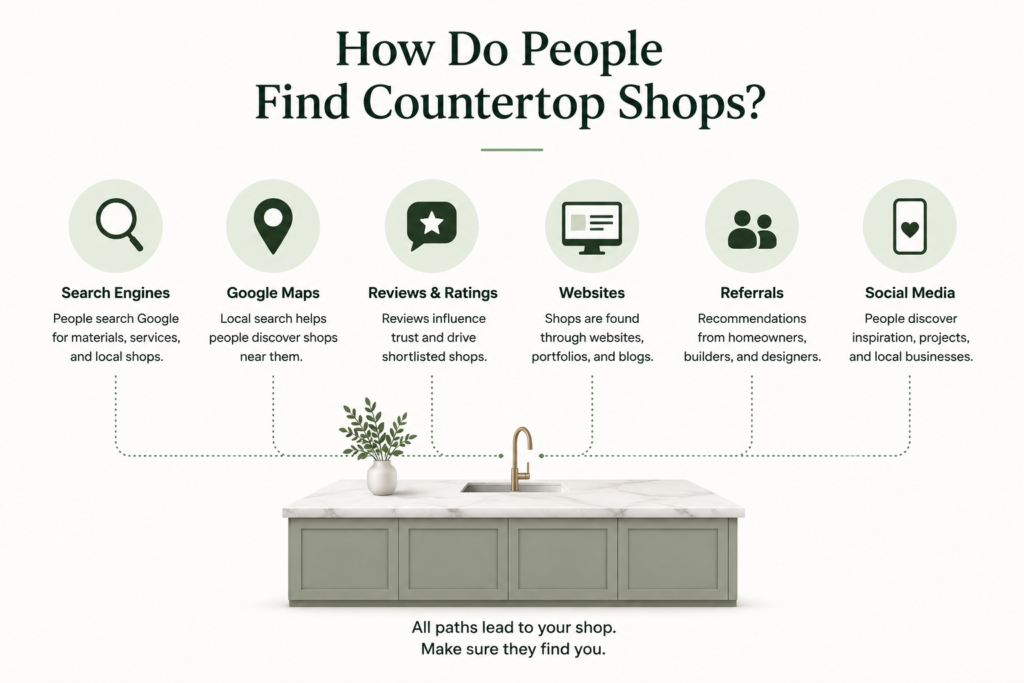
People find countertop shops through several connected discovery paths, including Google Search, Google Maps, referrals, builders and remodelers, social media, paid advertisements, directories, showrooms, and exposure to previously completed projects. The exact path varies by buyer, but many prospects move between several sources before deciding which businesses deserve further consideration.
A homeowner may first notice a finished kitchen on Instagram, search the company’s name on Google, read its reviews, visit its website, and then look for showroom information. Another buyer may begin with a direct search such as “countertop installers near me,” compare several companies in Google Maps, and ask a contractor whether any of the shops have a reliable reputation.
That means a countertop shop should not rely on one discovery channel alone. Its website, local profile, reviews, project photography, advertising, referral relationships, and business information should reinforce one another.
Google remains central to local business discovery. A verified Google Business Profile can help customers find a business through both Google Search and Google Maps, while providing information such as its location, hours, services, website, and contact details. Read Google’s official guide to getting started with a Business Profile.
Google is not the only route, however. Buyers may also encounter countertop companies through:
- A contractor, builder, designer, or kitchen and bath dealer.
- A recommendation from a past customer.
- A tagged project on social media.
- A local home-improvement directory.
- A manufacturer or distributor relationship.
- A showroom sign or slab-yard visit.
- A completed installation in a friend’s home.
- A paid Google or social media advertisement.
- A project photograph shared in a neighborhood or community group.
- A direct search for a company they have already heard about.
The important question is not simply, “Where did the buyer first hear about us?” It is also, “What did the buyer search for next?”
Search behavior often reveals how close a potential customer is to taking action.
High-Intent Searches
High-intent searches usually indicate that the buyer is actively looking for a provider, showroom, material, or project service.
Examples include:
- countertop installers near me
- quartz countertops in [city]
- granite countertop fabricator
- countertop showroom near me
- kitchen countertop replacement
- bathroom vanity top installer
These searches are commercially valuable because they combine a specific need with an action, service, material, or location.
Someone searching for “quartz countertops in Phoenix” is not necessarily ready to hire immediately, but that search suggests a more defined need than a broad query such as “kitchen design ideas.” The person has identified both a material and a market.
A countertop shop should have pages and local business information that match these high-intent searches accurately. For example:
- A quartz search should lead to a useful quartz countertop page.
- An installation search should lead to an installation service page.
- A showroom search should provide clear showroom details.
- A city-specific search should lead to a relevant location or service-area page where justified.
- A bathroom vanity search should not land on a vague page that discusses every service equally.
Google explains that local results are primarily influenced by relevance, distance, and prominence. This means a business must clearly communicate what it offers and where it operates if it wants to appear for relevant local searches. Read Google’s guidance on improving local search visibility.
Consumer research also shows that people use several Google environments when looking for nearby businesses. BrightLocal’s 2025 search behavior study found that Google Search remained the most common default platform for local searches, while a meaningful share of consumers began directly in Google Maps. Read BrightLocal’s 2025 Consumer Search Behavior report.
For countertop shops, this reinforces the need to treat the website and Google Business Profile as connected assets rather than separate marketing tasks.
Research Searches
Research searches happen when the buyer is still trying to understand materials, design choices, costs, maintenance, or the installation process.
Examples include:
- quartz versus granite
- best countertop material for a busy kitchen
- quartzite maintenance
- countertop edge profiles
- how much do new countertops cost
- porcelain countertops pros and cons
These searches may appear less commercially valuable because they do not always include a city or a direct request for an installer. However, they often occur while the buyer is preparing for a future purchase.
A person comparing quartz and granite may not be ready to request a quote today, but the company that provides the clearest explanation may become one of the shops the buyer remembers when the project advances.
Research content allows a countertop shop to demonstrate material knowledge before the first conversation. It can also guide readers toward relevant commercial pages.
For example:
- A quartz-versus-granite guide can link to both material pages.
- A countertop cost guide can link to the quote-request page.
- An edge-profile guide can feature real project examples.
- A quartzite maintenance article can link to available quartzite projects and showroom information.
- A porcelain pros-and-cons article can explain whether the shop fabricates or installs porcelain.
This is where informational content supports commercial intent without pretending that every reader is ready to buy immediately.
Research searches are also becoming more conversational as search engines provide AI-generated responses to complex questions. Google states that content appearing in its AI search features still needs to meet ordinary Search requirements and be eligible for indexing. Read Google’s official guidance on AI features and website content.
That makes clear, specific, well-supported material education increasingly important.
Brand And Validation Searches
Brand and validation searches occur after a buyer has already encountered a countertop shop and wants to determine whether it is credible.
Examples include:
- [company name] reviews
- [company name] projects
- [company name] showroom
- [company name] complaints
- [company name] financing
These searches are different from initial discovery searches because the buyer is no longer asking only, “Who provides countertops?” The buyer is asking, “Can I trust this particular company?”
A person may search the business name after:
- Receiving a referral.
- Seeing a project on social media.
- Passing the showroom.
- Clicking an advertisement.
- Receiving an estimate.
- Hearing about the shop from a builder or designer.
- Finding the company in Google Maps.
What the buyer finds during that validation stage can strengthen or weaken the original recommendation.
The results may include:
- The official website.
- Google reviews.
- Social profiles.
- Directory listings.
- News or community mentions.
- Project photographs.
- Manufacturer or association profiles.
- Complaints or unresolved negative feedback.
- Inconsistent addresses, phone numbers, or business descriptions.
This is why referral-driven businesses still need a strong digital presence. A recommendation may introduce the shop, but the buyer may still use Google to verify its reputation, work, location, and process before making contact.
Google notes that a complete and accurate Business Profile helps customers understand what a company does, where it operates, and when they can visit. Read Google’s guide to improving local rankings and business information.
Buyers May Move Between All Three Search Types
The three categories are not always separate stages.
One buyer may move through this sequence:
- Research: “Quartz versus granite.”
- High intent: “Quartz countertop installers near me.”
- Validation: “[Company name] reviews.”
- Action: Visit the website and request a consultation.
Another may begin with a builder referral, search the company’s name, review its projects, and then search for the specific material mentioned during the conversation.
The practical lesson is that countertop shops need content for more than one moment in the decision process.
They need:
- Service and location pages for high-intent searches.
- Material and educational content for research searches.
- Reviews, project evidence, showroom information, and accurate business profiles for validation searches.
- Clear calls to action for buyers ready to move forward.
Use First-Party Search Data To Confirm How Buyers Find The Shop
The examples above provide a useful planning framework, but every countertop business should verify its own discovery patterns.
Google Search Console can reveal the actual queries that generate impressions and clicks for the website. Google Business Profile performance data can show how customers interact with the local listing. Advertising search-term reports can reveal which queries produce calls, forms, and irrelevant traffic.
Useful first-party evidence for this section may include anonymized screenshots showing:
- Material searches.
- City-specific searches.
- “Near me” searches.
- Brand-name searches.
- Service searches.
- Question-based searches.
- Google Maps discovery queries.
- Queries that produced qualified leads.
The screenshots should remove client names, customer information, and sensitive performance data unless permission has been granted.
This evidence would allow the guide to move beyond hypothetical keywords and show how real countertop buyers search at different stages.
The larger point is simple: people do not find countertop shops through one predictable route. They discover, research, compare, validate, and return through multiple channels. The businesses that understand those paths can create a stronger presence at every point where a buyer is deciding what to do next.
Why Do Some Countertop Buyers Visit Several Websites Before Calling?
Countertop buyers often visit several websites because they are trying to reduce risk before making contact. A full countertop project can affect the appearance, cost, schedule, and function of a kitchen or bathroom, so buyers usually want more confidence than they would need for a simple local purchase.
They may be uncertain about which material is right, how much the project will cost, how long it will take, and whether the installation will be handled properly. They may also worry about visible seams, inaccurate measurements, damage during installation, poor communication, or unexpected changes to the estimate.
Comparing several websites helps them answer questions such as:
- Which shop offers the material I want?
- Which company serves my location?
- Who has completed projects similar to mine?
- Do the reviews mention reliable communication and installation?
- Can I see examples of seams, edges, sinks, and finished kitchens?
- Does the company explain its process clearly?
- Is there a showroom or slab yard I can visit?
- What should I expect before requesting a quote?
The decision may also involve more than one person. A homeowner may be comparing options with a spouse, contractor, kitchen designer, interior designer, or builder. Each person may focus on different concerns, from appearance and material selection to scheduling, measurements, coordination, and price.
This is why a countertop website must do more than look attractive. It should help buyers compare materials, understand the process, review credible project evidence, confirm service areas, and feel confident enough to take the next step.
Once a countertop business understands how buyers evaluate providers, it can build the online foundation those buyers expect.
What Does A Countertop Business Need Before It Starts Marketing?
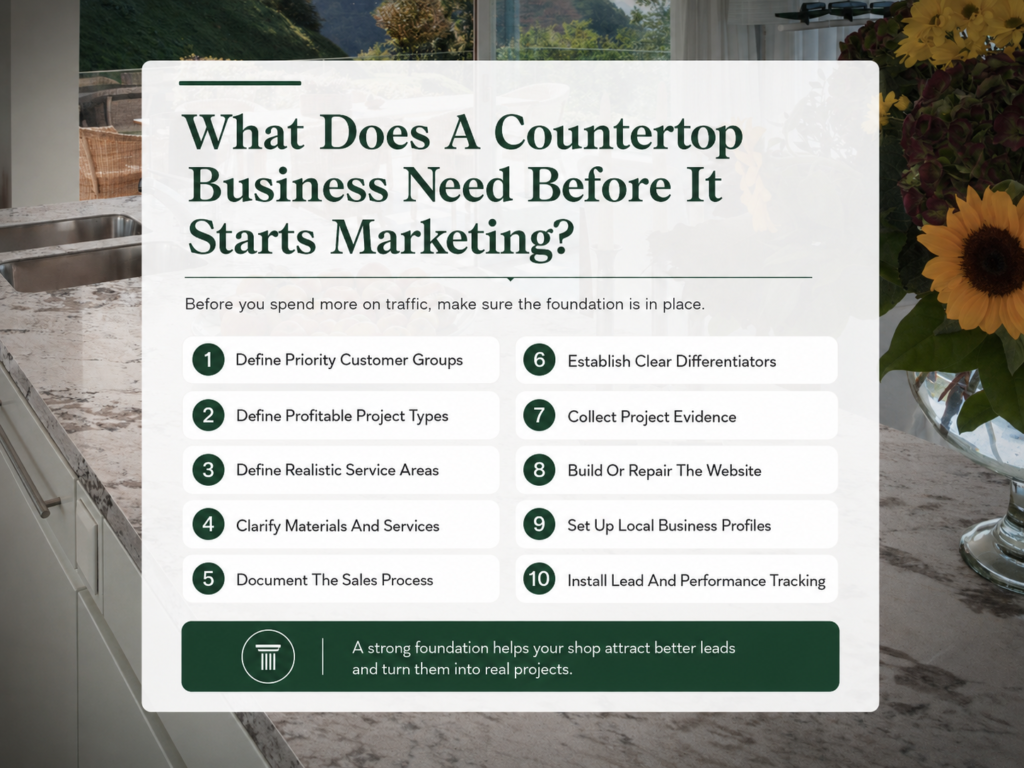
Before investing heavily in SEO, Google Ads, social media, or any other traffic source, a countertop business needs a clear foundation. That foundation should define who the business wants to reach, which projects it wants more of, where it can serve profitably, what makes it worth choosing, how prospects can take the next step, and how results will be tracked.
Without that groundwork, marketing can create activity without creating progress.
Your shop may attract more website visitors but still receive weak inquiries. You may generate leads from areas you cannot serve profitably. You may promote every material and project type equally, even though some are more valuable than others. You may also receive calls and quote requests without knowing which channel generated them or whether they resulted in estimates or sales.
A strong marketing plan for a countertop business should begin with ten practical foundations:
- Define priority customer groups.
- Identify profitable project types.
- Establish realistic service areas.
- Clarify the materials and services offered.
- Document the sales process.
- Define meaningful competitive advantages.
- Collect credible project evidence.
- Build or repair the website.
- Set up accurate local business profiles.
- Install lead and performance tracking.
These decisions determine what the business should promote, which pages it needs, where campaigns should run, what proof buyers should see, and how success should be measured.
Define Priority Customer Groups
You should decide which audiences matter most instead of trying to speak to everyone who may need a surface.
Potential customer groups include:
- Homeowners replacing kitchen countertops.
- Homeowners completing full remodels.
- Luxury residential clients.
- Builders.
- Remodelers.
- Kitchen and bath dealers.
- Interior designers.
- Commercial contractors.
- Property managers.
- House flippers.
- Trade partners.
Each group may value something different.
Homeowners may focus on design guidance, reviews, material education, and confidence in the installation process. Builders may care more about capacity, scheduling, pricing consistency, and dependable turnaround. Designers may prioritize material knowledge, samples, visual details, and collaboration.
This distinction is not theoretical. The 2026 U.S. Houzz Renovation Plans Report found that 93% of homeowners planning renovations expected to work with professionals. General contractors, builders, kitchen and bath designers, interior designers, and specialty contractors were among the professionals respondents expected to hire. This means a countertop shop may need to influence both the homeowner and the professionals helping shape the project.
The business does not need to reject every customer outside its priority audience. It needs to know which groups should shape its website, campaigns, project examples, and sales process first.
That focus also supports stronger search content. Google’s people-first content guidance asks whether a website has an intended audience and a clear primary purpose. A site built around real customer needs is more useful than one that publishes broad content for anyone who might arrive through search.
Identify Profitable Project Types
Not every project contributes equally to the business.
A countertop shop should identify which jobs:
- Produce healthy margins.
- Match current equipment and team capacity.
- Fit available materials and supplier relationships.
- Create repeat or referral opportunities.
- Can be scheduled and completed efficiently.
- Support the long-term direction of the company.
- Produce strong project evidence for future marketing.
For one shop, the priority may be full kitchen countertop replacements. For another, it may be luxury natural stone, builder packages, commercial fabrication, bathroom vanities, or repeat work from kitchen and bath dealers.
Marketing should not simply generate more demand. It should generate more demand for the work the company wants and can fulfill profitably.
This decision should involve sales, production, installation, and leadership rather than marketing alone. A campaign may look successful because it produces many inquiries, but those inquiries have limited value if the shop lacks the capacity, material access, margin, or geographic reach to fulfill them well.
Establish Realistic Service Areas
A countertop business should define where it can measure, fabricate, deliver, install, and support projects efficiently.
The decision should account for:
- Travel time.
- Fuel and labor costs.
- Installation logistics.
- Team availability.
- Follow-up visits.
- Local competition.
- Average project value.
- Existing demand.
- Whether the distance remains profitable for smaller projects.
A wider service area may increase lead volume while reducing the percentage of inquiries the shop can serve profitably. A tighter area may generate fewer leads but produce more practical opportunities.
The service-area decision affects local SEO, Google Business Profile settings, advertising geography, location pages, delivery information, and lead qualification.
Google explains in its local ranking guidance that local results are influenced primarily by relevance, distance, and prominence. A shop cannot control every ranking factor, but it can improve clarity by accurately describing what it offers, where it operates, and how customers can contact or visit the business.
A service area should therefore reflect real operational reach rather than a list of cities added only because the business wants to rank there.
Clarify Materials And Services
Your business should state clearly what it offers.
That may include:
- Granite.
- Quartz.
- Quartzite.
- Marble.
- Porcelain.
- Soapstone.
- Solid surface.
- Sintered stone.
- Butcher block.
- Countertop fabrication.
- Countertop installation.
- Countertop replacement.
- Templating and measurement.
- Commercial fabrication.
- Outdoor kitchen countertops.
- Bathroom vanity tops.
- Builder or trade programs.
The marketing should also establish useful boundaries.
A countertop fabricator may install surfaces but not cabinets. A showroom may require appointments. A shop may serve residential projects but not large commercial work. Another may fabricate for contractors but not sell directly to homeowners.
Clear information helps buyers understand the offer and reduces inquiries for services the shop does not provide.
It also gives search engines and answer systems clearer information about the business. Google’s Search Essentials recommends using the words people would use to find content and placing them in descriptive locations such as titles, headings, link text, and image alt text. That reinforces the value of clear, specific service and material language rather than vague descriptions of what the business does.
Document The Sales Process
The path from inquiry to sale should be clear before the business introduces more traffic.
The company should know:
- Where inquiries arrive.
- Who receives them?
- How quickly they are answered?
- Which details are needed to qualify the project?
- When a showroom visit or consultation is appropriate.
- Whether measurements, drawings, or photographs are required.
- How estimates are prepared.
- Who follows up after the estimate?
- How are won and lost opportunities recorded?
- How revenue is connected to the original lead source.
Marketing cannot permanently compensate for a sales process that is inconsistent, slow, or unclear.
Learning how to grow a countertop business, therefore, requires more than finding ways to generate leads. It also requires understanding what happens after a potential customer calls or submits a form.
A shop may discover that its largest problem is not traffic. The problem may be that inquiries are not assigned, project details are not collected consistently, estimates are not followed up on, or no one records why opportunities are lost.
Define Meaningful Competitive Advantages
A countertop shop should be able to explain why a suitable buyer should choose it instead of another local provider.
Generic claims such as “quality work,” “great service,” and “experienced professionals” are weak because nearly every competitor can make them.
A stronger differentiator may involve:
- In-house fabrication and installation.
- A large slab inventory.
- Fast turnaround.
- Design support.
- Digital measurement or visualization.
- Specialty material knowledge.
- Residential or commercial specialization.
- Builder and designer programs.
- Financing.
- Warranty coverage.
- Complex installation experience.
- Local showroom access.
- Transparent project communication.
The differentiator should be meaningful to the buyer and supported by evidence.
For example, in-house fabrication matters when it gives the customer fewer handoffs and clearer accountability. A large slab inventory matters when it gives buyers more materials to inspect locally. Fast turnaround matters only when the shop can deliver it consistently without creating unrealistic expectations.
Collect Credible Project Evidence
Countertop marketing becomes more persuasive when the business can show what it has already completed.
Useful project evidence may include:
- Finished project photographs.
- Before-and-after images.
- Material and color details.
- Edge profiles.
- Sink configurations.
- Project locations.
- Installation challenges.
- Customer reviews.
- Builder or designer collaborations.
- Commercial case studies.
- Team and facility photographs.
A shop should not wait until it needs a new website or advertising campaign before gathering this information.
Project documentation should become part of the normal workflow. The team can record the material, project type, location, design details, challenges, and final result while the information is still easy to collect.
This evidence can later support service pages, location pages, material guides, project galleries, social posts, advertisements, sales presentations, and AI-search-ready answers.
Build Or Repair The Website
The website should give potential buyers enough information to understand the company, trust its work, and take the next step.
At a minimum, it should explain:
- What the shop does.
- Which materials it offers.
- Which locations it serves.
- Which project types it handles.
- What its process looks like.
- Why the business is credible.
- How to call, request a quote, or arrange a visit.
If the website is slow, confusing, outdated, difficult to use on a phone, or missing important pages, buying more traffic may only expose those weaknesses to a larger audience.
A weak website can also limit the value of other marketing channels. A Google ad, referral, social post, local listing, or AI-generated recommendation may introduce the shop, but the website still has to confirm that the business is relevant and trustworthy.
Set Up Accurate Local Business Profiles
Local business profiles should be accurate and consistent before the company depends on them for discovery.
That includes:
- Correct business name.
- Accurate address or service area.
- Current phone number.
- Correct opening hours.
- Relevant business categories.
- Website link.
- Service descriptions.
- Showroom information.
- Original project photographs.
- Review monitoring and responses.
Google’s Business Profile guidance recommends keeping business information complete and accurate because that information helps Google match a company with relevant local searches.
A strong local profile supports both discovery and validation. It helps potential customers find the shop, but it also helps them confirm where it is located, when it is open, what it offers, and whether other customers trust it.
Install Lead And Performance Tracking
A countertop business should be able to follow what happens after someone sees an advertisement, visits the website, calls, submits a form, or requests an appointment.
Useful tracking may include:
- Website analytics.
- Google Search Console.
- Google Business Profile performance.
- Call tracking.
- Form tracking.
- Advertising conversion tracking.
- Lead source.
- Qualification status.
- Sales pipeline stages.
- Estimate value.
- Final sale value.
- Lost-opportunity reasons.
Traffic should not be treated as the final outcome.
Google Analytics provides recommended lead-generation events such as [generate_lead, qualify_lead, disqualify_lead, working_lead, and close_convert_lead]. Its recommended events documentation shows that lead measurement can extend beyond the original form submission to qualification, sales activity, and conversion.
Google’s lead acquisition reporting documentation also explains that businesses can use lead events to understand which channels generate new leads.
A countertop shop may use a CRM or another tracking system rather than relying entirely on Google Analytics, but the principle remains the same: the business should distinguish between a website visit, an inquiry, a qualified opportunity, an estimate, and a closed project.
Without that distinction, the shop may know that marketing is happening without knowing whether it is producing profitable work.
These ten foundations make countertop business growth strategies easier to prioritize, measure, and improve.
Who Is The Ideal Customer?
The ideal customer is not simply anyone who needs countertops. That description is too broad to guide effective marketing.
A useful ideal-customer definition should reflect the people, projects, locations, and commercial conditions that create the strongest fit for the business.
Possible customer segments include:
- Homeowners replacing kitchen countertops.
- Homeowners completing full remodels.
- Luxury residential clients.
- Builders.
- Remodelers.
- Kitchen and bath dealers.
- Interior designers.
- Commercial contractors.
- Property managers.
- House flippers.
- Trade partners.
The 2026 U.S. Houzz Renovation Plans Report reinforces why this segmentation matters. Homeowners planning renovations are expected to involve several types of professionals, including general contractors, builders, kitchen and bath designers, interior designers, and specialty contractors. A countertop shop may therefore be marketing to an end customer, a professional influencer, a repeat trade partner, or several of them within the same project.
The shop should evaluate each segment against practical questions:
- Which customers produce the most profitable projects?
- Which customers create repeat or referral work?
- Which projects fit current production and installation capacity?
- Which service areas remain profitable?
- Which inquiries repeatedly waste sales time?
- Which materials or services generate stronger margins?
- Which buyers appreciate the shop’s actual strengths?
- Which projects create the most operational problems?
A business may discover that its ideal homeowner is not simply someone remodeling a kitchen. It may be a homeowner within a defined service area who wants a complete countertop replacement, values material guidance, has a realistic budget, and is prepared to visit the showroom or provide project measurements.
A strong trade customer may be a remodeler or designer who provides consistent project information, respects lead times, communicates clearly, and creates recurring work.
The more specific the ideal customer becomes, the easier it is to decide:
- Which website pages to create?
- Which locations to target?
- Which project photographs to feature?
- Which messages to use?
- Which advertisements to run.
- Which calls to action to present?
- Which leads should receive immediate attention?
The purpose is not to make the audience unnecessarily narrow. It is to prevent the marketing from becoming so broad that it appeals strongly to no one.
What Should Make A Countertop Shop Different?
A countertop shop should be different in a way that gives buyers a clear and meaningful advantage. Generic claims such as “quality work,” “great service,” or “skilled craftsmanship” are too broad because nearly every competitor can make them.
A stronger differentiator explains what the shop does differently and why that difference matters to the customer.
Potential differentiators include:
- In-house fabrication and installation.
- A large slab inventory.
- Faster turnaround.
- Design support.
- Digital measurement or visualization.
- Specialty material knowledge.
- Residential or commercial specialization.
- Builder and designer programs.
- Financing options.
- Strong warranty coverage.
- Experience with complex installations.
- Local showroom access.
- Clear communication throughout the project.
The feature alone is not the full differentiator. The buyer advantage attached to it is what gives the message value.
For example:
- In-house fabrication and installation may create fewer handoffs and more control over the project.
- A large slab inventory may make material selection faster and easier.
- Digital measurement may improve precision and reduce uncertainty.
- A builder program may simplify repeat ordering, scheduling, and communication.
- Specialty material knowledge may give buyers more confidence when selecting quartzite, porcelain, marble, or another demanding surface.
- Transparent communication may help customers understand timelines, responsibilities, and next steps.
A useful positioning exercise is to complete this statement:
We help [specific buyer] complete [specific project] with [meaningful advantage], so they can [buyer outcome].
For example:
We help homeowners complete kitchen countertop replacements with in-house fabrication, material guidance, and clear project communication, so they can move from selection to installation with fewer delays and less uncertainty.
Another shop might use:
We help kitchen and bath remodelers complete repeat residential projects with dependable scheduling, accurate digital measurements, and coordinated fabrication and installation, so they can keep renovations moving without unnecessary countertop delays.
The statement should reflect something the business can actually deliver and support with evidence.
Once the company has defined who it wants to reach, which work it wants more of, where it can operate profitably, and why a buyer should choose it, the website can become the center of the marketing system.
Search Engine Optimization For Countertop Shops: Is SEO Worth It For Countertop Shops?
Yes, SEO can be valuable for your countertop shop because it helps your business appear while buyers are researching materials, comparing local providers, and searching for fabrication, installation, replacement, or showroom services. Its value depends on your market, competition, website quality, service areas, authority, and ability to convert search traffic into qualified inquiries.
The goal is not simply to bring more people to your website.
The goal is to help the right homeowners, builders, remodelers, contractors, and designers find the pages that match what they need and move toward a useful next step.
For your shop, that may mean appearing when someone searches for:
- Quartz countertops in your city.
- A granite fabricator nearby.
- Kitchen countertop replacement.
- Commercial countertop fabrication.
- A countertop showroom.
- The difference between quartz and quartzite.
- How countertop installation works.
- Whether you serve a specific suburb or metro area.
SEO gives you an opportunity to become visible during several stages of that decision.
Organic Traffic Is Not Always Qualified Traffic
More organic traffic can look encouraging in an analytics report, but traffic alone does not tell you whether SEO is helping your business.
A visitor researching how to remove a stain from granite may never need a fabricator. Someone searching for countertop installation in a city your shop serves may be much closer to requesting a quote.
This is why your SEO strategy should focus on the connection between the search, the page, the visitor, and the business outcome.
You should be able to ask:
- Did the visitor search for a service you provide?
- Is the visitor inside your actual service area?
- Did the visitor reach the most relevant page?
- Did the page answer the question behind the search?
- Did the visitor call, submit a form, or schedule a visit?
- Was the resulting inquiry qualified?
- Did the inquiry become an estimate or sale?
A smaller number of relevant visitors can be more valuable than a large volume of people who are unlikely to buy from your shop.
SEO Can Create Compounding Visibility
Paid search visibility usually stops when you stop paying for the campaign. SEO works differently.
A strong service page, material guide, project page, or location page can continue receiving impressions and clicks after it has been published, provided it remains useful, competitive, accessible, and relevant.
That does not make SEO free or permanent. Your pages may still need:
- Content updates.
- Better project examples.
- Stronger internal links.
- Technical repairs.
- New reviews.
- More useful answers.
- Improved titles and descriptions.
- Additional authority from relevant websites.
- Adjustments as competitors and search results change.
The value of SEO is that improvements can build on one another.
A quartz material page can support quartz project pages. Those projects can support city pages. The city pages can link to your installation service. A comparison guide can link back to both quartz and granite pages. Over time, those connections can create a stronger and more useful website than a group of isolated pages.
Google’s SEO Starter Guide explains that SEO helps search engines crawl, index, and understand your content. It also emphasizes creating a logical site structure, using descriptive links, and publishing content that is useful to people. These principles are especially relevant to countertop websites with multiple services, materials, locations, and projects.
Rankings Are Not The Final Outcome
A first-page ranking can be useful, but it is not the final measure of success.
Your shop can rank for a keyword and still receive little business value if:
- The keyword has the wrong intent.
- The page attracts buyers outside your service area.
- The search result does not earn clicks.
- The page does not build enough trust.
- The quote process is confusing.
- The visitor cannot find the right contact option.
- Your team responds too slowly.
- The lead is never tracked through the sales process.
You should measure SEO through a wider set of outcomes:
- Relevant impressions.
- Organic clicks.
- Calls.
- Quote requests.
- Showroom inquiries.
- Qualified leads.
- Measurements or consultations.
- Estimates.
- Closed projects.
- Revenue connected to organic search.
Rankings help explain visibility. They do not tell the full story of whether your countertop SEO is producing profitable work.
Local And Organic Search Work Together
Your countertop shop may appear in traditional organic results, Google Maps, local business results, image results, or AI-generated search experiences.
These environments are connected but not identical.
Your Google Business Profile can help buyers find your location, hours, phone number, reviews, photos, and directions. Your website gives Google and potential customers more detailed information about your services, materials, projects, locations, and expertise.
Google states that local results are primarily based on relevance, distance, and prominence. It also explains that complete business information, reviews, links, and overall visibility can contribute to local performance. Read Google’s official guidance on improving local rankings.
For your shop, this means local SEO should not be reduced to editing your Google Business Profile.
Your profile and website should support each other:
- Your profile says you provide countertop installation.
- Your website has a complete installation page.
- Your profile contains project photographs.
- Your website explains those projects in more detail.
- Your profile links to the correct website.
- Your website clearly states your showroom or service-area information.
- Your local pages reflect real markets you serve.
A strong website can help confirm the relevance and credibility that your local profile introduces.
SEO May Not Be Your First Priority In Every Situation
SEO is not always the first problem your shop needs to solve.
You may need to address other issues first if:
- Your website is unusable or badly outdated.
- Your services and materials are unclear.
- Your business information is inaccurate.
- You have no reliable project photography.
- You cannot respond to inquiries consistently.
- Your forms are broken.
- Your service areas have not been defined.
- You do not know which projects are profitable.
- Your production schedule cannot support more demand.
- You cannot track calls, forms, estimates, or sales.
In those situations, increasing search visibility may send more people into a system that is not ready to convert them.
Your SEO work should begin with a diagnosis. You need to understand whether the main problem is crawlability, content, local relevance, trust, conversion, lead quality, or follow-up.
If your shop needs help identifying the right searches, pages, and content priorities, explore 95 Green Shark’s SEO strategy services.
What Keywords Should Countertop Shops Target?
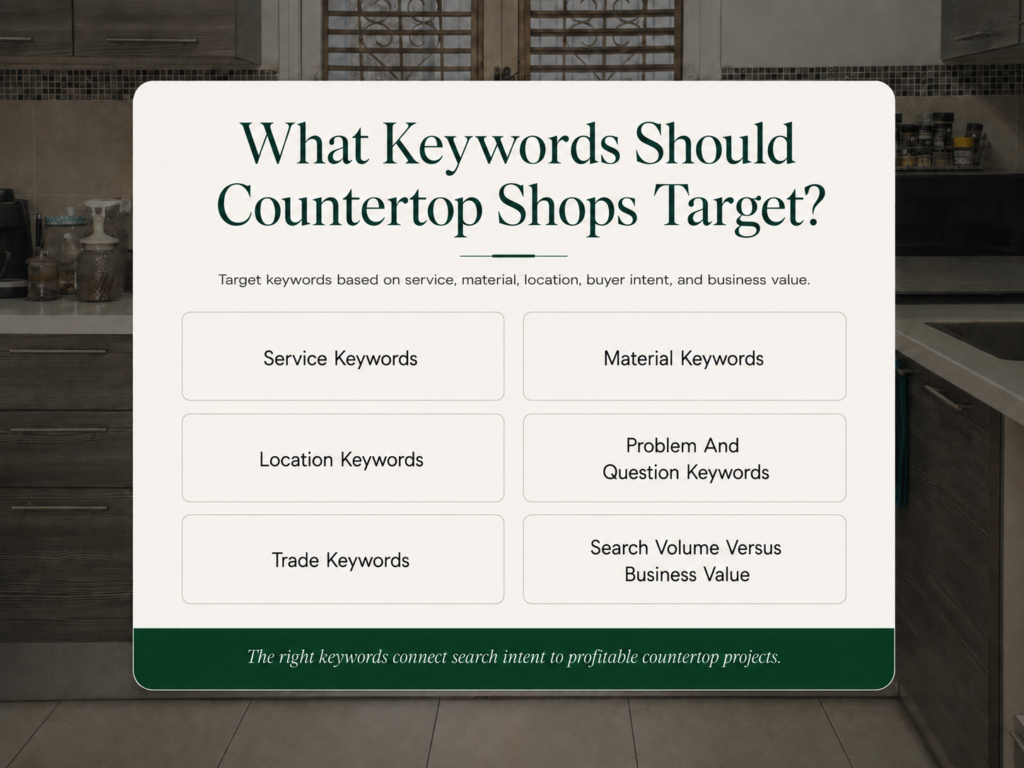
Your countertop shop should target keywords based on the services you provide, the materials you offer, the locations you serve, the projects you want, the questions buyers ask, and how close the searcher is to making a decision.
You should not build your keyword strategy around search volume alone.
A keyword is useful when it connects to a page your shop can create, a service you can deliver, and a customer you can serve profitably.
(i) Service Keywords
Service keywords describe the work the buyer wants performed.
Examples include:
- countertop installation
- countertop fabrication
- countertop replacement
- kitchen countertop installation
- commercial countertop fabrication
- bathroom vanity top installation
- countertop templating
- outdoor kitchen countertop installation
These searches should usually lead to dedicated service pages rather than one general page that briefly mentions everything your shop does.
A page about countertop installation should explain installation. A fabrication page should explain your fabrication capabilities. A replacement page should address the particular concerns involved in removing and replacing existing surfaces.
(ii) Material Keywords
Material keywords reflect the surfaces buyers are considering.
Examples include:
- quartz countertops
- granite countertops
- quartzite countertops
- marble countertops
- porcelain countertops
- soapstone countertops
- solid-surface countertops
A buyer searching for quartz may need different information from someone researching marble or porcelain.
Your material pages should not repeat the same copy with the material name changed. Each page should explain the actual characteristics, applications, limitations, care requirements, cost factors, available styles, and installation considerations associated with that surface.
(iii) Location Keywords
Location keywords connect the service or material to a geographic market.
Examples include:
- countertops in [city]
- countertop installers in [city]
- quartz countertops in [city]
- granite fabricator near [city]
- countertop showroom in [city]
- kitchen countertop replacement in [city]
These terms can be valuable because countertop measurement, fabrication, delivery, showroom access, and installation are tied to location.
However, you should only target cities and service areas your shop can serve honestly and profitably.
(iv) Problem And Question Keywords
Some buyers begin by researching a problem rather than searching for a company.
Examples include:
- Best countertop for a busy kitchen
- Quartz versus granite
- How long does countertop installation take
- Can countertops be replaced without changing cabinets
- Does quartzite need sealing
- What causes visible countertop seams
- How to prepare for countertop installation
These searches may happen earlier in the buying process, but they give your shop an opportunity to educate buyers and connect them to relevant commercial pages.
For example:
- A quartz-versus-granite guide can link to both material pages.
- An installation-preparation guide can link to your installation service.
- A replacement guide can lead to your quote page.
- A seam guide can include examples from real projects.
(v) Trade Keywords
If your shop works with builders, remodelers, contractors, or designers, you may need search terms and pages designed for those relationships.
Examples include:
- countertop fabricator for builders
- countertop supplier for contractors
- designer countertop trade program
- commercial countertop fabricator
- countertop fabrication for kitchen dealers
- wholesale countertop fabrication
Trade buyers may care less about introductory homeowner education and more about capacity, estimating, scheduling, drawings, material access, delivery, and repeat-project communication.
Your page should reflect that difference.
(vi) Search Volume Versus Business Value
A keyword with high search volume is not automatically the best keyword for your shop.
A broad phrase such as “countertops” may receive more searches than “commercial countertop fabricator in [city],” but the second phrase may be more valuable if commercial fabrication is a profitable service your shop actively wants.
Evaluate each keyword using questions such as:
- Does the search match a service we provide?
- Does it reflect a material we sell?
- Is the searcher likely to be within our market?
- Can we create a page that answers the intent properly?
- Would the resulting project fit our operation?
- Is the keyword likely to produce useful inquiries?
- Do we have the proof needed to compete for it?
A lower-volume phrase can produce greater commercial value when it closely matches your service, buyer, location, and capacity.
How Should Countertop Service And Material Pages Be Optimized?
Each countertop service or material page should focus on one clear subject, answer the questions a buyer is likely to ask, include original evidence, explain the relevant process, and connect naturally to related services, materials, projects, and locations.
The goal is not to insert a keyword as many times as possible.
The goal is to create the most useful page your shop can provide on that subject.
(i) Begin With A Clear Definition
The page should explain what the service or material is and why a buyer may be interested in it.
A quartz page should define quartz countertops clearly. A countertop replacement page should explain what replacement involves. A commercial fabrication page should explain the types of commercial work your shop can support.
Do not assume every visitor already understands industry terminology.
(ii) Explain The Best Use Cases
Help buyers understand when the material or service may be appropriate.
For a material page, that may include:
- Busy family kitchens.
- Luxury residential designs.
- Bathrooms.
- Rental properties.
- Outdoor applications.
- Commercial environments.
- High-maintenance or low-maintenance preferences.
For a service page, explain which projects it is designed to support.
(iii) Discuss Benefits And Limitations
A credible page should not pretend every material is perfect.
Explain both advantages and limitations.
For example:
- Quartz offers design consistency and low maintenance but may have heat limitations.
- Marble offers distinctive natural beauty but may etch or stain.
- Quartzite can provide natural movement and durability, but properties vary by stone.
- Porcelain can support certain modern applications but may require specialized fabrication and installation experience.
Balanced explanations build more trust than promotional claims that omit important tradeoffs.
(iv) Explain Cost Factors
You do not need to publish a universal price. You should explain what can affect the cost, such as:
- Material selection.
- Slab quantity.
- Thickness.
- Edge profile.
- Cutouts.
- Sink type.
- Backsplash.
- Removal.
- Layout.
- Access.
- Fabrication complexity.
- Installation conditions.
This helps buyers understand why a proper estimate requires project details.
(v) Cover Maintenance And Care
Material pages should explain sealing, cleaning, heat precautions, stain considerations, and ongoing care where relevant.
The advice should be accurate and specific to the material. Avoid repeating generic maintenance language across every page.
(vi) Show Available Styles And Options
Include relevant details such as:
- Colors.
- Patterns.
- Finishes.
- Edge profiles.
- Thickness.
- Slab movement.
- Sink configurations.
- Backsplash combinations.
Use original photographs whenever possible.
(vii) Explain The Installation Process
Help the buyer understand what happens next.
That may include:
- Consultation.
- Material selection.
- Preliminary estimate.
- Cabinet readiness.
- Templating.
- Final measurements.
- Fabrication.
- Installation.
- Final inspection.
Your exact process may differ, so the page should reflect how your shop actually works.
(viii) Add Relevant Project Evidence
A service or material page becomes stronger when it links to real projects.
A quartz page can show completed quartz kitchens. A commercial fabrication page can feature a commercial case study. An outdoor countertop page can show installations exposed to real environmental conditions.
Original examples give buyers proof and add information that competitors cannot copy easily.
(ix) Answer Focused FAQs
The FAQs should address questions that belong to the page.
A quartz page may answer:
- Does quartz need sealing?
- Can quartz handle hot pans?
- How do quartz seams look?
- Is quartz suitable for bathrooms?
An installation page may answer:
- How long does installation take?
- Do you disconnect plumbing?
- Must the cabinets be complete first?
- What should be removed before installation day?
Do not add the same generic FAQ block to every page.
(x) State Your Actual Service Area
Tell visitors where the service is available.
This may include:
- Cities.
- Counties.
- Metro areas.
- Travel limitations.
- Showroom location.
- Service-area qualifications.
The wording should be honest. Do not imply that your shop has offices in cities where it does not operate.
(xi) Use A Clear Call To Action
The next step should match the page.
Examples include:
- Request A Countertop Quote.
- Schedule A Showroom Visit.
- Ask About Quartz Availability.
- Upload Your Project Plans.
- Book A Material Consultation.
- Discuss A Builder Account.
(xii) Build Descriptive Internal Links
Link to pages that help the reader continue the decision.
For example:
- Quartz page → quartz installation service.
- Quartz page → quartz project gallery.
- Installation page → preparation guide.
- Material comparison → both material pages.
- Service page → relevant location page.
Google’s people-first content guidance recommends creating useful, reliable content for an intended audience rather than content designed primarily to manipulate rankings.
Google also explains in its SEO Starter Guide that clear structure, useful content, descriptive titles, and relevant internal links help people and search engines understand a website.
Do Countertop Shops Need Location Pages?
Your countertop shop may need location pages if it serves multiple cities, suburbs, counties, or markets and can provide genuinely useful information for buyers in each one.
A location page should do more than repeat your main service page with a different city name.
It should help a buyer understand:
- Whether you actually serve the area.
- Which services are available.
- Which materials you offer.
- How your process works for that market.
- Whether you have completed nearby projects.
- Whether the buyer must travel to a showroom.
- What the next step should be.
(i) What A Strong Location Page Should Include
A useful countertop location page may contain:
- Your actual service coverage.
- Relevant fabrication and installation services.
- Materials offered in that market.
- Market-specific buyer needs.
- Real nearby projects where available.
- Showroom or travel information.
- Measurement and installation considerations.
- Testimonials from customers in the area.
- Links to relevant service and material pages.
- Location-specific FAQs.
- Honest language about where your shop is based.
For example, a page targeting a distant suburb may need to explain whether you travel there for measurements, whether showroom visits happen elsewhere, and which project types justify the distance.
A page for the city where your showroom is located may focus more heavily on visiting, material selection, directions, and appointment details.
(ii) Avoid Thin Or Duplicated Location Pages
Do not create dozens of city pages by copying one template and swapping the location name.
Google defines doorway abuse as creating pages or sites intended to rank for similar queries that funnel users toward essentially the same destination. Its spam policies warn that these practices can cause pages or entire sites to rank lower or disappear from Search.
Google has also explained that doorway pages created primarily for search engines can harm the user experience. Read Google’s doorway page guidance.
The risk is not simply using the same structure. The risk is publishing pages that offer no meaningful difference.
Your location pages may share a consistent template, but the information should reflect the actual market, services, projects, buyer questions, logistics, and proof associated with that area.
Relevant 95 Green Shark location resources include:
- Digital Marketing For Countertop Shops In Arizona
- Digital Marketing For Countertop Shops In California
- Digital Marketing For Countertop Shops In Texas
- Content Strategy For Countertop Shops And Stone Fabricators In Arizona
- Content Strategy For Countertop Shops And Stone Fabricators In Colorado
- Content Strategy For Countertop Shops And Stone Fabricators In Texas
How Can Countertop Shops Build Strong Internal Links?
Your internal links should connect related services, materials, locations, projects, and educational resources so buyers and search engines can understand how your pages fit together.
Internal linking is not just an SEO task. It helps a visitor move from one question to the next.
A buyer reading about quartz should be able to reach your quartz projects. A buyer viewing a project should be able to find the installation service. Someone reading a location page should be able to see the materials and services available there.
(i) Useful Internal Link Paths
Examples include:
- Quartz material page → quartz installation service.
- Quartz material page → quartz project gallery.
- Quartz project → relevant city page.
- City page → countertop installation service.
- Kitchen countertop page → edge-profile guide.
- Quartz-versus-granite article → both material pages.
- Installation page → installation-preparation guide.
- Project page → quote-request page.
- Pillar guide → digital marketing service page.
Each link should help the visitor continue a logical journey.
(ii) Use Clear Anchor Text
The clickable words should explain where the link leads.
Better anchors include:
- quartz countertop installation
- countertop projects in Dallas
- granite countertop care guide
- digital marketing services for countertop shops
- kitchen countertop replacement
Weak anchors include:
- click here
- read more
- this page
- learn more
Generic anchor text provides less context to the visitor and to search systems.
Google’s link best practices explain that links help Google discover pages and understand their relevance. Google also recommends concise, descriptive anchor text that makes sense in context.
(iii) Avoid Common Internal-Linking Problems
Do not:
- Link every use of the same keyword.
- Force exact-match anchor text repeatedly.
- Create footer blocks filled with unrelated links.
- Leave important pages orphaned.
- Link to irrelevant pages solely to distribute authority.
- Use broken or non-crawlable links.
- Create several pages competing for the same intent without a clear hierarchy.
Google recommends building a logical site structure and linking important pages from other relevant pages. Read its sitelinks guidance for the same underlying principle.
Your internal links should reflect how countertop buyers think:
- Service.
- Material.
- Location.
- Project.
- Question.
- Next step.
How Long Does Countertop SEO Take?
There is no universal timeline for countertop SEO.
How quickly you see progress depends on your website’s current condition, local competition, service area, authority, indexing, content quality, internal links, external links, reviews, and how quickly improvements are implemented.
Google does not guarantee that it will crawl, index, rank, or display a page simply because the page follows best practices. Its guide to how Google Search works explicitly states that crawling, indexing, and serving are not guaranteed.
The timeline below should therefore be treated as a planning framework, not a promise.
(i) First 30 Days: Research, Tracking, And Priority Repairs
During the first month, the work may include:
- Reviewing Search Console.
- Checking indexing.
- Auditing the website structure.
- Mapping services, materials, and locations.
- Reviewing competitors.
- Fixing broken pages and links.
- Improving titles and headings.
- Checking mobile usability.
- Defining lead tracking.
- Prioritizing the strongest opportunities.
You may not see major ranking changes during this stage because much of the work is diagnostic and foundational.
(ii) Days 30–90: Publishing And Early Search Movement
The next stage may include:
- Improving core service pages.
- Publishing material pages.
- Creating useful location pages.
- Adding project evidence.
- Strengthening internal links.
- Improving your Google Business Profile.
- Publishing supporting educational content.
- Requesting indexing where appropriate.
- Monitoring impressions and queries.
At this stage, you may begin seeing:
- New pages being indexed.
- More search impressions.
- A wider range of queries.
- Early ranking movement.
- Increased branded searches.
- More visibility for lower-competition phrases.
These are early signals, not proof that the full strategy has succeeded.
(iii) Three To Six Months: Stronger Query Coverage May Develop
As pages are crawled, indexed, linked, and evaluated, your website may begin appearing for a broader set of relevant searches.
Progress may include:
- More consistent impressions.
- Better rankings for specific services or materials.
- Increased location-based visibility.
- More clicks to core pages.
- More local profile actions.
- Early qualified organic inquiries.
The speed will vary widely by market and website.
A new shop in a highly competitive metro area may need more time than an established fabricator with strong reviews, projects, brand recognition, and a technically sound website.
(iv) Six Months And Beyond: Improvements Can Compound
Longer-term SEO may involve:
- Expanding content depth.
- Publishing more projects.
- Earning relevant links and mentions.
- Building review strength.
- Updating older pages.
- Improving weak conversion paths.
- Creating stronger location clusters.
- Responding to new buyer questions.
- Refining pages using Search Console data.
- Tracking which organic leads become revenue.
SEO should not be treated as a one-time publishing exercise.
Your competitors will change their sites. Search results will evolve. New materials, services, locations, questions, and AI-generated search experiences will create new opportunities.
Google’s current AI search optimization guidance confirms that foundational SEO remains relevant to AI Overviews and AI Mode because those systems rely on Google’s Search index and core ranking systems.
That is the next part of the strategy.
Traditional organic rankings and Google Maps remain important, but buyers are increasingly receiving answers through AI-generated search experiences. Your content now needs to be useful not only as a full webpage, but also as a clear, accurate source that search and answer systems can understand.
How Can A Countertop Shop Appear In AI Search Results?

Your countertop shop improves its chances of appearing in AI-generated search results by publishing crawlable, indexed, useful, specific, and well-supported content that clearly explains your services, materials, locations, projects, and expertise.
There is no guaranteed method that forces Google, ChatGPT, Bing, or another answer engine to cite your website. However, your shop becomes a stronger candidate when its content answers real questions clearly, contains original evidence, and gives search systems enough context to understand what your business does and where it operates.
AI search is changing how potential customers research countertop projects.
Instead of typing only short phrases such as “quartz countertops near me,” a buyer may ask:
- What is the best countertop material for a busy family kitchen?
- Which countertop shops near me install porcelain?
- Can I replace my countertops without replacing my cabinets?
- What should I ask a countertop fabricator before requesting a quote?
- Which local countertop company has experience with large quartzite islands?
- How long does countertop templating and installation usually take?
AI-generated search experiences may answer these questions by combining information from several online sources and linking users to pages that provide additional detail.
For your shop, this creates another opportunity to become visible before a buyer is ready to call.
Where AI-Generated Search Visibility Can Happen
Your content may be discovered through several AI-supported search environments.
(i) Google AI Overviews
AI Overviews can appear above or within traditional Google results and summarize information from multiple sources. They may include links that allow searchers to explore the supporting websites in more detail.
Google explains in its official guidance for AI features and websites that pages must be indexed and eligible to appear in Google Search before they can be considered for AI Overviews or AI Mode. Google also states that there are no additional technical requirements, special schema types, or separate AI files required for inclusion.
That means your normal SEO foundation still matters:
- Google must be able to crawl the page.
- The page must be indexable.
- The content must be eligible to appear with a search snippet.
- The page should satisfy the searcher’s question.
- Your website should provide a usable experience.
- The information should be reliable and original.
Meeting these requirements does not guarantee that Google will cite or display your page. It only makes the page eligible for consideration.
(ii) Google AI Mode
AI Mode allows users to ask longer, more detailed questions and continue with follow-up questions. This can be useful for countertop buyers who need help comparing materials, planning a project, or evaluating different providers.
A buyer may begin with: What is the best countertop for a white kitchen with young children?
They may then ask: Which of those materials is available from fabricators near Dallas?
Your material pages, project examples, service-area content, and local business information may all help search systems understand whether your shop is relevant to that conversation.
Google says its generative search features rely on its Search index and core ranking and quality systems. Its generative AI optimization guidance recommends continuing to focus on technical SEO, helpful content, strong page experience, original information, and accurate business details rather than looking for separate AEO tricks.
(iii) ChatGPT Search And Research Experiences
Potential customers may also use ChatGPT to research materials, compare options, build renovation checklists, or look for relevant local providers.
OpenAI explains in its publisher and developer FAQ that public websites can appear in ChatGPT search and that sites should allow access to OAI-SearchBot if they want their content to be discovered, summarized, cited, and linked.
This is different from allowing a separate crawler to use your content for model training. Your developer should review your robots.txt settings carefully so your website does not accidentally block the search crawler while trying to manage other AI access preferences.
OpenAI’s ChatGPT search announcement also explains that its web search experience provides timely answers with links to relevant web sources.
For your countertop shop, that makes source-worthy content more important than content written only to repeat a keyword.
(iv) Bing And Microsoft AI Experiences
Bing also uses generative search to answer informational and complex questions while linking to supporting sources.
Microsoft describes Bing generative search as an experience that creates a tailored response from search results and provides links showing where the information came from.
In 2026, Microsoft also introduced AI Performance reporting in Bing Webmaster Tools, which allows site owners to see when their pages are cited across Bing’s AI-generated answers, Microsoft Copilot, and certain partner experiences.
That reporting does not guarantee that your shop will be cited, but it can help you identify which pages are already being referenced and which subjects may need clearer or more complete coverage.
Why There Is No Guaranteed AI Citation Method
No legitimate consultant can guarantee that a specific page will appear in an AI-generated answer.
Each system may:
- Interpret the question differently.
- Use different indexes or retrieval methods.
- Select several sources.
- Personalize or localize the answer.
- Change the sources used for similar questions.
- Decide that no citation from your site is necessary.
- Prefer a page with stronger evidence or clearer relevance.
- Update its systems over time.
You should therefore be cautious of services promising guaranteed AI citations, guaranteed inclusion in AI Overviews, or a fixed number of mentions from particular platforms.
Google specifically warns against unsupported AEO and GEO shortcuts. Its AI optimization guide states that Google does not use llms.txt files or other special AI markup to determine inclusion in its generative search experiences.
Structured data can still help search engines understand certain entities and page details, but it should accurately represent visible content. It is not an AI citation switch.
Ordinary SEO Foundations Still Matter
AI search does not remove the need for SEO.
If your pages cannot be crawled or indexed, search systems may struggle to retrieve them. If your service and material pages are vague, answer engines may not understand when your shop is relevant. If your location information is inaccurate, the system may not confidently associate your business with the market being discussed.
Your foundation should include:
- Crawlable HTML pages.
- Correct indexation settings.
- Logical site architecture.
- Clear page titles and headings.
- Descriptive internal links.
- Accurate service-area information.
- Complete material and service pages.
- Original images with useful context.
- Fast, mobile-friendly pages.
- Consistent business information.
- Updated Google Business Profile details.
- Reliable author and company information.
Google’s guide to how Search works explains that pages generally move through crawling, indexing, and serving before appearing in search experiences. It also makes clear that indexing and visibility are never guaranteed.
AI visibility begins with making your website understandable and accessible.
Factual Clarity And Original Evidence Are Crucial
AI systems can summarize generic information from thousands of websites. Your strongest opportunity is to publish information that comes from your shop’s real experience.
A generic article may say that quartz is low-maintenance.
Your shop can add:
- Which quartz colors customers in your market request most often.
- What buyers commonly misunderstand about heat exposure.
- How seams were positioned in a real L-shaped kitchen.
- Which edge was used in a completed project.
- How a large island affected slab requirements.
- What the homeowner needed to prepare before templating.
- How long each step took in that specific project.
Those details make your content more useful to people and more distinct from mass-produced summaries.
Google’s guidance on succeeding in AI search recommends creating unique, non-commodity content and supporting it with relevant images and video where they improve the user’s understanding.
Your shop does not need to reveal confidential pricing, customer identities, or proprietary processes. It needs to share enough authentic detail to demonstrate that the information comes from real countertop work.
What Makes Countertop Content Easy For Answer Engines To Use?
Answer engines can interpret and retrieve your content more reliably when it contains clear questions, immediate answers, complete entity names, structured comparisons, nearby evidence, and passages that remain understandable when separated from the rest of the page.
This does not mean writing robotic content for machines.
It means removing ambiguity and making useful information easier for both people and search systems to understand.
(i) Use Question-Led Headings
Use headings that reflect the way buyers ask questions.
For example:
- Does Quartz Need To Be Sealed?
- How Long Does Countertop Installation Take?
- Can You Replace Countertops Without Replacing Cabinets?
- What Is The Difference Between Quartz And Quartzite?
- How Much Do Porcelain Countertops Cost?
These headings give the page a clear structure and help readers locate the exact answer they need.
Do not force every heading into a question when a descriptive heading would be clearer. The goal is usefulness, not a rigid format.
(ii) Answer Within The First Paragraph
Give the direct answer before adding detail.
For example: Quartz countertops do not normally require sealing because the engineered surface is nonporous. However, homeowners should still follow the manufacturer’s cleaning and heat-protection guidance.
After that answer, you can explain exceptions, maintenance, project examples, and product-specific considerations.
Do not make the reader move through several introductory paragraphs before receiving the answer.
(iii) Define Technical Terms
Countertop professionals may understand templating, bookmatching, overhang support, mitered edges, and vein alignment. Homeowners may not.
Define each important term when it first appears.
For example: Countertop templating is the process of capturing the final measurements and layout details needed before fabrication begins.
A clear definition can become a useful retrieval passage on its own.
(iv) Use Complete Names Instead Of Ambiguous Pronouns
Avoid sentences that depend heavily on the surrounding context.
Weak: It may need it depending on how it is used.
Clearer: Natural quartzite may require periodic sealing, depending on the stone’s porosity and how the countertop is used.
The second sentence tells both the reader and the answer engine exactly which material and treatment are being discussed.
(v) Keep One Principal Idea Per Passage
A paragraph about quartz maintenance should not suddenly move into showroom scheduling, installation pricing, and service areas.
Separating ideas makes the content easier to scan, quote, summarize, and retrieve.
It also helps you link each claim to the correct supporting source.
(vi) Add Evidence Near The Claim
Don’t just place all citations at the bottom of a long article.
If you state that Google AI features rely on indexed Search content, link to Google beside that statement. If you cite a manufacturer’s care requirement, link to the correct manufacturer page in the same paragraph.
This reduces ambiguity and makes your content easier to verify.
(vii) Use Steps For Processes
Processes such as quote preparation, templating, fabrication, or installation should be explained in an ordered sequence.
For example:
- The customer submits plans or measurements.
- Your shop provides a preliminary estimate.
- Cabinets are installed and ready.
- Your team completes the final template.
- The material is fabricated.
- The countertop is installed.
- Plumbing and other trades complete their work.
Your exact process may differ, so publish the process your shop actually follows.
(viii) Use Tables For Comparisons
Tables can make material comparisons easier to understand.
Useful columns may include:
- Material.
- Maintenance.
- Heat considerations.
- Stain considerations.
- Appearance.
- Best use cases.
- Important limitations.
The supporting text should still explain important nuances. A table should summarize the comparison, not replace expert guidance.
(ix) State Limitations
Avoid presenting recommendations as universal facts.
For example:
Porcelain can be a strong option for certain countertop applications, but fabrication requirements, edge details, slab thickness, and installer experience should be considered before selection.
Acknowledging limitations makes the answer more trustworthy and reduces the risk of misleading a buyer.
(x) Include Dates Where Freshness Matters
Add dates when discussing:
- Current product availability.
- Current warranties.
- Current financing.
- Current service areas.
- Current market findings.
- Updated manufacturer recommendations.
- Recent search or advertising changes.
A visible “last updated” date can help readers understand how current the information is.
(xi) Distinguish Fact, Observation, And Recommendation
Use language that makes the evidence level clear.
Examples:
- Fact: “Google requires a page to be indexed and eligible for a snippet before it can appear in its AI features.”
- Shop observation: “Our team often sees homeowners confuse quartz and quartzite during initial consultations.”
- Recommendation: “Your shop should create separate pages for quartz and quartzite if both are important materials in your inventory.”
Do not present your shop’s experience as a universal industry statistic.
(xii) Add Original Examples
A specific example is more useful than a generic claim.
Instead of saying: Large islands can be difficult.
Explain: A large kitchen island may require more than one slab, additional seam planning, extra support, or special handling during installation. A documented project can show how your shop solved those constraints.
(xiii) Maintain Visible Author And Update Information
Readers should be able to identify:
- Who wrote or reviewed the content.
- Why that person is qualified.
- When the page was published.
- When it was last updated.
- Which business is responsible for the information.
This is especially important for detailed guidance that may influence an expensive renovation decision.
What Original Information Can A Countertop Shop Publish?
Your countertop shop can publish first-party project, material, process, service-area, and customer-question information that a generic publisher cannot reproduce without access to your work.
This is one of your strongest advantages in AI search.
You may not be able to outpublish a national home-improvement website, but that website does not have your project photographs, your installers’ experience, your showroom observations, or your knowledge of what buyers in your market repeatedly ask.
(i) Completed Project Details
Turn completed work into documented case studies.
Include details such as:
- Project location.
- Room type.
- Material.
- Color or slab name.
- Edge profile.
- Sink type.
- Backsplash.
- Number of slabs.
- Design challenge.
- Installation constraint.
- Final solution.
- Project photographs.
This gives search systems and buyers more context than an unlabeled gallery image.
(ii) Material Selection Patterns
Your team may notice repeated preferences in your market.
For example:
- Homeowners choosing warmer quartz colors.
- Designers requesting more full-height backsplashes.
- Builders favoring specific neutral materials.
- Increased interest in porcelain or quartzite.
- Common confusion between natural and engineered surfaces.
Present these as observations from your business, not universal market statistics, unless you have enough documented data to support a broader claim.
(iii) Common Customer Questions
Record the questions your salespeople, designers, estimators, and installers hear repeatedly.
Those questions may include:
- Can I see the full slab?
- Will the seam be visible?
- Do I need to remove my sink?
- Can my existing cabinets support stone?
- When should templating happen?
- How long will I be without a working kitchen?
- Can I use quartz outdoors?
- Does quartzite need sealing?
Each question can become an FAQ, article, video, social post, or section within a service page.
(iv) Installation Challenges
Your shop can explain real issues such as:
- Tight access.
- Uneven walls.
- Large islands.
- Seam placement.
- Cabinet readiness.
- Overhang support.
- Plumbing coordination.
- Appliance clearances.
- Elevator or stair access.
- Material movement and pattern alignment.
Show how your team evaluated and solved the challenge without revealing private customer information.
(v) Edge And Sink Choices
Publish examples that connect design decisions to completed projects.
You can explain:
- Why a homeowner chose a mitered edge.
- How an undermount sink affected fabrication.
- Which edge suited a traditional kitchen.
- When a waterfall end required additional slab planning.
- How sink size influenced the surrounding stone.
(vi) Real Project Timelines
Rather than publishing one universal timeline, document how actual projects moved through your process.
For example:
- Initial consultation.
- Material selection.
- Preliminary estimate.
- Cabinet completion.
- Final template.
- Fabrication.
- Installation.
Explain which factors accelerated or delayed the work.
(vii) Maintenance Observations
Your team may see recurring maintenance mistakes, such as:
- Using harsh chemicals.
- Ignoring manufacturer heat guidance.
- Delaying sealing.
- Standing on countertop overhangs.
- Treating quartzite like engineered quartz.
- Using abrasive pads on polished surfaces.
Connect the advice to manufacturer guidance whenever possible.
(viii) Slab Availability Insights
You can explain how availability affects selection.
Useful topics include:
- Why samples may not show full-slab movement.
- Why natural stone varies from slab to slab.
- When multiple slabs should be selected together.
- Why reserve timing matters.
- How lot differences may affect engineered products?
- What customers should inspect during a slab visit.
(ix) Local Design Preferences
Your project data may show local tendencies involving:
- Popular colors.
- Common cabinet combinations.
- Kitchen sizes.
- Outdoor applications.
- Remodel styles.
- Builder specifications.
- Frequently requested materials.
Label these as observations from your market and state the time period when possible.
(x) Anonymous Quote Trends
If your shop tracks enough inquiries, you may publish aggregated findings such as:
- Most requested project types.
- Commonly requested materials.
- Average number of slabs requested.
- Most active service areas.
- Common reasons leads are disqualified.
- Frequently requested timelines.
Remove customer identities and avoid publishing sensitive commercial data.
(xi) Common Measurement Mistakes
Your estimators can explain errors that make preliminary quotes less accurate.
Examples include:
- Missing backsplash measurements.
- Excluding island dimensions.
- Not identifying sink type.
- Using cabinet measurements instead of countertop dimensions.
- Forgetting overhangs.
- Omitting appliance openings.
- Providing photos without a basic layout.
This can become a useful quote-preparation checklist.
(xii) Before-And-After Photographs
Before-and-after content can show:
- The original condition.
- Material selection.
- Design change.
- Installation result.
- Practical improvement.
- Relevant project details.
Always obtain permission before publishing customer homes or identifying information.
(xiii) Staff Expertise
Your fabricators, installers, designers, estimators, and project managers each hold different knowledge.
You can publish:
- Short expert interviews.
- Installation tips.
- Material explanations.
- Shop walkthroughs.
- Fabrication demonstrations.
- Common mistake videos.
- Answers to buyer questions.
Name the expert and explain their role.
(xiv) Fabrication Videos
Videos can show:
- Digital templating.
- Slab layout.
- Cutting.
- Edge finishing.
- Sink cutouts.
- Polishing.
- Quality checks.
- Installation preparation.
The surrounding page should explain what viewers are seeing so the information remains useful even without watching the full video.
(xv) Builder Or Designer Interviews
Trade partners can contribute perspectives on:
- Coordination.
- Material selection.
- Scheduling.
- Design intent.
- Project communication.
- Common delays.
- What makes a fabricator easier to work with?
Obtain permission and identify any commercial relationship transparently.
Generic Content Versus First-Party Countertop Knowledge
Generic content repeats information that any publisher could summarize.
First-party countertop knowledge shows what your shop has actually learned, built, measured, photographed, or observed.
| Generic Content | First-Party Countertop Knowledge |
| Quartz is popular. | The three quartz styles your showroom visitors requested most often during a stated period. |
| Countertop installation requires planning. | Your shop’s actual pre-installation checklist and the mistakes it helps prevent. |
| Project galleries build trust. | A documented local kitchen project with material, edge, sink, challenge, and result. |
| Quartzite may need sealing. | Your team’s maintenance explanation supported by the stone supplier’s guidance. |
| Large islands can be complex. | A real large-island project showing slab planning, support, seams, and installation access. |
| Reviews matter. | Common themes customers mention in your shop’s reviews and what you changed as a result. |
The second column is harder to copy because it comes from your operation. That is the kind of information your shop should capture consistently.
Does AEO Replace SEO?
No. AEO does not replace SEO.
Answer engine optimization improves how clearly your content answers questions and how easily individual passages can be retrieved, understood, summarized, and cited. However, it still depends on foundational SEO factors such as crawlability, indexing, relevance, content quality, site structure, authority, and accurate business information.
Google states directly in its generative AI optimization guide that AEO and GEO are not separate replacements for SEO. From Google’s perspective, optimizing for generative search remains part of optimizing the overall search experience.
Your shop does not need an SEO strategy and a completely separate AI strategy.
You need one strong search strategy that:
- Helps search engines access and understand your pages.
- Answers buyer questions directly.
- Includes original countertop evidence.
- Connects services, materials, locations, and projects.
- Gives people a useful next step.
- Tracks which visibility produces qualified business.
Search content can build long-term visibility across both traditional and AI-supported experiences. Local SEO then connects that visibility to the real cities, service areas, showrooms, and nearby buyers your countertop shop can serve.
Local SEO For Countertop Shops and Home Improvement Companies
Your countertop shop can improve its local visibility by keeping your business information accurate, choosing the right categories, earning genuine reviews, publishing useful photos, strengthening your website, and building a recognizable presence within the markets you actually serve.
Google explains that local results are mainly based on three factors: relevance, distance, and prominence. Relevance is how closely your business matches the search. Distance considers how far your shop is from the searcher or the location included in the query. Prominence reflects how well-known and established your business appears online and offline. Read Google’s official local ranking guidance.
You cannot control every part of local ranking. You cannot move your showroom closer to every potential customer, and Google does not allow businesses to pay for better organic local placement. You can, however, make it much easier for Google and nearby buyers to understand:
- What your countertop shop does.
- Which materials you offer.
- Whether you fabricate, install, or provide both.
- Where your showroom or facility is located.
- Which cities and service areas you genuinely cover.
- What your past customers say about your work.
- How buyers can call, request a quote, or schedule a visit.
That is the foundation of local SEO for countertop companies.
Your Google Business Profile is a major part of that foundation, but it should not be treated as an isolated listing. Your profile, website, reviews, photographs, local mentions, and service-area pages should all describe the same business consistently.
A buyer who finds your profile in Google Maps may still visit your website before calling. Another buyer may discover a material page through organic search, then check your profile for reviews, hours, photos, and directions. Your local marketing works best when those experiences support one another.
Want to learn more about local SEO, read our guide on local SEO for home-service businesses?
How Should A Countertop Shop Optimize Its Google Business Profile?
Your Google Business Profile should give buyers accurate information about your shop and help them take a useful next step.
Review the following elements carefully.
(i) Use Your Correct Business Name
Use the name your countertop shop uses in the real world.
Do not add unnecessary keywords, cities, materials, or promotional claims to the profile name simply to influence rankings. A business called “Stone Ridge Surfaces” should not rename its profile “Stone Ridge Surfaces — Best Quartz And Granite Countertops In Dallas” unless that is genuinely the established business name.
Google’s guidelines for representing your business require businesses to represent themselves consistently and accurately.
(ii) Add An Accurate Address Or Service Area
If customers can visit your staffed showroom during the stated business hours, use the correct physical address.
If you travel to customers and do not receive them at your location, your business may need to operate as a service-area business and hide the address. If your shop combines a showroom with on-site measurement and installation, you may qualify as a hybrid business.
Do not use a virtual office, mailbox, or location where your team does not actually operate.
Google allows eligible service-area businesses to add up to 20 service areas using cities, postal codes, or other accepted geographic areas. Read Google’s service-area management guidance.
Your selected areas should reflect where your shop can realistically measure, deliver, install, and support projects. Adding distant cities does not guarantee visibility in those markets.
(iii) Select The Most Accurate Primary Category
Your primary category should describe the central activity of your business as precisely as Google’s available options allow.
The exact category will depend on your business model. A fabricator and installer may need a different primary category from a slab supplier, kitchen remodeler, cabinet dealer, or general contractor.
Choose the category that best represents what your business is, not every service it offers.
Relevant secondary categories can help describe additional legitimate parts of the business, but adding unrelated categories does not make your profile more valuable.
(iv) Keep Your Hours Accurate
List the hours when customers can actually call, visit, or receive service.
Update holiday hours, temporary closures, and seasonal changes when needed. If your showroom operates by appointment, explain that clearly rather than publishing hours that create false expectations.
Incorrect hours can create a poor experience before the buyer ever speaks with your team.
(v) Use A Current Phone Number
The phone number should connect buyers directly to your shop or to the team responsible for handling new inquiries.
Check that:
- Calls are answered or routed correctly.
- Voicemail identifies the business.
- Missed calls are returned.
- Call tracking does not create inconsistent public information.
- The number remains active across your website and major listings.
(vi) Link To The Right Website Page
Your primary website link will usually point to your homepage, showroom page, or location page, depending on your structure.
Additional links may lead to:
- A quote-request page.
- A consultation page.
- A showroom appointment page.
- A material-selection booking page.
- A commercial project inquiry form.
Google allows eligible businesses to add certain booking or transaction links to their profiles. Read Google’s guidance on local business links.
Do not send every visitor to a generic page when a more relevant next step is available.
(vii) Add Accurate Service Descriptions
Describe the services your countertop shop genuinely provides.
Examples may include:
- Countertop fabrication.
- Countertop installation.
- Kitchen countertop replacement.
- Bathroom vanity tops.
- Commercial countertops.
- Countertop templating.
- Outdoor kitchen countertops.
- Builder or designer support.
Do not list a service simply because you want to appear for the keyword if your shop does not actually provide it.
(viii) Add Products Or Materials Where Appropriate
If the feature is available for your profile, you may use it to present important materials or product categories such as:
- Quartz.
- Granite.
- Quartzite.
- Marble.
- Porcelain.
- Soapstone.
- Sintered stone.
- Solid surface.
Keep the descriptions useful and link to the corresponding material page when possible.
Do not treat the product section as a replacement for a complete website page. Your website should provide the detailed information, comparisons, projects, maintenance guidance, and calls to action that the profile cannot contain.
(ix) Write A Clear Business Description
Your description should explain:
- What your shop does.
- Who you serve.
- Where you operate.
- Which materials or services are central to the business.
- What makes the company meaningfully different.
Avoid keyword stuffing, excessive promotional language, unsupported claims, and information that changes frequently.
(x) Add High-Quality, Current Photos
Your profile should include real visual evidence of your business and completed work.
Useful categories are discussed in the next subsection, but the overall standard is simple: the images should be clear, current, and representative of what a customer will actually experience.
Google recommends that Business Profile photos be in focus, well lit, and free from excessive filters or significant alterations. The image should represent reality. Read Google’s Business Profile photo requirements.
(xi) Review Questions And Answers
Customers may ask questions directly through your profile or encounter questions submitted by other users.
Review the section periodically and answer useful questions accurately.
Potential questions include:
- Do you install countertops?
- Do I need an appointment to visit the showroom?
- Which areas do you serve?
- Do you carry full slabs?
- Do you work with builders?
- Do you remove existing countertops?
- Do you offer financing?
Answers should reflect your current policies and link to more complete website information when appropriate.
(xii) Check The Profile Regularly
Business information can become outdated, and Google may sometimes suggest or apply edits based on third-party information.
Review your profile routinely for:
- Incorrect hours.
- Changed categories.
- Outdated services.
- Missing links.
- Duplicate profiles.
- Incorrect photos.
- Unanswered reviews.
- New customer questions.
- Address or service-area changes.
Do not create multiple profiles for the same business in an attempt to occupy more search results. Google states that a business should generally have only one profile per eligible location, and duplicate profiles may not appear in Search or Maps. Read Google’s duplicate profile guidance.
What Photos Should Countertop Shops Add To Google?
Your Google Business Profile photos should help nearby buyers understand what your shop does, what your work looks like, and what they can expect if they visit or hire you.
Original, current photography is generally more useful than generic manufacturer imagery because it proves that the project, showroom, inventory, team, or facility is connected to your actual business.
Your photo library should include several categories.
(i) Completed Kitchens
Show a range of finished kitchens that reflect the projects your shop wants more of.
Include:
- Full-room views.
- Island details.
- Sink areas.
- Seams where visible.
- Edge profiles.
- Backsplash combinations.
- Material close-ups.
- Different design styles.
Avoid uploading several nearly identical angles without giving buyers additional value.
(ii) Bathroom Vanities
Bathroom projects help show that your shop handles more than full kitchen installations.
Photograph:
- Single and double vanities.
- Integrated backsplashes.
- Vessel and undermount sinks.
- Powder rooms.
- Custom edge details.
- Matching shower or wall surfaces where applicable.
(iii) Commercial Projects
If commercial work is an important part of your business, show the environments you can support.
Examples include:
- Reception desks.
- Restaurants.
- Offices.
- Multifamily properties.
- Retail spaces.
- Hospitality projects.
- Healthcare or institutional surfaces.
Only feature commercial work that accurately reflects your capabilities and permissions.
(iv) Material Close-Ups
Close photographs can show:
- Natural veining.
- Quartz patterns.
- Surface texture.
- Finish.
- Edge details.
- Seam execution.
- Sink cutouts.
- Waterfall transitions.
Pair close-ups with wider project images so the viewer can understand the context.
(v) Slab Inventory
Show buyers what material selection looks like at your facility.
Useful images may include:
- Full natural-stone slabs.
- Organized slab rows.
- Newly arrived materials.
- Bookmatched slabs.
- Large-format porcelain.
- Clearly labeled displays.
Keep the area clean and photograph materials in lighting that represents their appearance accurately.
(vi) Showroom
Show your showroom from the perspective of a first-time visitor.
Include:
- Displays.
- Material samples.
- Consultation areas.
- Kitchen and bathroom vignettes.
- Reception.
- Signage.
- Accessible entrances where relevant.
These photos can reduce uncertainty for buyers who are deciding whether to visit.
(vii) Fabrication Process
Show the equipment, skill, and processes behind the finished project.
Examples include:
- Digital templating equipment.
- Slab layout.
- CNC machinery.
- Cutting.
- Polishing.
- Edge finishing.
- Sink cutouts.
- Quality checks.
Use captions or related website content to explain what the viewer is seeing. Machinery alone may look impressive, but buyers also need to understand why it matters to their project.
(viii) Installation Process
Installation photos can demonstrate professionalism and care.
Show:
- Surface preparation.
- Safe material handling.
- Countertop placement.
- Seam work.
- Leveling.
- Final inspection.
- Protective measures in the customer’s home.
Do not publish images that expose customer information, unsafe practices, or unfinished work without context.
(ix) Team Members
Introduce the people buyers may meet.
Useful team photos include:
- Designers.
- Estimators.
- Fabricators.
- Installers.
- Project managers.
- Showroom staff.
- Owners or leadership.
Real team photographs can make your business feel more familiar before the first call or visit.
(x) Exterior And Entrance
Help customers recognize the correct building.
Include:
- Exterior signage.
- Main entrance.
- Street-facing view.
- Building number.
- Showroom entrance.
- Slab-yard entrance if separate.
This is particularly useful when your facility is located in an industrial park or shared commercial complex.
(xi) Before-And-After Projects
Before-and-after images help buyers understand the change your work produced.
Use the same or similar angle when possible. Add context on the related website project page so the images explain more than the visual difference.
Google recommends clear, well-lit images that accurately represent the business rather than heavily altered or excessively filtered visuals. Read Google’s tips for business-specific photos.
Your profile does not need hundreds of images added at once. A smaller collection of strong, current, varied photographs is more useful than a large gallery of repetitive or outdated content.
How Do Website Pages Support Google Business Profile Visibility?
Your website gives Google and potential customers more detailed context than your Business Profile can provide on its own.
Your profile may state that you offer quartz countertops, serve a particular city, and accept showroom appointments. Your website can explain:
- What quartz is.
- Which quartz styles you offer.
- How your fabrication and installation process works.
- Which local projects you have completed.
- Where the showroom is located.
- How to prepare for a visit.
- What happens after someone requests a quote.
That deeper information supports both buyer confidence and local relevance.
Google’s local ranking guidance explains that prominence can be influenced by information Google finds about a business across the web, including links and other references. It also notes that complete and detailed business information helps Google understand relevance. Read Google’s local ranking guidance.
Your website and profile should therefore connect intentionally.
(i) Profile Service → Dedicated Service Page
If your profile lists countertop installation, link visitors to a complete countertop installation page where appropriate.
That page can explain:
- What the service includes.
- Which projects you handle.
- Your installation process.
- Service areas.
- Related projects.
- Frequently asked questions.
- How to request a quote.
(ii) Profile Product Or Material → Material Page
If your profile highlights quartz, granite, quartzite, or porcelain, your website should have a useful page for that material.
The page should include:
- Definition.
- Best use cases.
- Benefits.
- Limitations.
- Maintenance.
- Cost factors.
- Available styles.
- Real projects.
- Clear next step.
(iii) Profile Image → Related Project Page
A completed project photo becomes more useful when a buyer can visit a corresponding page containing the material, city, project type, edge, sink, challenges, and finished result.
The profile earns attention. The website provides the evidence and context.
(iv) Profile Location → Showroom Or Location Page
Your showroom or location page should include:
- Correct address.
- Hours.
- Appointment expectations.
- Directions.
- Parking.
- What visitors can see.
- Materials or displays available.
- Photos.
- Phone number.
- Quote or appointment options.
If you serve several markets without physical offices there, your location pages should describe service coverage honestly rather than implying that you have branches that do not exist.
(v) Appointment Link → Relevant Conversion Page
Do not send appointment traffic to a page with no scheduling information.
The destination should explain:
- What the appointment is for.
- What the customer should bring.
- How long it may take.
- Whether measurements, plans, or photos are useful.
- Who the customer will meet.
- What happens afterwards.
This alignment reduces confusion and helps buyers complete the next step.
Your Google Business Profile can introduce your shop to nearby buyers, but your website must provide the depth needed to educate, reassure, and convert them.
Local visibility should therefore be supported by a deliberate content system. The next step is not to publish random blog posts. It is to create content that answers real countertop questions, demonstrates your expertise, and connects buyers to the services, materials, projects, and locations that matter.
Content Marketing Strategy For Countertop Shops and Fabricators
Your countertop shop should create content that answers the questions buyers ask before requesting a quote. The strongest topics usually involve materials, cost, design, installation, maintenance, service areas, completed projects, and the process of working with your shop.
The purpose is not to publish constantly or cover every possible home design topic. Your content should help the right buyer make a decision, understand what your shop offers, and move toward a relevant service, material, project, location, or contact page.
Google’s people-first content guidance recommends publishing for an intended audience and providing substantial value rather than creating content primarily to attract search traffic. For your shop, that means answering countertop questions with practical knowledge, real project evidence, and details that reflect how your business actually works.
Educate Buyers About Materials
Material questions often appear early in the buying process because homeowners may know the appearance they want without understanding which surface best fits their kitchen, lifestyle, or maintenance preferences.
Useful topics may explain:
- Quartz versus granite.
- Quartz versus quartzite.
- The benefits and limitations of porcelain.
- Marble care and maintenance.
- Heat, stain, and scratch considerations.
- Suitable materials for rentals, outdoor kitchens, bathrooms, or busy family homes.
These topics should not be generic summaries copied from manufacturer websites. Your shop can make them more useful by explaining how the materials perform in the projects you handle, what customers commonly misunderstand, and what buyers should inspect before making a selection.
For example, a quartz-versus-quartzite article can explain the difference between an engineered surface and natural stone, then show real projects completed with each material. It can also link buyers to your quartz and quartzite pages, relevant galleries, and material consultation process.
This is how countertop content marketing supports a sale without turning every article into a sales pitch.
Explain Cost And Project Planning
Price is rarely determined by the material name alone. Buyers may need help understanding how slab quantity, layout, dimensions, cutouts, sinks, edge profiles, backsplashes, removal, fabrication complexity, access, and installation conditions affect the estimate.
Your content can explain:
- What affects countertop cost.
- How preliminary measurements are used.
- What happens during templating.
- When cabinets must be installed.
- How buyers should prepare for installation.
- What commonly delays a project.
- Why final pricing may change after material or layout decisions.
The goal is not necessarily to publish one universal price. It is to reduce uncertainty and help buyers provide the information your team needs to prepare a useful estimate.
A strong planning article might explain the difference between an early budget estimate and a final quote after templating. That answer can save your sales team from repeating the same explanation and help prospects arrive better prepared.
Help Buyers Understand Design Decisions
Countertop buyers also need content that helps them visualize the finished project.
You may explain how edge profiles, sinks, backsplashes, waterfall islands, slab movement, vein matching, and cabinet colors affect the final result. These topics become more valuable when they include original photographs from your shop rather than generic inspiration images.
For example, an article about waterfall islands can show how slab quantity, pattern continuity, seam planning, and installation access affected an actual project. A sink guide can compare undermount, farmhouse, and vessel configurations using completed work from your portfolio.
Google’s current guidance for AI-supported search recommends publishing unique, non-commodity information and using relevant images or video where they improve understanding. Read Google’s guidance on succeeding in AI search.
Your project experience is what separates useful design guidance from another list of countertop trends.
Create Local And Trade-Focused Content Where It Supports The Business
Local content should help buyers understand whether you serve their area, what your process looks like there, and what evidence you have of nearby work.
That may include documented projects by location, showroom information, service-area guidance, and observations from the markets you serve. It should not be created simply by adding a city name to otherwise identical content.
Trade-focused content should answer the concerns of builders, remodelers, kitchen and bath dealers, contractors, and designers. Those audiences may need clearer information about estimating, drawings, material access, production capacity, scheduling, repeat ordering, and project coordination.
A homeowner guide and a builder page may discuss the same countertop service, but they should not use identical messaging. The homeowner may want education and reassurance. The builder may want process reliability and operational clarity.
Should Countertop Shops Publish Blog Posts?
Yes, but only when the post has a clear role within your marketing system.
A blog post is worth publishing when it answers a real buyer question, supports a relevant service or material, connects naturally to a commercial page, and contains information that is specific enough to help someone make a decision.
A useful test is to ask: After reading this post, will the buyer understand something important about their project, and is there a logical next page or action for them?
A post about preparing for countertop installation can support your installation page and help reduce preventable project delays. A quartz-versus-granite guide can lead readers to both material pages. A project-cost article can help prospects understand what information they should provide before requesting an estimate.
A generic article such as “Ten Beautiful Kitchen Ideas” may attract attention but do little to explain your services, demonstrate your expertise, or move a buyer toward a countertop project.
You should also avoid publishing AI-generated summaries that repeat information already available across dozens of websites. Google states in its guidance on generative AI content that AI can assist with research and structure, but producing many pages without adding meaningful value may violate its scaled content abuse policies.
Google defines scaled content abuse as creating large amounts of unoriginal content primarily to manipulate rankings rather than help users. The issue is not simply whether AI was used. The issue is whether the finished content contributes genuine value.
For your countertop shop, that value may come from:
- Your project experience.
- Your staff’s explanations.
- Your local market knowledge.
- Your installation process.
- Your original photographs.
- Your answers to recurring customer questions.
You do not need to publish every week simply to appear active. One detailed article that answers an important question and connects to the rest of your website can be more useful than several thin posts written only to maintain a schedule.
How To Use One Countertop Project To Support Several Marketing Channels?
One completed countertop project can support several parts of your marketing when your team documents it properly.
Consider a quartz kitchen completed in one of your priority service areas. Instead of uploading three unlabeled photographs to a gallery, you can record the material, color, location, project type, edge profile, sink, backsplash, design challenge, installation details, and final result.
That information can become a full project case study on your website. The photographs can strengthen your quartz page and the relevant location page. One image can be added to your Google Business Profile, while a short sequence can become a social post or email feature. Your sales team can also use the project when speaking with a buyer considering a similar kitchen.
The same project may therefore support:
- Search visibility.
- Material education.
- Local proof.
- Website conversion.
- Social discovery.
- Email communication.
- Sales conversations.
This does not mean publishing the same caption everywhere. Each channel should use the part of the project that is most useful there.
On your website, the project needs context and internal links. On Google Business Profile, the image should help prove that your shop completes real local work. Google recommends that Business Profile photos be clear, well lit, and representative of reality rather than significantly altered or excessively filtered. Read Google’s Business Profile photo guidelines.
On social media, the project may be presented as a short visual story. In a sales conversation, it may demonstrate how your shop handled a specific design or installation concern.
The value comes from documenting the project once and using the information intentionally, not from creating content for every platform simply because the platform exists.
Your content strategy should therefore begin with what your buyers need to understand and what your shop can prove. Organic content can build visibility and trust over time, while paid advertising can create faster exposure once the website, message, proof, and lead process are ready.
Paid Media Advertising For Countertop Shops: How Do You Advertise A Countertop Business?

You can advertise your countertop business through Google Search, location-based Google campaigns, Meta platforms, video, display, retargeting, and selected industry channels.
The right choice depends on who you want to reach, how close they are to making a decision, where they live, what you are promoting, how much you can spend, and whether you can track qualified leads through to estimates and sales.
Paid advertising can create visibility faster than SEO, but speed does not guarantee quality. A campaign can generate clicks almost immediately and still waste money if it reaches the wrong locations, promotes an unclear offer, or sends buyers to a page that does not match what they searched for.
Your countertop advertising should begin with a business question, not a platform question.
Don’t begin with: Should we run Google Ads or Facebook Ads?
Begin with: Which projects do we want more of, who is most likely to buy them, and what would show that the campaign is producing profitable opportunities?
If your shop wants kitchen countertop replacement projects from homeowners who are actively searching within a defined service area, Google Search may be the strongest starting point. If you want to show completed work to previous website visitors or promote a showroom event to nearby homeowners, Meta may play a more useful role.
The channel should follow the buyer intent.
Should you do Google Ads before local SEO for your home service business or should it be the other way round? We have a comprehensive blog post, “Google Ads vs Local SEO,” to show you which one to prioritize.
Do Google Ads Work For Countertop Shops?
Yes, Google Ads can work for your countertop shop when your campaigns focus on realistic service areas, high-intent searches, clearly separated services, relevant landing pages, and qualified-lead tracking.
Google Search Ads are especially useful when someone is already expressing a need through a search such as:
- countertop installers near me
- quartz countertops in [city]
- kitchen countertop replacement
- granite fabricator near me
- countertop showroom
- commercial countertop fabrication
These searches do not guarantee that the person will become a customer, but they reveal stronger purchase intent than broad lifestyle or inspiration searches.
For your campaigns to work effectively, several conditions must be in place.
(i) Target Areas Your Shop Can Serve Profitably
Your campaign geography should reflect where your team can measure, deliver, install, and support projects without damaging your margins.
Google Ads allows you to target cities, regions, ZIP codes, radiuses, and other geographic areas, depending on the country. It also lets you control whether ads are shown based on a person’s physical location, interest in a location, or both. Read Google’s official location-targeting guidance.
For a countertop shop, this setting deserves close attention. A campaign intended for homeowners physically located within your installation area may perform differently if it also reaches people who merely searched for or showed interest in that city.
Review performance by location instead of assuming every targeted area produces the same value. Google recommends analyzing geographic performance so advertisers can allocate more budget to markets where campaigns perform best. Read Google’s guidance on refining location targeting.
(ii) Separate Campaigns By Service And Intent
Do not place every countertop keyword into one campaign with one general advertisement.
A better structure may separate:
- Countertop installation.
- Kitchen countertop replacement.
- Quartz countertops.
- Granite countertops.
- Commercial fabrication.
- Showroom searches.
- Brand searches.
- Selected competitor searches where appropriate and compliant.
This separation gives you greater control over the message, landing page, budget, search terms, and results associated with each service.
Someone searching for commercial countertop fabrication should not see the same message as a homeowner searching for a bathroom vanity top. The buyer, project, proof, and next step may be completely different.
(iii) Match Keywords To The Projects You Want
Your keywords should reflect the work your shop can deliver and the projects you want more of.
For example, a shop that sells complete fabricated and installed projects should be cautious about spending heavily on broad material-only searches that may come from people looking for loose slabs, remnants, wholesale material, samples, cleaning products, or DIY information.
The keyword may sound relevant to countertops while the buyer’s actual intention is irrelevant to your business.
Your search-term reports should be reviewed regularly to see the real phrases that triggered your ads. That is where you may find wasted spending, new keyword opportunities, and unexpected buyer questions.
(iv) Use Negative Keywords Carefully
Negative keywords can prevent your ads from appearing for irrelevant searches.
Google explains that negative keywords help exclude search terms that do not matter to your business, allowing campaigns to focus more closely on relevant customers. Read Google’s negative keyword guidance.
Depending on your offer, potential negative keywords may involve terms such as:
- jobs
- salary
- training
- DIY
- cleaner
- repair kit
- free
- used
- wholesale
- sample
- contact paper
- laminate paint
However, negative keywords should not be added blindly. An overly broad exclusion can block searches that might have produced valuable leads. Review the actual query, its context, and your business model before excluding it.
Google’s more recent guidance also warns that negative keywords are restrictive and should be used carefully, especially in campaigns that rely heavily on automated matching. Read Google’s current negative keyword recommendations.
(v) Send Traffic To A Relevant Page
Your ad, keyword, and landing page should describe the same offer.
If the search is about quartz countertop installation, the buyer should reach a page that clearly explains your quartz options, installation process, service area, completed work, and quote process.
Google recommends choosing a landing page that closely matches the ad and keywords because this alignment improves relevance and landing-page experience. Read Google’s guidance on optimizing ads and landing pages.
The homepage may still be appropriate for a brand campaign, but it is usually too broad for a tightly focused service or material campaign.
Want to seehow to choose the right page to send traffic from your ad campaign between your homepage and a proper landing page? We have created a comprehensive blog post titled, homepage vs landing page to show you the effects of using either one.
(vi) Track Calls, Forms, And Lead Quality
Your campaign should track more than clicks.
At minimum, you need to know:
- Which campaign produced the inquiry.
- Which keyword or search theme was involved.
- Which landing page the buyer used.
- Whether the lead was inside your service area.
- Whether the requested project matched your services.
- Whether the lead became an appointment or estimate.
- Whether the estimate became a sale.
A campaign that produces many forms can still perform poorly if most leads are unqualified.
You should optimize toward qualified opportunities rather than raw conversion volume whenever your data and platform setup allow it.
(vii) Maintain The Campaign Consistently
Google Ads is not a set-it-and-forget-it channel.
Your campaigns need regular review of:
- Search terms.
- Geographic performance.
- Lead quality.
- Conversion tracking.
- Landing pages.
- Ad messages.
- Budget allocation.
- Device performance.
- Calls and forms.
- Lost-lead reasons.
A campaign can drift as search behavior, competition, automated matching, and your own priorities change.
Why Do Countertop Ads Generate Poor-Quality Leads?
Countertop ads often generate poor-quality leads because the targeting is too broad, the offer is unclear, the search terms do not match the shop’s real services, or every form submission is treated as equally valuable.
Poor lead quality is usually a system problem rather than proof that advertising never works.
(i) The Campaign Targets DIY Or Information-Only Searches
A person searching for countertop paint, repair kits, cleaning products, templates, or DIY installation may click an ad without any intention of hiring a fabricator.
If your business sells full-service countertop projects, these clicks consume budget without creating realistic sales opportunities.
Review search terms and exclude consistently irrelevant themes where appropriate.
(ii) Material Searches Are Too Broad
A keyword such as “granite” can mean many different things.
The searcher may want:
- Granite countertops.
- Raw slabs.
- Tile.
- Cleaning advice.
- A monument.
- A supplier.
- A remnant.
- A sample.
- A repair product.
A more specific phrase such as “granite countertop installation in [city]” may receive less traffic but align more closely with the service your shop sells.
(iii) The Geographic Target Is Too Wide
A broad radius may include areas where travel, delivery, measurement, and installation are not profitable.
It may also cross into markets your shop cannot support consistently.
More leads are not useful when your team must reject them because of distance.
(iv) The Advertisement Does Not Set Expectations
An ad can attract the wrong audience when it promises vague affordability, instant pricing, or services your shop does not actually provide.
If you sell complete installed projects, your message should not accidentally imply that you are a low-cost slab-only seller.
If you serve luxury residential clients, a discount-heavy message may attract buyers who are unlikely to fit the project.
(v) Every Visitor Lands On The Homepage
The homepage may require the visitor to search again for the exact service they clicked to find.
That creates friction and weakens the connection between the search and the offer.
A person searching for countertop replacement should immediately see replacement information, relevant projects, service-area confirmation, and a clear quote option.
(vi) The Form Does Not Qualify The Project
A form that asks only for a name and phone number may generate more submissions, but your sales team may receive too little information to judge the opportunity.
You may need fields such as:
- Project ZIP code.
- Kitchen, bathroom, commercial, or other project.
- Material preference.
- Approximate timeline.
- Measurements, drawings, or image upload.
- New construction or replacement.
- Preferred contact method.
The form should remain easy to complete, especially on mobile, but it should collect enough information to support the next conversation.
(vii) Pricing Language Creates The Wrong Impression
Ads promising “cheap countertops,” “lowest prices,” or unrealistic starting costs may increase clicks while attracting buyers who are unlikely to accept the actual project estimate.
Pricing claims should reflect what your shop can genuinely offer and should explain the conditions attached to any promotion.
(viii) Calls And Leads Are Not Reviewed
If no one listens to calls, reads form details, or records disqualification reasons, the campaign may continue optimizing toward weak conversions.
Your marketing team needs feedback from the people handling estimates and sales.
Useful lost-lead categories may include:
- Outside service area.
- Service not provided.
- Material-only request.
- Budget mismatch.
- Project too small.
- Commercial project not supported.
- Duplicate or spam.
- No response from the lead.
- Timeline mismatch.
Without this feedback, poor lead quality remains a complaint rather than a problem that can be diagnosed.
Should Countertop Ads Send Visitors To The Homepage?
Usually not.
High-intent countertop ads generally work better when the visitor reaches a page that matches the exact service, material, location, or offer included in the search and advertisement.
Google defines the landing page as the page a user reaches after clicking the ad and allows advertisers to review performance by destination URL. Read Google’s landing-page definition and landing-page performance guidance.
A focused countertop landing page should include the information the visitor needs to decide whether to contact your shop.
(i) Match The Search And Advertisement
The main heading should confirm that the visitor reached the right page.
If the ad promotes quartz countertop installation in Austin, the page should immediately confirm:
- Quartz countertops.
- Installation.
- Austin or the actual service area.
- The relevant next step.
Do not make the buyer infer that your shop may provide the service.
(ii) Focus On One Main Service Or Material
A landing page should not try to explain every part of your business equally. A quartz campaign should emphasize quartz. A commercial fabrication campaign should emphasize commercial capabilities. A showroom campaign should help the buyer plan a visit.
Related services can be mentioned, but the central offer should remain clear.
(iii) Show Relevant Project Evidence
Use projects that match the campaign.
A kitchen replacement page should show completed replacement projects. A commercial page should show commercial work. A quartz page should feature quartz installations.
Relevant evidence is more persuasive than a general gallery.
(iv) Confirm The Service Area
State where the service is available.
This prevents buyers from completing the form only to learn later that your shop does not serve their area.
(v) Add Reviews And Trust Signals
Include reviews that relate to the advertised service when possible.
Other trust signals may include:
- In-house fabrication.
- Showroom information.
- Warranty.
- Years of experience.
- Certifications.
- Builder or designer relationships.
- Project process.
- Real team and facility images.
(vi) Explain The Process
Give the visitor a concise picture of what happens after they make contact.
For example:
- Submit your project details.
- Speak with the team.
- Review materials or visit the showroom.
- Confirm measurements or plans.
- Receive the next estimate or consultation step.
(vii) Use One Clear Primary CTA
The page may include a phone option and a form, but the main action should be obvious.
Examples include:
- Request A Countertop Quote.
- Schedule A Showroom Visit.
- Upload Your Project Plans.
- Ask About Quartz Availability.
- Request A Commercial Estimate.
(viii) Keep The Mobile Form Practical
Do not require buyers to complete an unnecessarily long form on a phone.
Collect the information your team needs most and allow files or additional details to be submitted later when appropriate.
(ix) Track The Page Properly
Track calls, forms, appointments, and later sales outcomes.
Google includes landing-page experience as one component of Search campaign Quality Score, alongside expected click-through rate and ad relevance. Read Google’s Quality Score guidance.
Quality Score should not become your only business metric, but it reinforces the importance of sending users to useful, relevant pages.
Should Countertop Shops Use Facebook And Instagram Ads?
Yes, Meta ads can support your countertop marketing, but they usually play a different role from Google Search Ads.
Google Search often reaches people who are actively expressing a need. Facebook and Instagram commonly reach people based on audience signals, past engagement, location, or interests while they are browsing content.
That makes Meta useful for awareness, inspiration, retargeting, events, offers, and staying visible during a longer decision process.
(i) Retarget Website Visitors
A buyer may visit your quartz page or project gallery and leave without requesting a quote.
Retargeting can show that person additional project images, reviews, showroom information, or a consultation offer later.
Meta explains that retargeting can reach people who have already visited a website, app, shop, or Facebook Page. Read Meta’s official retargeting overview.
Your privacy disclosures, consent practices, and tracking setup should reflect applicable laws and platform requirements.
(ii) Promote Completed Projects
Countertops are visual, which makes completed installations useful creative assets.
A strong campaign may show:
- The finished kitchen.
- The material.
- The project location.
- One meaningful design detail.
- The service provided.
- A clear next step.
The image should demonstrate real work rather than function as decoration.
(iii) Promote Showroom Events Or Material Arrivals
Meta can help spread awareness of:
- Showroom events.
- Designer evenings.
- Builder events.
- New slab arrivals.
- Remnant sales.
- Limited material promotions.
- Consultation days.
Use accurate dates, availability, terms, and service-area targeting.
(iv) Reach Selected Local Audiences
Meta can help you introduce your shop to homeowners in selected markets before they actively search.
This may be useful when:
- Your business is entering a new service area.
- You have strong project photography.
- Your showroom is underused.
- You want to build retargeting audiences.
- You are promoting a design or planning offer.
(v) Reconnect With Past Customers
Past customers may refer friends, return for another property, or need bathroom, outdoor, or commercial work later.
Meta can support brand familiarity, but it should be part of a broader customer communication strategy rather than the only follow-up channel.
(vi) Do Not Confuse Engagement With Lead Generation
Likes, video views, comments, and shares can indicate that the creative attracted attention. They do not prove that the campaign generated qualified countertop opportunities.
Track:
- Website visits.
- Quote requests.
- Calls.
- Appointments.
- Qualified leads.
- Estimates.
- Sales.
Meta Pixel can track website activity and support advertising measurement and optimization. Read Meta’s official Pixel overview.
Your shop should still compare platform-reported conversions with real CRM and sales outcomes.
How Much Should A Countertop Shop Spend On Advertising?
There is no universal advertising budget for countertop shops.
The amount your shop can afford depends on your market, average project value, gross profit, close rate, lead quality, capacity, cost per qualified lead, and growth target.
Do not choose a budget simply because another fabricator spends that amount or because an advertising platform recommends it.
Begin with the economics of your business.
(i) Start With The Revenue Goal
Determine how much additional monthly revenue you want advertising to help generate.
For example: Your shop wants $80,000 in additional monthly countertop sales.
That is the target, not the advertising budget.
(ii) Calculate The Number Of Sales Required
If your average project value is $8,000: $80,000 ÷ $8,000 = 10 additional projects
You would need approximately 10 additional sales to reach the goal, assuming the average value remains accurate.
(iii) Work Backward Through The Close Rate
If your shop closes 25% of qualified estimates: 10 sales ÷ 25% = 40 qualified estimates
If half of qualified leads reach the estimate stage: 40 estimates ÷ 50% = 80 qualified leads
This means the campaign may need to contribute roughly 80 qualified leads to support the revenue target under those assumptions.
(iv) Estimate The Affordable Lead Cost
Suppose your maximum acceptable customer acquisition cost is $600 per sale.
At 10 sales: 10 × $600 = $6,000 maximum acquisition spend
If you need 80 qualified leads: $6,000 ÷ 80 = $75 maximum cost per qualified lead
This does not mean every shop should pay $75 per lead. It shows how your own economics can produce a useful planning threshold.
(v) Include Gross Profit, Not Just Revenue
Revenue alone can make an advertising campaign appear healthier than it really is.
Your calculations should consider:
- Material costs.
- Labor.
- Installation.
- Delivery.
- Rework.
- Sales commissions.
- Overhead.
- Gross profit.
- Advertising management fees.
- Creative and landing-page costs.
A $10,000 project does not create $10,000 in profit.
(vi) Account For Capacity
Your shop should not pay to generate more demand than your team can fulfill.
Before increasing spending, ask:
- How many additional projects can production handle?
- How many installations can the team complete?
- Can estimators respond quickly?
- Is the showroom prepared for more appointments?
- Will lead times become unattractive?
- Which project types should receive priority?
Advertising should support operational capacity rather than overwhelm it.
(vii) Use A Controlled Testing Budget
Your first campaign does not need to cover every service, material, and city.
A more disciplined test may focus on:
- One profitable service.
- One defined service area.
- One landing page.
- One clear conversion.
- One lead-qualification process.
Run the test long enough to collect useful search-term and lead-quality data, then decide whether to expand, refine, or stop.
Do not judge the campaign only by the first few clicks, but do not continue funding obvious waste when tracking reveals a clear problem.
(viii) Build A Countertop Advertising Budget Planner
A useful budget worksheet should include:
- Monthly revenue target.
- Average project value.
- Gross profit per project.
- Desired number of sales.
- Qualified-lead-to-estimate rate.
- Estimate-to-sale rate.
- Required qualified leads.
- Target cost per qualified lead.
- Maximum acquisition cost.
- Available fabrication and installation capacity.
- Actual revenue generated.
- Actual gross profit generated.
This turns your advertising budget into a business model rather than an arbitrary monthly number.
Paid ads and SEO can both bring your countertop shop to the buyer’s attention. The next challenge is trust. Before many prospects request a quote or accept an estimate, they will look for reviews, completed projects, process information, and other evidence that your shop can handle the work.
How Important Are Reviews For Countertop Shops?
Reviews are important because buyers use them to judge your installation quality, communication, reliability, problem resolution, and the likelihood of having a smooth experience with your shop. A strong reputation can support conversion after a homeowner, contractor, or designer discovers you through search, advertising, social media, or a referral.
Why Do Review Quantity And Recency Matter?
Buyers generally want to see enough reviews to confirm that your reputation is based on more than a few isolated experiences. They may also pay closer attention to recent feedback because it reflects how your team currently communicates, schedules, fabricates, installs, and responds to problems.
That does not mean you should chase an arbitrary review count. A steady pattern of genuine feedback is more credible than a sudden burst of vague five-star ratings.
Why Are Detailed Reviews More Useful Than Star Ratings?
A star rating provides a quick signal, but the written review gives the buyer evidence.
Detailed reviews may explain whether your team arrived when expected, handled measurements accurately, protected the home during installation, communicated about delays, resolved a concern, or delivered a finished countertop that matched expectations.
Those details help prospective customers evaluate the parts of the project they are most worried about. A review that says, “Great job,” is positive. A review that describes the material-selection process, installation, communication, and final result is far more persuasive.
Why Should Your Shop Respond To Reviews?
Review responses show that your shop pays attention to customer feedback.
Google states that helpful and positive responses can demonstrate that a business is responsive to its customers. Read Google’s guidance on managing and responding to reviews.
Your responses should be professional, specific, and brief. Thank customers when appropriate, acknowledge concerns calmly, and avoid discussing private project details publicly.
Responses matter especially when a review describes a problem. Buyers do not necessarily expect every project to be perfect, but they may pay close attention to whether your shop takes responsibility and works toward a resolution.
BrightLocal’s 2026 Local Consumer Review Survey found that 80% of consumers said they were likely to use a business that responds to all reviews, while 42% said they were unlikely to use one that never responds. Although this research covers local businesses generally rather than countertop shops specifically, it reinforces the role review responses can play in customer confidence.
Why Should Reviews Not Be Your Only Proof?
Reviews are strongest when they are supported by visible evidence elsewhere.
A buyer should be able to move from a review to:
- A completed project.
- A material or service page.
- Your fabrication and installation process.
- Showroom information.
- Warranty details.
- Team and facility information.
A five-star rating cannot show whether your shop has completed a large quartzite island, handled a commercial installation, or worked successfully with a builder. Your project gallery, case studies, process explanations, and team expertise provide that additional proof.
Countertop reputation marketing should therefore connect reviews with the real work behind them.
How Can Countertop Shops Get More Google Reviews?
Your countertop shop can earn more Google reviews by asking consistently at an appropriate milestone, making the review link easy to access, and welcoming honest feedback.
The best time to ask is usually after installation, final inspection, a resolved concern, a repeat project, or a successful builder or designer collaboration. Send the direct review link by email or text, explain that honest feedback is appreciated, and follow up once when appropriate.
Google allows businesses to share a review link or QR code with customers. Read Google’s tips for getting more reviews.
Do not offer discounts, gifts, or other incentives in exchange for reviews. Do not pressure customers to leave a particular rating or selectively ask only satisfied customers while discouraging negative feedback. Google’s review content policies prohibit incentivized reviews, review gating, and attempts to influence the rating or content of a review.
The goal is not to manufacture a perfect reputation. It is to build a credible record of real customer experiences that helps future buyers understand what working with your shop is actually like.
Where Should A Countertop Shop Start With Marketing?
Your countertop shop should start with the part of the marketing system that is currently preventing suitable buyers from becoming profitable customers. That may be visibility, trust, conversion, lead quality, tracking, or sales follow-up.
Starting with the newest platform or most popular tactic can waste time and money when the real problem sits elsewhere.
For example, you may assume that your shop needs more traffic when potential customers are already finding your website but leaving without requesting a quote. You may blame your advertising when the campaign is generating suitable inquiries that your team is not following up consistently. You may also invest in SEO without first confirming which services, project types, and locations are most profitable.
Before choosing a channel, answer six questions.
Can The Right Buyers Find Your Shop?
If your website receives few relevant impressions, your Google Business Profile rarely appears, and buyers cannot find your services in the markets you serve, visibility may be the first problem to solve.
Review whether your shop appears for searches involving your priority materials, services, and locations. Google Search Console can show the queries, pages, impressions, clicks, and countries associated with your organic search visibility.
For local search, remember that Google primarily considers relevance, distance, and prominence. Accurate profile information and genuine market relevance matter more than simply listing additional cities.
If visibility is weak, the starting point may involve SEO, local search optimization, stronger service pages, useful location content, or carefully targeted advertising.
Do Buyers Trust What They Find?
If people are finding your shop but not moving forward, review the evidence they see.
Can a potential customer find real completed installations, detailed reviews, process information, showroom details, material expertise, warranty information, and clear signs that your team can handle the project?
A visibility strategy can introduce your shop, but it cannot replace missing proof. If your website makes broad claims without showing the work behind them, trust may be the more urgent priority.
Can Buyers Take The Right Next Step?
Your shop may have strong traffic and credible work but still lose opportunities because the conversion path is unclear.
Check whether visitors can easily:
- Call your team.
- Request a quote.
- Upload plans or measurements.
- Schedule a showroom visit.
- Ask about material availability.
- Start a builder, contractor, or designer inquiry.
The correct action should match the page and the visitor’s stage. Someone researching quartz may need a material consultation, while a contractor with drawings may be ready to request an estimate.
If visitors engage with your pages but rarely contact you, your offer, calls to action, forms, mobile experience, or landing pages may need attention before you invest in more traffic.
Are The Inquiries Qualified?
A high lead count does not automatically mean your marketing is working.
Your shop should know whether inquiries fall within your service area, match the services you provide, meet your project requirements, and have a realistic path toward an estimate.
If most leads want DIY advice, loose material, unsupported repairs, projects outside your area, or work below your minimum requirements, the problem may be targeting rather than lead volume.
Review the searches, ads, pages, forms, and messages producing those inquiries. Better targeting and clearer qualification can be more valuable than simply increasing the number of submissions.
Does Someone Follow Up Consistently?
A qualified lead still needs a clear owner and next step.
Your shop should know:
- Who receives each inquiry.
- How quickly the first response happens.
- Which details are needed.
- When an appointment or measurement should be scheduled.
- Who follows up after an estimate.
- Why the opportunity was won or lost.
If leads sit unanswered, move between team members, or disappear after the first conversation, more marketing will only create more missed opportunities.
Can You Connect Marketing Leads To Sales?
You should be able to distinguish between visibility, inquiries, qualified opportunities, estimates, and closed projects.
Google Analytics supports recommended events for stages such as generating, qualifying, working, and converting leads. Read Google’s lead-generation event guidance.
Your shop may use a CRM, call-tracking platform, spreadsheet, or another system, but you should still be able to answer:
- Which channel produced the inquiry?
- Was the lead qualified?
- Did it receive an estimate?
- Did the project close?
- What revenue did it produce?
- Why were other opportunities lost?
Without that information, you may continue funding visible activity while remaining unsure which parts of your marketing actually support growth.
The right starting point becomes clearer when you identify the first major break in the system:
- If suitable buyers cannot find you, begin with visibility.
- If they find you but remain unconvinced, strengthen trust.
- If they trust you but do not contact you, improve conversion.
- If the inquiries are poor, fix targeting and qualification.
- If good leads are being lost, repair follow-up.
- If you cannot tell what works, establish tracking first.
Your countertop shop does not need to fix every marketing problem at once. It needs to solve the constraint that is currently limiting the value of everything else. All that willl make sense when you finally choose the right digital marketing company to move your business forward.
How To Choose The Right Marketing Partner For Your Countertop Shop
Your countertop shop should consider hiring a reputable marketing company when your team no longer has the time, expertise, or systems to manage your website, SEO, advertising, content, tracking, and lead reporting consistently.
You may understand that your shop needs stronger visibility, better service pages, more useful content, improved advertising, and clearer lead tracking. The difficulty is making all those parts work together while continuing to run estimates, manage projects, coordinate fabrication, schedule installations, and serve customers.
Marketing often becomes fragmented when responsibility is spread across several people. One person occasionally posts on social media. Another updates the website when something breaks. An outside freelancer runs ads without access to sales data. Nobody knows which calls became estimates or which estimates became profitable projects.
A capable marketing partner should bring those activities into one system.
Why Should You Hire A Company That Understands Countertop Marketing?
A general agency may understand SEO, advertising, or website design but still need time to learn how countertop buyers search, compare materials, evaluate projects, and move from a quote request to installation.
A company familiar with countertop shops should already understand the importance of:
- Material, service, project, and location pages.
- Residential and trade audiences.
- Showroom and slab-yard visits.
- Fabrication and installation processes.
- Realistic service areas.
- Project photography.
- Qualified leads rather than raw form volume.
- The relationship between marketing, estimates, capacity, and sales.
That industry context helps the company ask better questions and avoid generic strategies that could apply equally to a dentist, restaurant, or software business.
Your marketing partner should still take time to understand your specific operation. Two countertop shops may serve completely different customers, markets, materials, and project types. Industry familiarity should make the discovery process more precise, not encourage a copied strategy.
What Should You Look For In A Countertop Marketing Partner?
Look for a company that can explain how your website, SEO, content, paid advertising, reputation, conversion paths, and lead tracking support one another.
The company should want to understand which projects are profitable, which locations you can serve, which leads waste your team’s time, and what happens after someone requests a quote. It should report on qualified inquiries, estimates, and sales where the available systems allow it—not hide behind traffic, clicks, and rankings.
You should also expect transparency.
A reputable company should explain what it intends to do, provide understandable reporting, and set realistic expectations. Google warns that no SEO provider can guarantee a number-one ranking and recommends caution when a company is secretive or unwilling to explain its methods. Read Google’s guidance for hiring an SEO.
Your shop should also retain appropriate access to important business assets such as its website, analytics, Search Console, Google Business Profile, advertising accounts, and campaign data. Google Ads allows agencies to manage client accounts through linked manager accounts without removing the client account’s ownership of its data. Read Google’s explanation of manager ownership and client accounts.
Be cautious when a marketing company:
- Guarantees rankings, leads, or revenue without understanding your business.
- Refuses to explain its strategy.
- Creates accounts you cannot access.
- Reports only impressions, clicks, or form totals.
- Publishes duplicated location pages.
- Recommends every channel regardless of fit.
- Cannot explain how marketing will connect to qualified projects.
Why Work With 95 Green Shark?
95 Green Shark is built around the specific marketing needs of countertop shops, stone fabricators, kitchen and bath businesses, cabinetry businesses, and related home-improvement companies.
That means your strategy is not built from a generic local-business template.
We look at how your buyers search, which services and materials deserve dedicated pages, where your current website loses trust, whether your location content provides genuine value, how your ads attract or waste leads, and whether your tracking connects inquiries to real business opportunities.
Our goal is not to make your shop appear busy online. It is to build a connected system that makes your business easier to find, easier to trust, and easier to contact while helping you understand which activities contribute to qualified leads.
Explore our digital marketing services for countertop shops to see how 95 Green Shark can help you connect strategy, SEO, content, website improvements, advertising, and lead tracking around the projects your shop actually wants.
Find The Marketing Gaps Costing Your Countertop Shop Better Opportunities
Your marketing system is only as strong as the stage where buyers stop moving forward.
You may have a visibility problem if the right homeowners, builders, designers, and contractors cannot find your shop. You may have a trust problem if people visit your website but do not see enough project evidence, reviews, expertise, or process information to feel confident.
You may have a conversion problem if visitors engage with your pages but struggle to request a quote, schedule a showroom visit, or take the next step. You may have a follow-up problem if qualified inquiries are arriving but not becoming consultations, estimates, and sales.
95 Green Shark can review your website, search visibility, content, paid advertising, conversion paths, and lead tracking to identify where your marketing system is breaking down and which improvements should come first.
Request A Countertop Marketing Review | Explore Digital Marketing Services For Countertop Shops