
General Digital Marketing Vs. Niched Digital Marketing for Countertop Shops, Fabricators, and Remodelers
A lot of countertop shops and remodelers are told the same thing when leads slow down.
- Run more ads.
- Post more often.
- Fix the website.
- Do more SEO.
- Get more traffic.
And to be fair, none of those things is wrong. The problem is that “more marketing” does not always fix the real issue.
Because a homeowner is not choosing a countertop shop the same way they choose a coffee shop, a t-shirt, or a quick online product. They are trusting someone with their kitchen, bathroom, measurements, material choice, budget, installation, and home.
That is a very different kind of buying decision.
And the market is big enough for this to matter. Harvard’s Joint Center for Housing Studies said the U.S. remodeling market was expected to stay above $600 billion in 2025. The National Kitchen & Bath Association also projected the kitchen and bath industry to generate $235 billion in revenue in 2025.
So this is not a small, casual space where generic marketing advice is always enough.
Countertop shops, stone fabricators, and remodelers are competing in a serious home improvement market where buyers compare materials, photos, reviews, service areas, quote processes, and trust signals before they ever call.
That is where general digital marketing can fall short. Not because SEO, ads, websites, or social media are useless. They are useful.
But when the strategy does not understand how countertop and remodeling buyers actually search, compare, trust, and request quotes, the marketing can stay busy without becoming effective.
Learn more about
.
General Digital Marketing Is Useful, But It Is Often Too Broad
General digital marketing is not the enemy.
SEO is useful.
Paid ads are useful.
Website design is useful.
Social media, email, analytics, and content are all useful.
The problem starts when the same playbook is used for every business.
- A countertop shop does not sell like a restaurant.
- A remodeler does not sell like a clothing brand.
- A stone fabricator does not sell like a SaaS company.
The buyer journey, proof needed, trust signals, and quote process are all different.
A general strategy may ask:
- How do we get more traffic?
- How do we run more ads?
- How do we post more content?
- How do we make the website look better?
But a niche strategy asks better questions:
- What does a homeowner need to see before they trust this shop?
- Which service pages are missing?
- Which material pages are too thin?
- Which cities should have dedicated location pages?
- Are the project photos helping the buyer feel confident?
- Is the quote path clear enough for someone ready to start?
That is the difference.
The American Marketing Association explains that segmentation helps marketers focus attention, strategy, resources, and positioning around selected customers instead of trying to be everything to everybody.
That is exactly why niche marketing matters for countertop shops and remodelers. It is not “smaller marketing.” It is marketing with a sharper understanding of who the buyer is, what they care about, and what they need to believe before they request a quote.
Niche Marketing Starts With How The Buyer Actually Searches
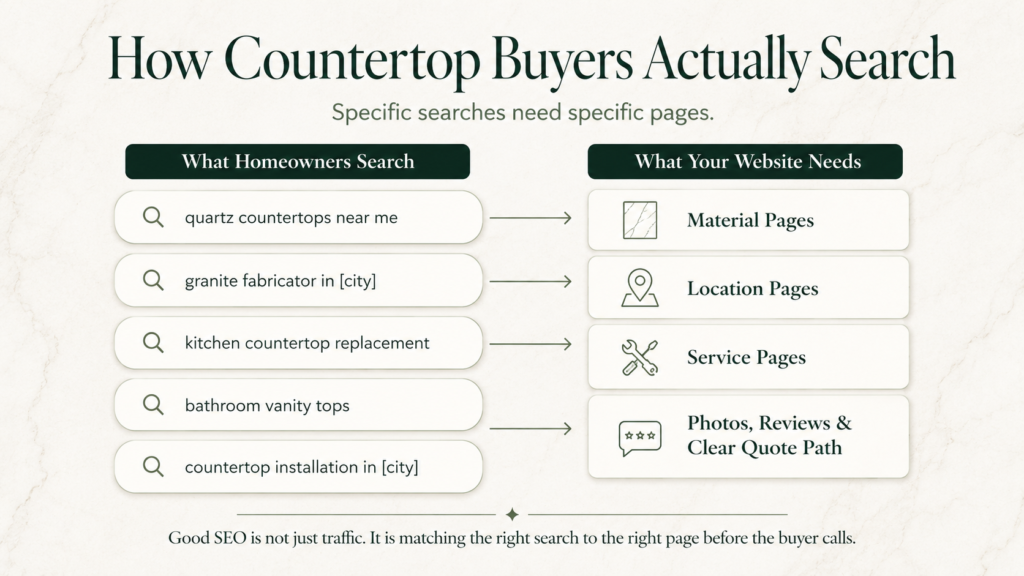
A countertop buyer may not begin with your company name. They may not even know your shop exists yet. They may start with the thing they want, the material they are considering, or the city where the project is happening.
They may search for things like:
- Quartz countertops near me
- Granite fabricator in [city]
- Kitchen countertop replacement
- Bathroom vanity tops
- Stone fabricator near me
- Countertop installation in [city]
That is why countertop marketing cannot be built only around a homepage and a few service descriptions.
- If the buyer searches by material, your website needs material pages.
- If they search by city, your website needs location pages.
- If they search by project type, your website needs service pages that speak to that project.
- If they are comparing options, your website needs photos, proof, reviews, and a clear way to request a quote.
This is where general digital marketing can miss the point. It may chase traffic, but niche marketing asks a better question:
Which searches are most likely to come from a homeowner who is actually preparing to buy?
Google and Ipsos studied local search behavior and found that people use smartphones and computers/tablets to look for local information before taking action. The research also found that many consumers want search ads customized to their city, zip code, or immediate surroundings.
That is crucial for countertop shops and remodelers.
A homeowner looking for a countertop shop is usually not searching in a vague way. They are looking for something close, specific, and useful.
So the real work is not just “do SEO.” The real work is building the right pages around the way buyers search before they call.
The Buyer Journey Is Not Linear, So The Marketing Cannot Be Shallow
A homeowner may not visit your website once and immediately request a quote.
They may search today, compare materials tomorrow, look at photos later in the week, read reviews after dinner, ask a spouse what they think, check another shop, then come back to your website again.
That is normal.
Google calls this kind of behavior the “messy middle.” In its research, Google studied hundreds of shopping journeys and found that buyers do not always move in a straight line from search to purchase. They move between exploration and evaluation before making a decision.
That makes sense for countertop and remodeling projects.
A homeowner is not just choosing a product. They are trying to reduce doubt.
They Explore Their Options
This is where they look at quartz, granite, marble, quartzite, porcelain, cabinet styles, kitchen layouts, bathroom ideas, and project photos.
They are asking:
- What material makes sense for my home?
- What style do I like?
- What does this kind of project usually look like?
- Which shops seem to know what they are doing?
At this stage, thin content is a problem. If your website does not help them explore, they will explore somewhere else.
They Evaluate The Businesses
After they understand their options, they start comparing companies.
They look at:
- service areas
- reviews
- project galleries
- material pages
- process pages
- showroom information
- quote request options
This is where a countertop shop can win or lose trust before the first call.
A general marketing strategy may only care that the website gets visitors. A niche marketing strategy cares about what those visitors see while they are deciding.
They Look For Confidence Before They Act
A buyer may like your work and still hesitate if the next step feels unclear.
They may wonder:
- Do you serve my city?
- Do you work with the material I want?
- Can I see projects like mine?
- What happens after I request a quote?
- Will someone guide me through the process?
That is why one homepage cannot carry the whole sale.
Your service pages, material pages, location pages, project proof, reviews, CTAs, and follow-up path all need to support the decision.
The Real Point
The more considered the purchase, the more helpful your marketing needs to be. For countertop shops and remodelers, the buyer journey is not just:
search → click → call
It is closer to:
search → compare → doubt → review → revisit → ask → decide
That is why niche marketing matters.
It builds around the real path homeowners take before they trust a business with their project.
How To Make Your Countertop Marketing More Relevant To Buyers
A homeowner does not care that you are “doing digital marketing.” They care whether your website, pages, project photos, ads, and follow-up make it easier for them to decide that you are the right countertop shop.
That is why relevance matters.
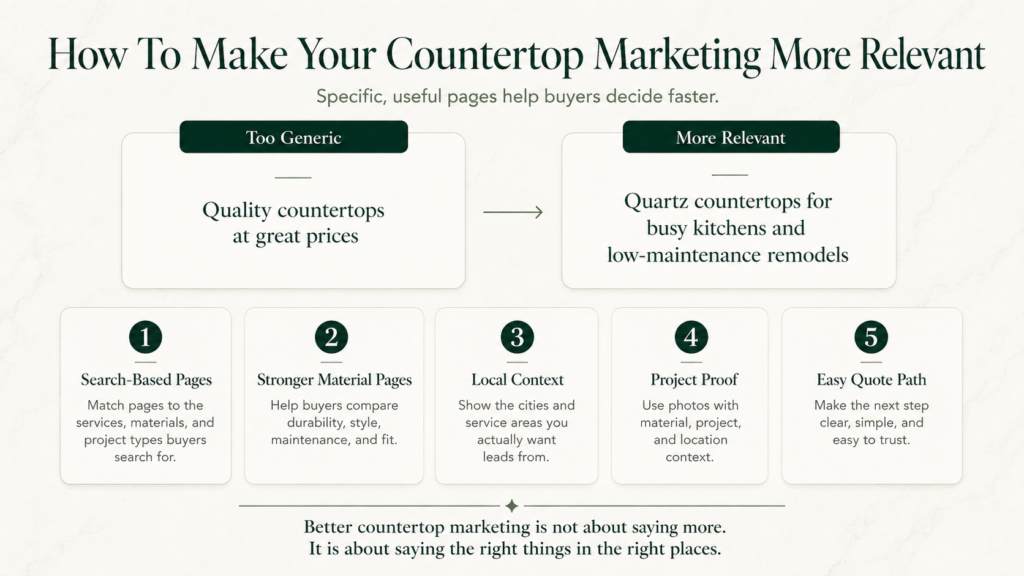
A generic marketing message might say: “Quality countertops at great prices.”
But a more useful message helps the buyer understand something specific: “Quartz countertops for busy kitchens, rental properties, and low-maintenance remodels.”
That second version gives the homeowner something to connect with.
McKinsey reports that personalization can reduce customer acquisition costs by up to 50%, increase revenue by 5% to 15%, and improve marketing ROI by 10% to 30%. It also found that faster-growing companies get 40% more of their revenue from personalization than slower-growing companies.
Now, your countertop shop does not need to personalize every page for every visitor. But your marketing should feel specific enough that the right buyer can say: “This answers what I was actually looking for.”
Here are a few ways to make that happen.
1. Build Pages Around The Way Buyers Search
If homeowners are searching for quartz countertops, granite countertops, bathroom vanity tops, countertop replacement, or stone fabrication in their city, your website should have pages that match those searches.
Not one broad page trying to cover everything. Specific searches need specific pages. You’ll learn more about this in our guide on how to design highly functional website for your service-based business.
2. Make Material Pages More Useful
A thin quartz or granite page is easy to ignore. A stronger material page helps buyers compare durability, maintenance, cost, style, project fit, and common use cases.
That kind of content does not just help SEO for countertop shops. It helps the buyer feel more informed before they call.
3. Add Local Context To Your Website
Many countertop shops serve multiple cities, but the website does not make that clear.
If you want leads from specific service areas, your website should show that clearly through location pages, project examples, internal links, and local content.
This is where niche marketing becomes practical. It connects your services to the places your buyers are actually searching from.
4. Use Project Photos As Buying Proof
Your photos should do more than show that the work looks nice.
When possible, support them with details like the material used, project type, location, style, and what the homeowner was trying to achieve. That turns a gallery into proof.
5. Make The Quote Path Feel Easy
A buyer may like your work and still hesitate if the next step feels unclear.
- Tell them what to do next.
- Tell them what happens after they request a quote.
- Tell them what details to send.
- Make the form easy to find.
Relevance is not only about copy. It is also about removing friction. The point is simple: better countertop marketing is not about saying more. It is about saying the right things in the places where buyers are already looking for answers.
How To Use Proof To Help Countertop And Remodeling Buyers Trust You
A homeowner can like your offer and still hesitate. That is normal. They are not only asking, “Can this company install countertops?”
They are asking:
- Have they done projects like mine?
- Do they work with the material I want?
- Do they serve my area?
- Do other homeowners trust them?
- Will the finished work look clean?
- Will the quote process be simple?
- Will I regret choosing them?
That is why countertop shops and remodelers need proof, not just promotion. A general marketing strategy may treat photos, reviews, service pages, and website copy like separate pieces.
But to a homeowner, they are all part of the same decision.
1. Use Project Photos As Evidence, Not Decoration
Your gallery should not only show beautiful kitchens or bathrooms. It should help the buyer understand what they are looking at.
When possible, add context:
- Material used
- Project type
- City or service area
- Countertop style
- Edge profile
- Kitchen, bathroom, vanity, or commercial use
- What changed from before to after
A photo becomes stronger when it answers the buyer’s quiet question: “Can they handle a project like mine?”
2. Make Reviews Easy To Find And Easy To Trust
Reviews matter because homeowners often want outside confirmation before choosing a local business.
BrightLocal’s 2025 Local Consumer Review Survey found that 74% of consumers use two or more websites to read reviews before deciding on a local business.
That means your reviews should not be treated like something hidden at the bottom of the page. They should support the buyer journey across your website, Google Business Profile, landing pages, and service pages.
3. Connect Proof To The Page The Buyer Is Reading
This is where many countertop websites miss it. If someone is reading about quartz countertops, show quartz projects. If someone is on a city page, show work from that city or nearby service areas when possible.
If someone is reading about kitchen countertop replacement, show kitchen projects, not random photos with no context. Proof works better when it matches the buyer’s current question.
4. Explain The Process Before They Ask
Proof is not only about photos and reviews. Clarity is also proof.
When your website explains how quotes work, what information to send, what happens after a request, and how the project usually moves forward, the business feels more reliable.
That matters because confusion creates hesitation.
5. Use Proof To Reduce Risk
A countertop or remodeling project can feel expensive, personal, and hard to reverse. The buyer wants to feel safe before they reach out. So your marketing should use proof to reduce that risk.
- Show the work.
- Explain the material.
- Clarify the service area.
- Make reviews visible.
- Describe the next step.
That is how proof turns into trust.
A Pretty Website Is Not The Same As A Sales-Ready Website
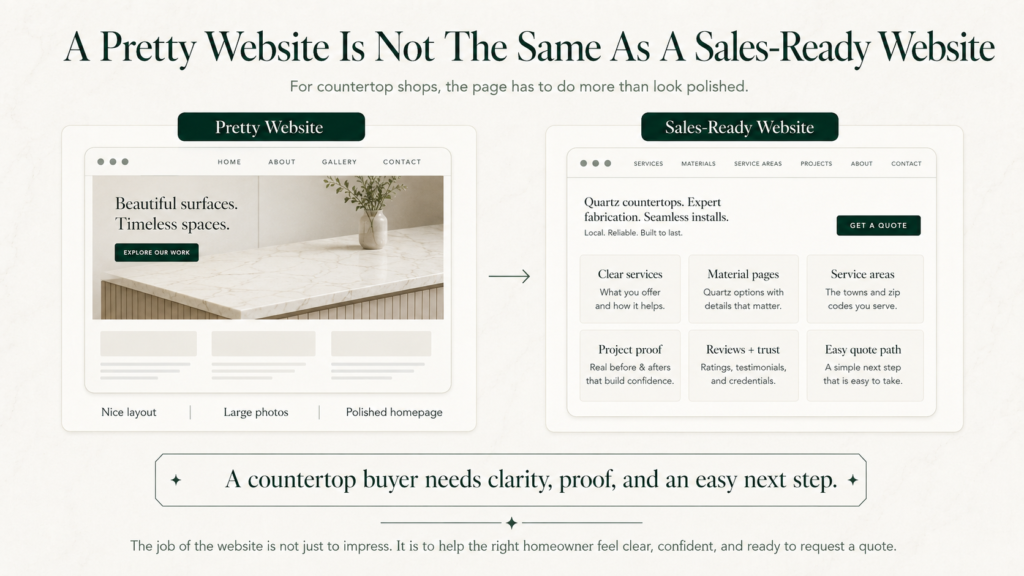
A countertop website can look clean and still do very little for the business.
- The colors may be nice.
- The layout may look modern.
- The photos may be large.
- The homepage may feel polished.
But if the message is vague, the service pages are thin, the material pages do not help buyers compare, the gallery has no context, and the CTA is weak, the website is still leaving too much work for the visitor.
And countertop buyers do not always have the patience for that.
A kitchen or bathroom project is not a casual decision. Houzz’s 2025 U.S. Kitchen Trends Study found that 81% of renovating homeowners changed the style of their kitchen during renovation, and high-end major kitchen remodels reached $180,000 or more at the 90th percentile.
That tells us something important.
People are not only buying a countertop. They are making decisions about how one of the most important spaces in their home will look, feel, and function. So the website needs to do more than look good. It needs to make the decision feel safer.
A sales-ready countertop website should help the buyer understand:
- What services you offer
- What materials you work with
- What areas you serve
- What your finished projects look like
- Why other homeowners trust you
- What happens after they request a quote
That is where general website design can fall short. It may focus on the look of the page, but not the job of the page.
For countertop shops and remodelers, the job of the website is not just to impress people. It is to help the right homeowner feel clear enough, confident enough, and ready enough to take the next step.
Why Paid Ads For Countertop Shops Need The Right Landing Page
Paid ads are not the problem. A countertop shop can absolutely use Google Ads, Facebook Ads, or other paid campaigns to reach people who are already looking for kitchen countertops, bathroom vanities, stone fabrication, or remodeling help.
The problem starts after the click. Someone searches for quartz countertops in [city]. They click the ad. Then they land on a broad homepage that barely talks about quartz, does not mention their city, shows random project photos, and makes the quote process feel unclear.
That is how paid traffic gets wasted.
The ad may have done its job.
The targeting may have been decent.
The buyer may have had real intent.
But the page did not continue the conversation.
And that matters because buyers do not always move in a straight line. Google’s “messy middle” research shows that people move between exploring and evaluating before they make a decision. For a countertop or remodeling buyer, that means the page after the click still has to help them compare, trust, and act.
So the question is not only: Are your ads getting clicks?
The better question is: Does the page after the click match what the buyer was looking for?
For example:
- A quartz ad should lead to a quartz-focused page.
- A city-based ad should lead to a page that speaks to that location.
- A kitchen remodel ad should show kitchen-specific proof.
- A vanity top ad should not send people to a generic countertop page.
- A quote-focused ad should make the quote request easy to complete.
This is also where relevance affects performance. McKinsey reports that personalization can reduce customer acquisition costs by as much as 50%, lift revenue by 5% to 15%, and improve marketing ROI by 10% to 30%.
Again, this does not mean every countertop shop needs complicated personalization software.
It means the message should match the buyer’s intent. If someone clicks because they want quartz countertops in their city, the page should make them feel like they are in the right place.
That is what niche marketing does better. It connects the ad, the landing page, the material, the location, the project proof, and the CTA, so the buyer does not have to restart their decision from scratch after the click.
Niche Marketing Connects The Whole Buyer Journey
Niche marketing is not just “better SEO” or “better ads.” For countertop shops and remodelers, the stronger strategy is the one that connects every part of the buyer journey, from the first search to the final quote request.
A homeowner may find your business through Google, land on a service page, look through project photos, read reviews, compare materials, check your location, and then decide whether the next step feels easy enough to take.
That means each part of your marketing has to support the next one. SEO should not only bring traffic. It should bring the right people to the right pages. Website design should not only make the business look good. It should make the offer easier to understand.
Content should not only fill space. It should answer the questions a homeowner is already asking before they trust you with their kitchen, bathroom, or remodel.
This is where general marketing can become disconnected. One person may run ads, another may write blogs, another may redesign the website, and another may post on social media, but none of it may feel connected to how a countertop buyer actually makes a decision.
The business may be active online, but the buyer journey still feels broken because the search, page, proof, CTA, and follow-up are not moving in the same direction.
For a countertop shop, the path is usually more connected than people think. A search for quartz countertops should lead to a page that talks clearly about quartz.
That page should show relevant project proof. The proof should build trust. The CTA should make it easy to request pricing. The follow-up should help the lead move forward while they are still interested.
If any part of that path feels weak, the buyer can slow down, get distracted, or choose another business that makes the decision feel easier.
This is also why niche marketing is really about positioning, not just promotion. A study published in Industrial Marketing Management found that market orientation can shape positioning strategy, and positioning strategy can influence brand performance.
In simple terms, when a business understands its market better, it can position itself more clearly for the people it wants to reach.
For countertop shops and remodelers, that market understanding should affect everything: the service pages, the material content, the location pages, the project gallery, the ads, the social posts, the quote forms, and the follow-up process.
The goal is not to make the business louder. The goal is to make it easier for the right homeowner to understand why this business is the right fit.
What Niche Marketing Looks Like For Countertop Shops And Remodelers
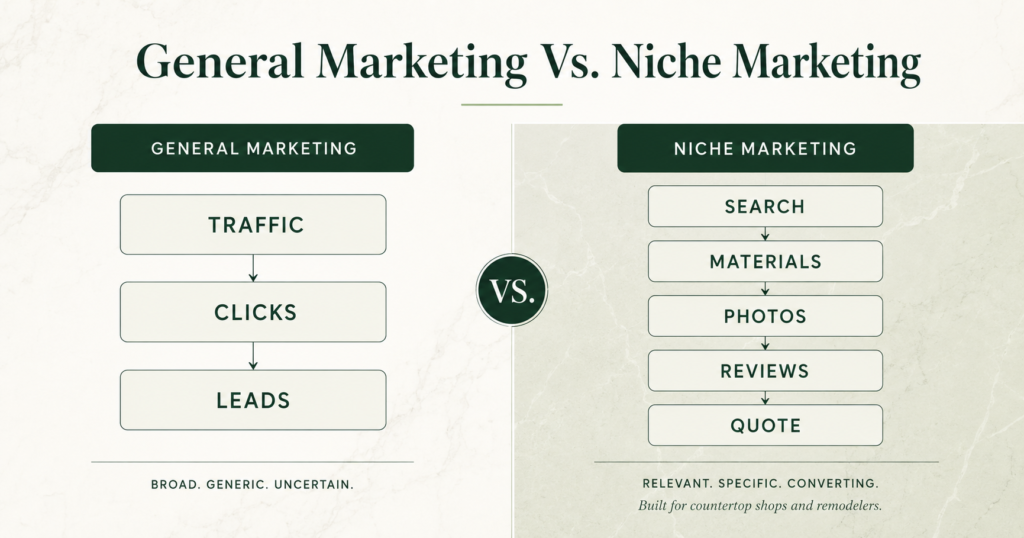
This is where the difference becomes practical. General digital marketing usually starts with the channel: More traffic. More posts. More ads. More keywords. More leads.
Niche marketing starts with the buyer’s decision.
- What are they searching for?
- What do they need to compare?
- What proof will make them feel safe?
- What page should they land on?
- What next step feels easy enough to take?
1. Traffic
General digital marketing might say: “Let’s get more website traffic.”
Niche marketing asks: “Which service, city, material, or project type should this traffic be tied to?”
Because countertop traffic is not automatically useful. A homeowner searching for quartz countertops in their city is different from someone casually reading about kitchen design ideas. The strategy should know the difference.
2. Website Design
General digital marketing might say: “Let’s make the website look better.”
Niche marketing asks: “Does the website help buyers understand the services, materials, service areas, project proof, and quote process?”
A clean website is good, but a clear website is better. For countertop shops and remodelers, the design should help the visitor feel like the business can handle their specific project.
3. Content and SEO
General digital marketing might say: “Let’s publish more content.”
Niche marketing asks: “Which buyer questions should the content answer before someone requests a quote?”
That could mean material comparison pages, city pages, service pages, project explainers, FAQs, or blogs that help homeowners understand what they need before they call.
We’v created a thorough post to help you learn more about SEO for your countertop, plumbing, roofing, or HVAC business.
4. Project Photos
General digital marketing might say: “Let’s post more photos.”
Niche marketing asks: “Which project photos, material details, locations, before-and-after examples, and captions will help a homeowner trust the shop?”
Photos are not just content for countertop shops. They are proof. But they work better when the buyer understands what they are looking at.
5. Paid Ads
General digital marketing might say: “Let’s run ads.”
Niche marketing asks: “Does the ad match the buyer’s search, and does the landing page make the quote request easy?”
If someone clicks an ad for granite countertops in their city, the page after the click should continue that exact conversation. Otherwise, the ad spend can leak.
6. Social Media
General digital marketing might say: “Let’s post more often.”
Niche marketing asks: “Which posts will make the business feel more trustworthy before a homeowner reaches out?”
For a remodeler or countertop shop, that may mean finished projects, showroom updates, material education, review highlights, installation details, FAQs, and simple process explanations.
7. Follow-Up
General digital marketing might say: “Let’s get more leads.”
Niche marketing asks: “What happens after someone fills out the form?”
A quote request is not the finish line. If follow-up is slow, unclear, or inconsistent, a warm lead can still choose another shop.
That is the real difference.
General marketing often tries to create more activity. Niche marketing makes the activity more connected to how countertop and remodeling buyers actually decide.
Ready To Make Your Marketing Fit The Way Buyers Actually Choose?
If your countertop shop or remodeling business already does good work, your marketing should not make homeowners work hard to see that.
- Your website should make your services clear.
- Your SEO should help the right buyers find you.
- Your project proof should build trust.
- Your ads should lead to stronger pages.
- Your follow-up should keep real opportunities moving.
At 95 Green Shark, we help countertop shops, stone fabricators, and remodelers build digital marketing that is clearer, more specific, and better connected to how homeowners search, compare, and request quotes.