
SEO For Home Service Businesses: How To Get Found By Better Local Customers
Regular SEO advice can only take your home service business so far. You are not trying to rank a software page or publish random blog posts. You need people in your service area to find you, believe you can do the work, and feel confident enough to call or request a quote.
That means your SEO has to cover things that generic advice often skips: your Google Business Profile, reviews, project photos, service-area pages, location trust, and clear next steps.
If you want to see why this matters beyond general marketing theory, our article on general digital marketing vs niched digital marketing explains why service-based businesses need more specific strategy than generic marketing advice usually provides.
Even Google says local results are shaped by relevance, distance, and prominence, so your visibility depends on more than keywords alone.
Table of Contents
SEO Should Help Better Customers Find And Choose Your Business
SEO for home service businesses is not just about getting your website to appear higher in Google. That matters, but it is only one part of the job.
The real job of SEO is to make your business easier to find, understand, trust, and contact when someone in your area needs the service you provide.
Google explains that Search works by crawling pages, indexing content, and serving results that match what people are looking for. So if your website does not clearly explain what you do, where you work, and why someone should contact you, your SEO is already working with a weak foundation.
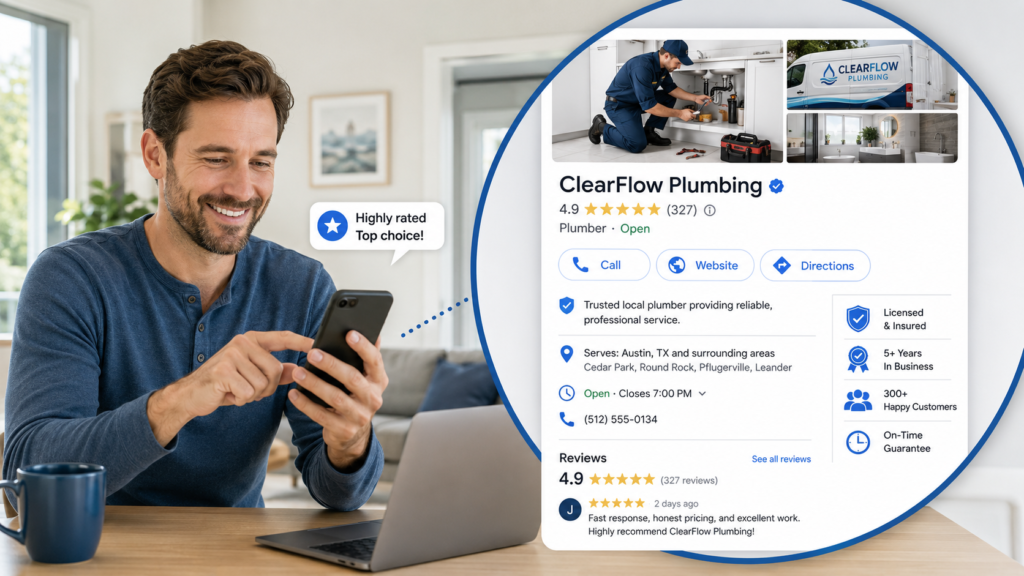
A page can rank and still fail. Think about a plumber who shows up high in search, but the Google Business Profile has old photos, average reviews, no owner replies, and recent complaints that nobody answers the phone. The business may be visible, but the buyer is still comparing.
If another plumber below them has recent reviews, real job photos, clear pricing information, and answers the phone quickly, that lower-ranked business may win the call.
That is the part many SEO reports miss. Visibility gets you into the conversation, but trust and conversion decide what happens next. For your home service business, SEO should not be judged only by impressions, clicks, or rankings. I explained this more directly in Rankings Vs Visibility, because ranking is only useful when it creates real business opportunity.
The better question is: are better local buyers finding you and taking the right next step?
Why Home Service SEO Is Different From General SEO
Home service SEO is different because your customer is not just looking for information. They are deciding who to trust with their home, property, money, and time.
That changes everything.
A person searching for a plumber, roofer, remodeler, landscaper, electrician, HVAC company, or countertop installer usually has a local problem or project in mind. They are not browsing casually. They want to know:
- Do you serve my area?
- Do you handle this specific service?
- Can I trust you inside or around my home?
- Have you done this kind of work before?
- What happens after I call or request a quote?
That is why general SEO advice can fall short. It may tell you to publish content, target keywords, improve titles, or build links. Those things can help, but they do not fully cover how a home service buyer makes a decision.
A homeowner may search, open several websites, check Google reviews, look at project photos, compare service areas, read FAQs, and then contact one or two businesses. Your SEO has to support that full journey.
For a home service business, your website and local presence need to work together. Your service pages should explain what you do. Your location pages should prove where you work. Your Google Business Profile should match the message on your website. Your reviews should support trust. Your photos should show real proof. Your quote process should make the next step simple.
This is also why website content cannot be treated like filler. Your pages need to explain the business clearly, support search visibility, and help buyers make a decision. Our guide on business website content strategy goes deeper into how website content should support clarity, trust, and conversion.
A home service business does not win because it appears once. It wins because the buyer finds consistent proof across search results, your website, Google Business Profile, reviews, photos, and the follow-up process.
Why Relevance, Distance, And Prominence Matter: Local SEO Starts With Owning One Market Before Chasing Ten
Local SEO is not just adding city names to your website and hoping Google connects the dots.
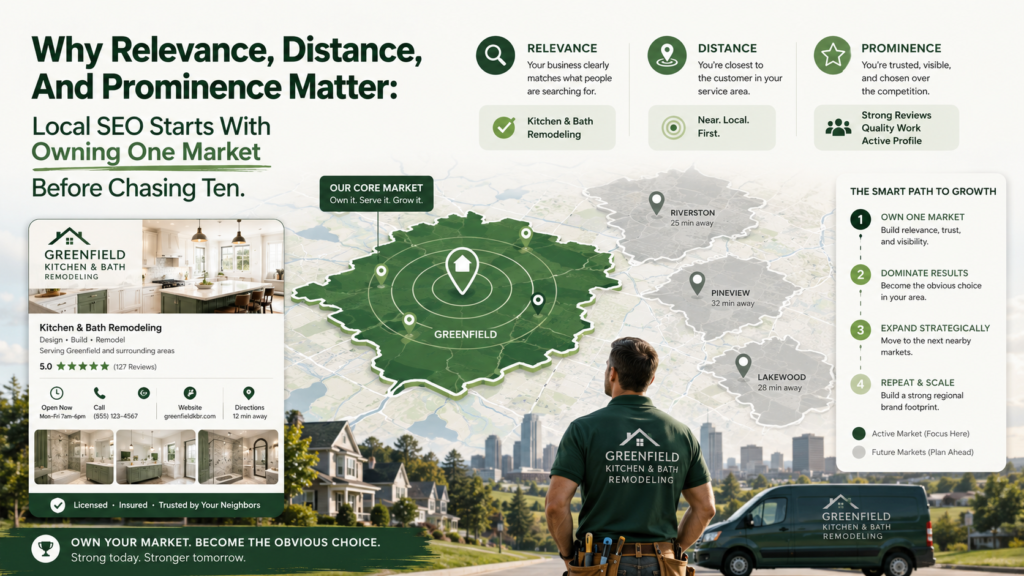
For a home service business, local SEO starts with one simple question: where do you want to become trusted first? That’s a crucial question because you are not only trying to appear in search results. You are trying to look relevant, close enough, active, reviewed, and credible when someone nearby needs your service.
Google says local results are mainly shaped by relevance, distance, and prominence. Relevance means your business matches what the person searched for. Distance means your business is close enough or connected to the searcher’s area. Prominence means your business is known, trusted, and credible enough to show. (Google Business Profile Help)
For home service businesses, those three ideas should guide the strategy.
Relevance: Your Google Business Profile, website, service pages, categories, descriptions, and photos should clearly show what you do. If you are a plumber, roofer, remodeler, landscaper, HVAC company, or countertop installer, Google and the customer should not have to guess which jobs you handle.
Distance: Your location or service area has to make sense. Google allows service-area businesses and hybrid businesses to set service areas, but the profile still needs to represent how the business actually serves customers. (Google Business Profile Help)
Prominence: This is where many home service businesses struggle. You may serve the area, but do you have reviews, real project photos, useful service pages, local content, and consistent business information that support your credibility? BrightLocal’s review research shows that reviews remain a major part of how consumers evaluate local businesses, which is why visibility without trust is not enough. (BrightLocal)
This is why a new or growing home service business should not try to look local everywhere from day one. Start with the market you can actually serve well. Build reviews there. Publish project proof from that area.
Then expand location by location. If your business is planning a wider service-area strategy, you can see how we organize location-focused content on our Areas Served page.
The Right Keywords Are Not Always The Biggest Keywords
One of the easiest ways to mislead a home service business owner is to show them a list of big keywords and say, “Look how much search volume this has.”
That may look impressive in a report, but search volume is not the same as buyer quality.
The keywords that bring in your best customers may not always be the biggest ones. Sometimes, the smaller, more specific searches are the ones that produce the calls, quote requests, showroom visits, and booked jobs your business actually wants.
Think about the difference:
| Keyword Type | Example | What It Usually Means |
| High-intent searches | “emergency plumber near me,” “roof repair contractor,” “quartz countertop installer” | The buyer may be ready to call or request a quote. |
| Research searches | “quartz vs granite,” “best flooring for pets,” “how much does bathroom remodeling cost” | The buyer is learning, comparing, and building confidence. |
| Brand and validation searches | “[company name] reviews,” “[company name] photos,” “[company name] service area” | The buyer is checking whether they should trust you. |
This is where many SEO strategies become too shallow. Agencies and SEO specialists may focus on ranking for large, broad keywords because those terms look good in a presentation. But a home service business does not need traffic from everyone. It needs traffic from the right people in the right area with the right problem.
A smaller keyword like “water heater replacement in [city]” may be more valuable than a broad keyword like “plumbing tips.” A search like “quartz countertop installer near me” may be more valuable than a general blog post about kitchen design. The smaller keyword may not look exciting, but it may carry stronger buying intent.
A strong keyword strategy should match the customer journey. Some buyers are ready to act now. Some are still researching. Some have already found your business and are validating you before they call. Your SEO should support all three stages.
Not all organic traffic is qualified traffic. The question is not just, “Are we ranking?” The better question is, “Are these rankings bringing in the kind of buyers we actually want?”
Service Pages, Location Pages, And Website Structure
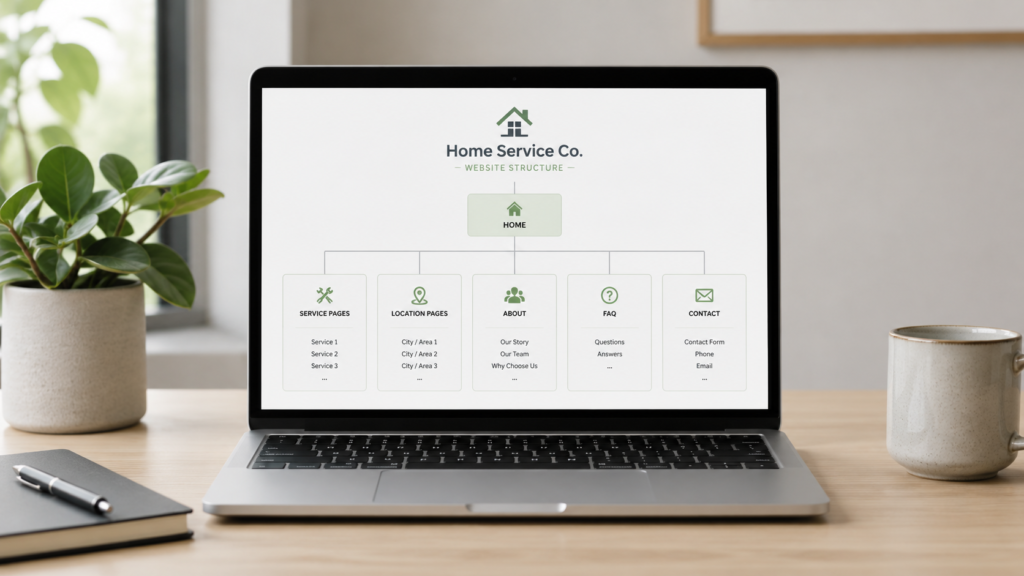
A home service website cannot depend on the homepage alone. If your business offers several services in several areas, Google needs structure, and so does the buyer.
Service pages explain what you do. Location pages explain where you do it. FAQs answer the questions that may stop someone from calling. Project photos, reviews, and testimonials add proof. Calls to action show the visitor what to do next.
A service page should not simply say, “We offer this service.” It should explain the problem, who the service is for, how the process works, where the service is available, what proof supports the business, and how someone can request a quote.
Location pages should work the same way. They should support real service areas, not exist as copied pages with city names swapped.
Internal links are also crucial here. But they are not just an SEO trick. They are a buyer journey tool. A good internal link moves someone from a service page to a related location page, project example, FAQ, review section, or quote page.
For example, if you run a countertop shop, your website should connect service pages, material pages, project galleries, location pages, and quote forms. That is why our digital marketing services for countertop shops focus on the full website structure, not just isolated pages. That is why our SEO content strategy services focus on building pages that support search visibility, buyer education, and better quote requests.
If your main issue is website structure itself, our website design for countertop shops page shows how a service business website can be planned around services, materials, proof, and conversion instead of just visual design.
Reviews, Photos, And Project Proof Are Part Of SEO
For home service businesses, trust assets are SEO assets.
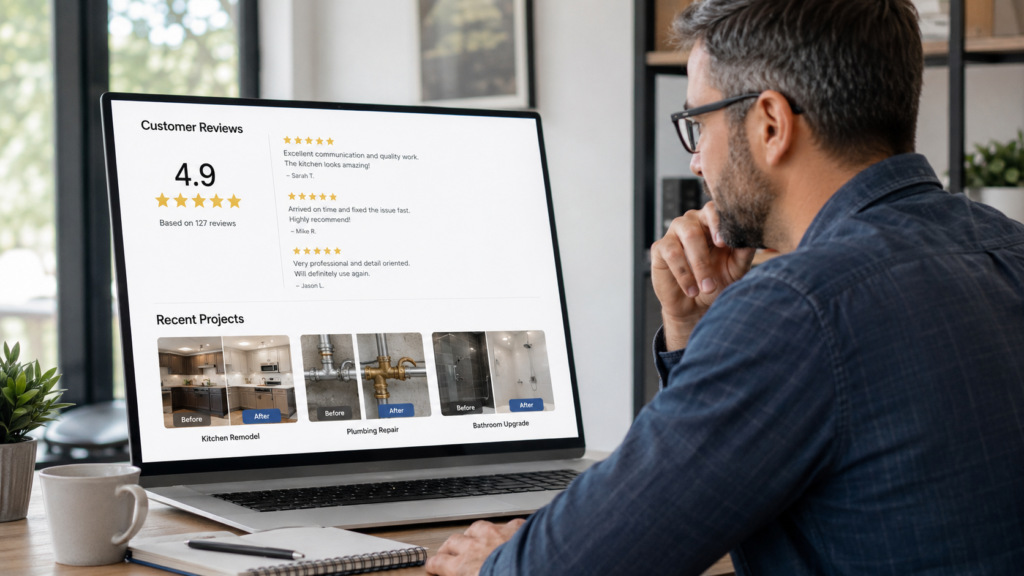
A buyer may find you through Google, but they still need proof before they call. That proof often comes from your reviews, photos, project gallery, testimonials, before-and-after images, and the details customers share about working with you.
BrightLocal’s 2026 Local Consumer Review Survey reports that 2 in 5 consumers read reviews every time they look for a business, and that star ratings and review recency continue to matter. That matters because a buyer is not only asking, “Can this company do the work?” They are also asking, “Can I trust them?”
For a home service business, project proof can show:
- The type of work you actually do
- The quality of the finished result
- The neighborhoods or service areas you work in
- The materials, systems, or solutions you use
- The kind of customer experience people can expect
- Whether the business is active and still doing good work
This is why a completed project should not disappear after the invoice is paid. It should become marketing proof.
One good project can support your Google Business Profile, website gallery, service pages, location pages, social media, paid ads, sales conversations, FAQs, and review requests. You can see this same idea applied to countertop businesses in our guide on how to start a countertop business with marketing built in from day one, where we explain why project documentation, reviews, website planning, and local visibility should be part of the business from the beginning.
That is a different way to think about SEO. Your website pages and keywords matter, but so does the evidence behind them. If your business claims to offer a service, your reviews and project photos should help prove it.
SEO Should Lead To Calls, Quotes, And Better Customers
SEO for home service businesses should not stop at rankings, impressions, or traffic. Those numbers can show progress, but they do not tell the full story.
The real question is simpler: are the right local buyers finding your business, trusting what they see, and taking the next step?
That means your SEO should be connected to real business outcomes, such as:
- Phone calls
- Form submissions
- Quote requests
- Booked consultations
- Showroom visits
- Lead quality
- Service-area quality
- Estimate value
- Closed jobs
- Revenue by lead source
This is where many businesses get stuck. They may have search visibility, but the website is unclear. They may get traffic, but the quote form is weak. They may receive calls, but nobody tracks where those calls came from. They may get leads, but nobody follows up fast enough.
A business can rank and still lose money if the rest of the system is broken.
That is why SEO should be part of a larger marketing system, not an isolated ranking project. For a deeper look at visibility, trust, conversion, and follow-up, read our guide on how to market a countertop business.
If your home service business needs stronger search visibility, clearer website content, better local SEO, and a lead-generation system that connects visibility to real inquiries, request a digital marketing review from 95 Green Shark.
About the author: Joseph Omosuvie is the founder of 95 Green Shark. He has years of agency-side experience creating SEO content, service pages, location pages, and practical marketing systems for home-improvement and service businesses.
See documented location-page SEO results and examples from 95 Green Shark.
Explore SEO strategy services for home-service businesses that need better local visibility.