
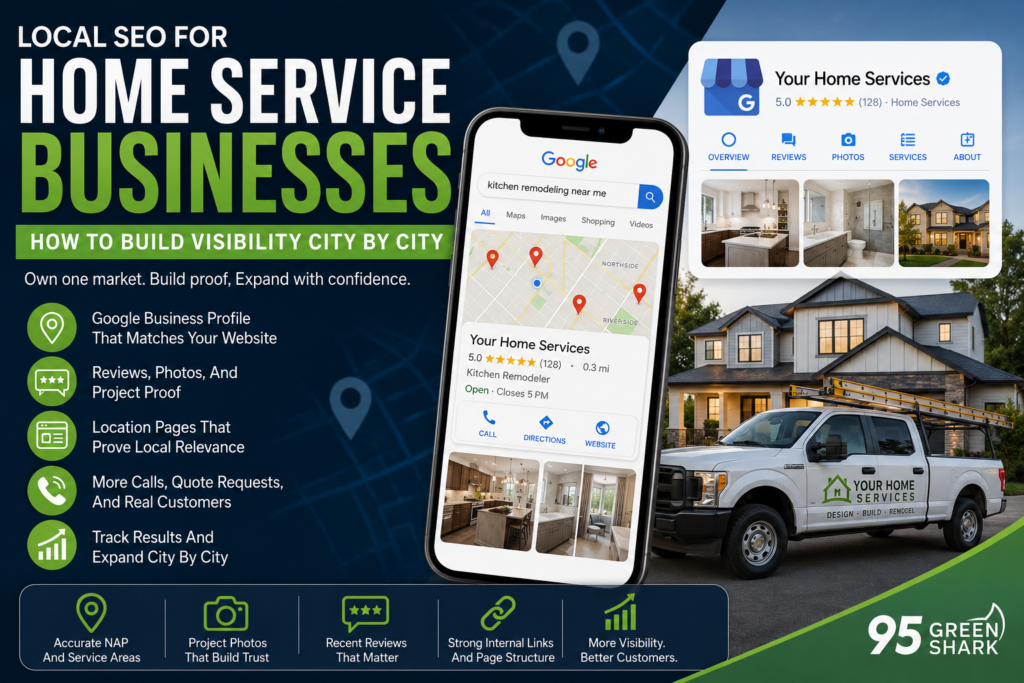
Local SEO For Home Service Businesses: How To Build Visibility City By City
Local SEO is not about making your home service business look like it serves everywhere. That is the mistake many businesses make when they start chasing nearby cities, stuffing location names into pages, or expecting one Google Business Profile to carry the whole strategy.
If you want better local customers, you need more than rankings. You need proof that your business belongs in the market you want to win.
That means your website, Google Business Profile, reviews, service areas, photos, and location pages all have to tell the same story: you serve this area, you do this work, and you can be trusted.
This is also why SEO for home service businesses should never be treated as rankings alone. It should connect local visibility to trust, clarity, and real inquiries.
The goal is simple: own one market first, then expand city by city with real proof behind you.
Table of Contents
Local SEO Starts With The Market You Can Actually Win
Your first local SEO goal is not to look like you serve every city within driving distance. Your first goal is to become visible, relevant, and trusted in the market you can actually win.
That may be the city where your shop is located, the suburb where most of your best projects come from, or the service area where your team can respond quickly, collect reviews, photograph completed work, and build a real reputation.
Google says local results are mainly shaped by relevance, distance, and prominence. In plain terms, that means Google is trying to understand whether your business matches the search, whether you are close enough or connected to the searcher’s area, and whether your business looks known and trusted enough to recommend. (Google Business Profile Help)
That is why local SEO for plumbers, roofing companies, and home improvement businesses cannot be built on keywords alone. Your website, Google Business Profile, service pages, reviews, project photos, and business details all need to support the same local story.
You can serve many areas, but your strategy still needs a clear starting point.
Start with the market where you can build the strongest proof. Then, when you expand into nearby cities, the expansion feels believable because there is already evidence behind the business.
A home service business should own one market before chasing ten. Once buyers and Google can see why you deserve to show up in that first market, your next location becomes easier to support.
This is the same principle behind the location-page results shown in our case studies, where focused local pages were built to support real search visibility instead of random city targeting.
Your Google Business Profile And Website Must Tell The Same Story
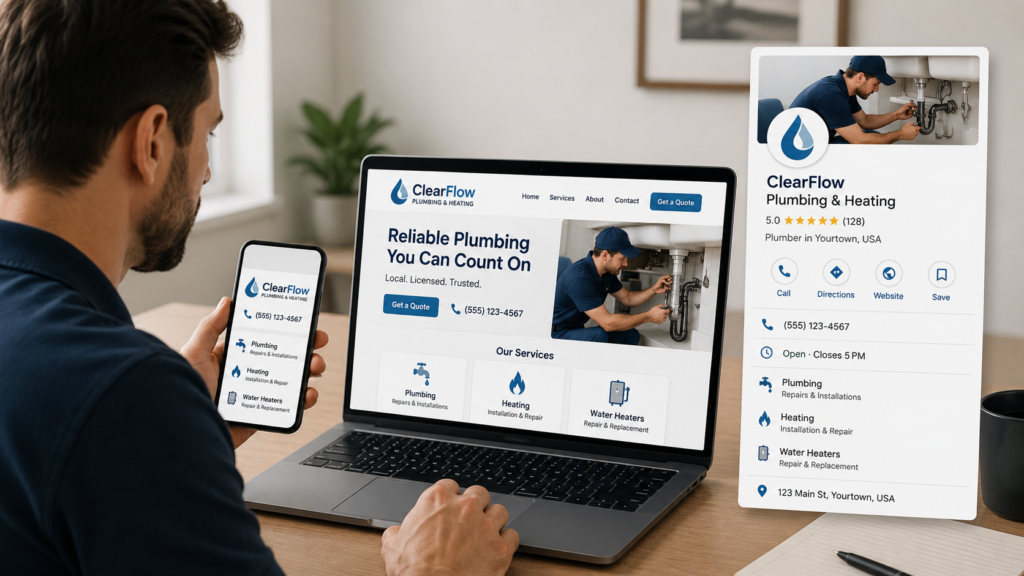
Your Google Business Profile should not feel like one version of the business while your website tells another story.
For a home service business, the profile is often the first place a local buyer checks before deciding whether to call. But the profile cannot carry the full trust burden alone. It should work with your website, not separately from it.
That means the basics need to match:
- Business name
- Phone number
- Opening hours
- Services
- Service areas
- Photos
- Business description
- Website link
- Quote, call, or booking path
Google says service-area and hybrid businesses can set service areas so people can find their Business Profile, but that setup should still reflect how the business actually serves customers. So if your profile lists areas you barely serve, while your website only talks about your main city, the local story starts to feel weak.
The website has its own job too. Google’s Local Business structured data documentation shows that business information like hours, departments, and other local details can be communicated more clearly on the website. That matters because local SEO becomes stronger when your business details are consistent, specific, and easy to understand.
A confused local presence weakens trust. If your website says you serve one area, your profile lists another, your photos show nothing current, and your service pages are vague, the buyer has no reason to feel certain.
Your Google Business Profile, website pages, categories, descriptions, photos, and calls to action should all point to the same conclusion: this business does this work, serves this area, and knows what the customer should do next.
If the website side of that story is weak, our SEO content strategy services can help turn vague service pages, thin location pages, and unclear content into a stronger local search foundation.
Service Areas Are Not A Shortcut To Ranking Everywhere
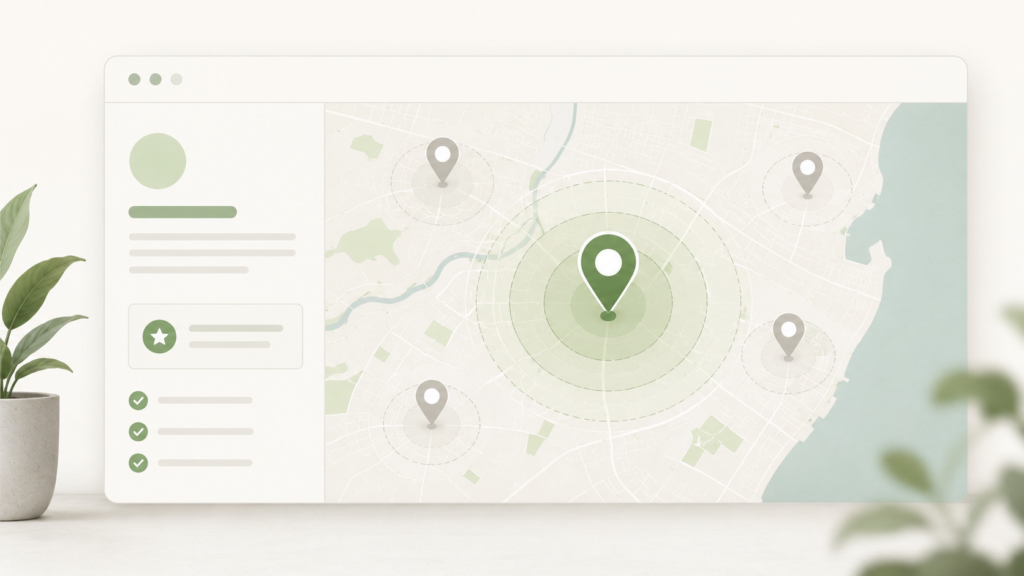
Adding more service areas to your Google Business Profile does not automatically make your business locally trusted in every city you list.
That is where many home service businesses get it wrong. They assume that if they add ten nearby cities, Google will start showing them in all ten places. But a service area is not the same as local authority. It only helps describe where your business works.
Google’s own guidance says service-area and hybrid businesses can list service areas so customers can find their Business Profile, but the profile should still represent how the business actually serves customers. (Google Business Profile Help)
So, if you list a city, the next question is simple: what supports that claim?
Do you have reviews from that area? Project photos? A useful location page? Service pages that connect to that market? Calls, estimates, or completed jobs from that city? Can your team actually respond there without hurting service quality?
This matters because local visibility is not distributed evenly just because a business is technically nearby. Research on “near me” search exposure has also shown that location-based retrieval systems can create uneven visibility between businesses, which is another reason you should not treat service-area visibility as automatic. (arXiv)
A broad service area can make your business look unfocused if nothing supports it. Instead of claiming every city equally, build local evidence first. Start with the areas where you already have demand, capacity, reviews, and proof. Then expand the footprint with stronger pages, better photos, internal links, and real customer evidence behind each location.
This is also why you must understand the intricacies of general digital marketing vs niched digital marketing. A general campaign may say “target more areas,” but a better local strategy asks whether the business has the proof, capacity, and page structure to support each area properly.
Location Pages Should Prove Local Relevance, Not Just Swap City Names
Location pages can help your home service business show up in the areas you serve, but only when those pages are useful.
A weak location page says the same thing as every other page and only changes the city name. That may look like local SEO, but it does not give Google or the buyer much to work with.
Google’s spam policies describe doorway abuse as creating pages mainly to rank for specific, similar searches. That is why location pages should not be treated as a copy-and-paste exercise. If the page exists only to capture a city keyword, without adding real value, it is not helping your local SEO strategy in a meaningful way. (Google Search Central)
A strong location page should prove why that location matters.
It can include:
- The specific services offered in that area
- Why that city or service area matters to the business
- Nearby neighborhoods or service context
- Real project examples, when available
- Reviews or testimonials from customers in that area
- Photos from local work
- A clear quote, call, or booking path
- Internal links to relevant service pages
- Internal links from related pages back to the location page
The point is that a location page should not pretend local relevance. It should demonstrate it.
If there is no proof, no useful local detail, no service-area reason, and no buyer value, the page is probably not strengthening the business. But when a location page connects real services, real areas, real proof, and a clear next step, it becomes part of a serious city-by-city local SEO system.
You can see how location-focused strategy works in practice on our Areas Served page, including examples like content strategy in Texas, content strategy in Arizona, and content strategy in Colorado.
Reviews, Photos, And Project Proof Build Prominence City By City
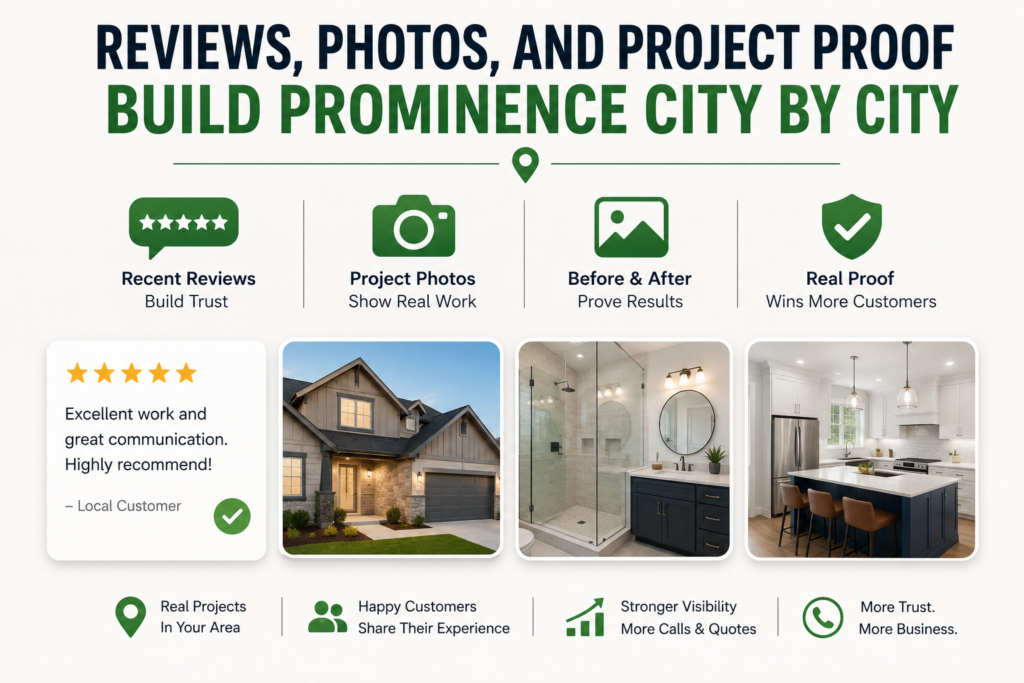
Home service businesses do not build local trust with words alone. You can say you serve a city, but buyers still want proof that you actually do good work there.
That proof often comes from reviews, project photos, before-and-after images, testimonials, and real customer details.
BrightLocal’s 2026 Local Consumer Review Survey reports that consumers now expect higher star ratings and more recent reviews when choosing local businesses. That matters because local buyers are not only checking whether your business exists. They are checking whether your business still looks active, trusted, and worth calling.
For a home service business, local proof can include:
- Recent reviews from customers in the area
- Detailed reviews that mention the service, communication, timing, or finished result
- Photos from completed projects
- Before-and-after examples
- Project galleries organized by service or location
- Testimonials that show what the customer experience felt like
This proof should not sit in one place. A completed project in one city can become a review request, a Google Business Profile photo, a location-page example, a service-page proof point, a social post, an ad creative, and a sales asset.
That is how local SEO grows city by city.
If you want to expand into a new location, do not just publish a page and hope it ranks. Build proof around that location. Show the work. Ask for the review. Add the photos. Connect the project to the right service page and location page.
Every completed job should feed the local SEO system. That is how your business becomes more believable in each market you want to win.
For a related example in the countertop space, our guide on how to start a countertop business with marketing built in from day one explains why project documentation, reviews, website planning, and local visibility should be part of the business from the beginning.
Local SEO Should Support Calls, Quote Requests, And Paid Lead Readiness
Local SEO should not stop at showing up in maps or organic results. It should help the right person call, request a quote, book a consultation, visit a showroom, or take the next step.
It should also make your business more ready for paid lead generation.
That matters because paid local visibility often depends on the same things your local SEO should already be fixing: accurate business details, clear services, real service areas, strong photos, reviews, and a website that supports the offer.
Google says Local Services advertisers must have a public and verified Google Business Profile to advertise with Local Services Ads. Google also says Local Services Ads setup asks for business information such as hours, service area, and services offered, and reviews may include reviews from the Google Business Profile.
So before you spend on local ads, ask:
- Is your Google Business Profile accurate?
- Do your services match your website pages?
- Is your service area realistic?
- Do your photos and reviews support trust?
- Does the landing page explain the offer clearly?
- Can you track calls, forms, lead source, estimate value, and closed jobs?
- Does someone follow up quickly?
Paid traffic should not be launched into a weak local presence. If the profile is thin, the website is unclear, and follow-up is slow, more visibility will not automatically create better customers.
Local SEO is part of the lead-generation system. It prepares your business to be found, trusted, contacted, tracked, and sold properly.
If your business is already thinking about paid traffic, our paid ads services can help you connect landing pages, tracking, and lead quality before you start spending.
How To Expand Local Visibility City By City
The best local SEO strategy is not to publish every city page at once. It is to expand the same way a strong home service business grows: one believable market at a time.
Here is the process.
Step 1: Choose Your Primary Market First
Start with the city or service area where you have the strongest chance of winning. This may be where your business is located, where your best customers already come from, or where your team can respond quickly and deliver consistently.
Step 2: Build The Local Foundation
Make your Google Business Profile accurate and complete. Your name, phone number, hours, services, service area, photos, description, and website link should all match what customers see on your website.
Step 3: Strengthen Your Service Pages
Before creating more location pages, make sure your main service pages are useful. They should explain what you do, who the service is for, what the process looks like, where the service is available, and how someone can request a quote.
Step 4: Create Location Pages Only Where They Make Sense
A location page should support a real market. Add it when you can explain the services offered there, connect it to relevant service pages, include useful local details, and show proof when available.
Step 5: Collect Reviews And Project Proof From That Area
Ask real customers for reviews. Upload project photos consistently. Use completed jobs as proof on your Google Business Profile, service pages, location pages, and sales materials.
Step 6: Connect The Pages Internally
Link service pages, location pages, FAQs, project examples, and quote pages together. This helps Google understand the structure of your website, but it also helps buyers move from interest to trust to action.
Step 7: Build Local Visibility Beyond Google
Google matters, but it is not the only local discovery platform. Apple says Business Connect helps businesses manage how they appear across Apple Maps, Wallet, Siri, and other Apple services. That is why local listings such as Apple Business Connect, Bing Places, and relevant directories should support the same business information. (Apple Business Connect)
Step 8: Track Which Cities Produce Real Opportunities
Do not measure local SEO only by rankings. Track calls, quote requests, estimate value, booked jobs, and closed work by location. If one city produces better inquiries than another, that should shape your next move.
Local SEO should grow as the business grows. First, become findable and trusted in the market you can serve best. Then use proof, content, reviews, and structure to expand into nearby cities without creating weak pages or fake local signals.
If your home service business needs a local SEO strategy that connects Google Business Profile, website structure, location pages, reviews, project proof, and lead tracking, request a digital marketing review from 95 Green Shark.
About the author: Joseph Omosuvie is the founder of 95 Green Shark. He has years of agency-side experience creating SEO content, service pages, location pages, and practical marketing systems for home-improvement and service businesses.
See documented location-page SEO results and examples from 95 Green Shark.
Explore SEO strategy services for businesses that need stronger city-by-city visibility.