
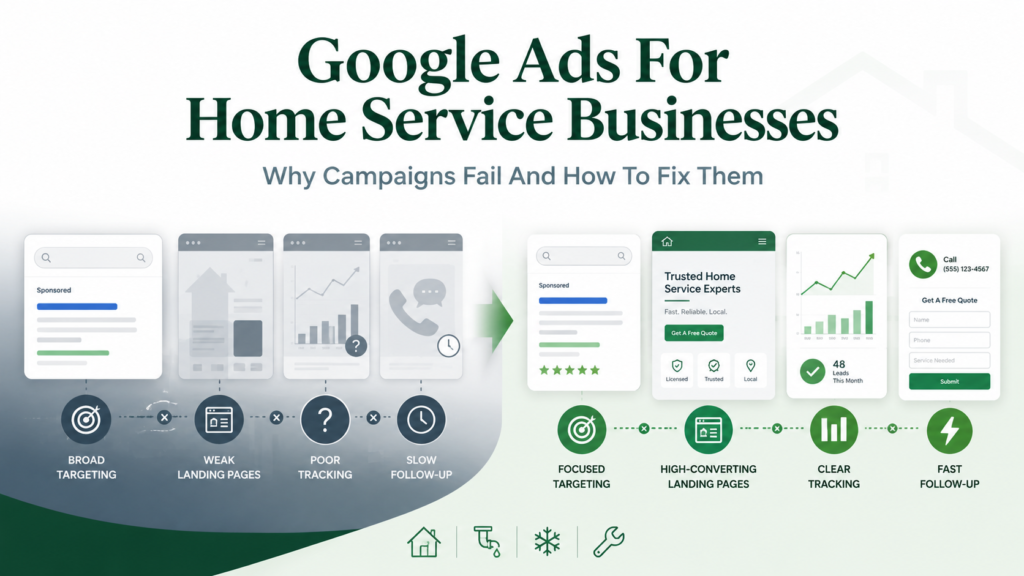
Google Ads For Service-Based Businesses: Why Campaigns Fail And How To Fix Them
As a service-based business, Google Ads can bring people to your home service business quickly, but they can also waste money even more quickly.
You may be paying for clicks, getting some calls, seeing form submissions, and still wondering why the campaign is not turning into enough good jobs. That does not always mean Google Ads cannot work for your business. It may mean the campaign is sending traffic into a weak system.
The keywords may be too broad. The landing page may not match the service. The offer may be unclear. Calls may not be tracked. Forms may be ignored for too long. Leads may come in, but nobody connects them to estimates, booked work, or revenue.
For home service businesses, Google Ads should not be treated as “turn it on and wait for leads.” It needs the right targeting, landing page, tracking, and follow-up process before you spend more.
Google Ads Can Work For Service-Based Businesses, But They Expose Weak Systems Fast
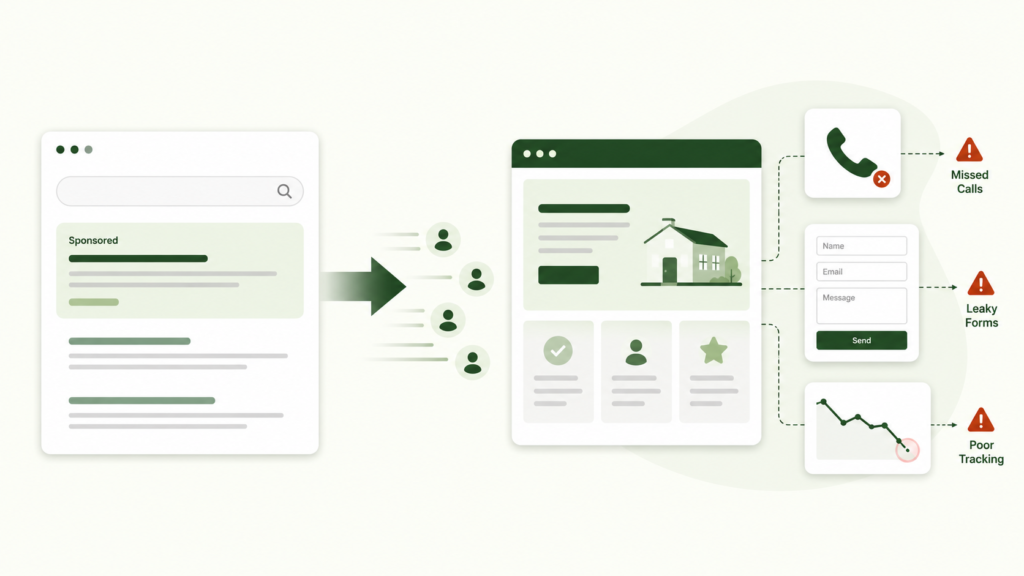
You may be getting clicks, but not enough real calls, quote requests, or booked jobs. That does not automatically mean Google Ads cannot work for your home service business.
It may mean the campaign is exposing problems that were already there.
Google Ads for home service businesses can put you in front of people searching for urgent or high-intent services. Someone searching for roof repair, emergency plumbing, HVAC repair, water heater replacement, drain cleaning, kitchen remodeling, or countertop installation may already have a real problem they want solved.
But paid traffic is only valuable if your business is ready to handle it.
LocaliQ’s 2025 home services search advertising benchmarks show that performance can vary widely across home service categories, and its report is based on more than 3,200 U.S. home services search advertising campaigns. That is a useful reminder that home service advertising is competitive, and results are not automatic just because the campaign is running.
WordStream’s 2025 Google Ads benchmark report also found that the overall average cost per lead in Google Ads increased from 2024 to 2025. In other words, wasted clicks are not getting cheaper.
This is why Google Ads should be treated like a pressure test. If the landing page is weak, the offer is vague, the quote form is confusing, the phone is not answered, or tracking is broken, ads may simply make those problems more expensive.
A good home service Google Ads campaign is not just about buying visibility. It is about turning paid search traffic into real opportunities. That means your keywords, location targeting, landing page, proof, call tracking, and follow-up process all need to work together before you increase the budget.
Why Google Ads Campaigns Fail For Home Service Businesses
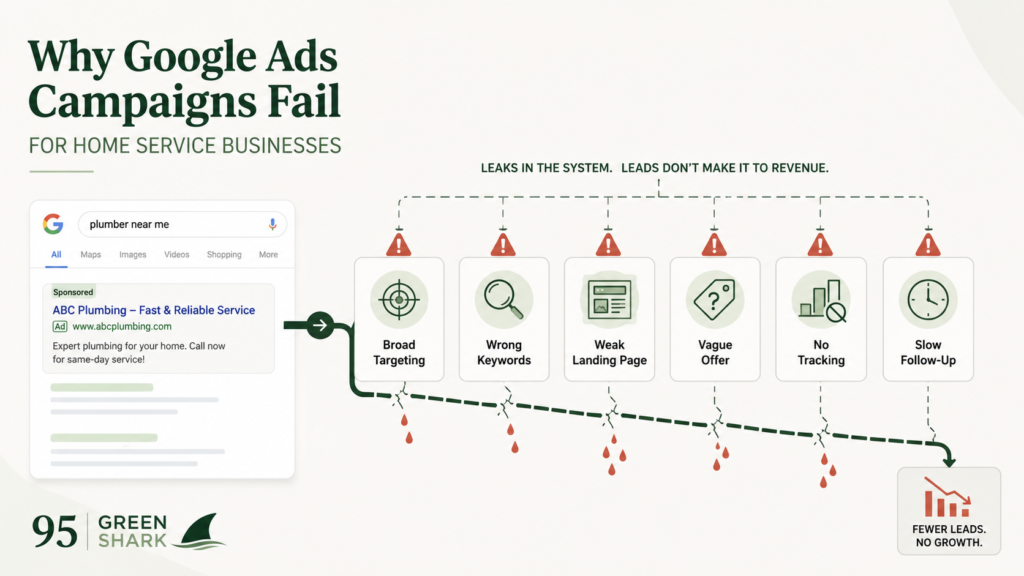
Most Google Ads campaigns do not fail for one reason. They usually fail because several weak points stack together. The targeting is too broad, the keywords bring in the wrong people, the landing page is weak, the offer is unclear, tracking is incomplete, and follow-up is too slow.
Here are the most common reasons Google Ads fail for home service businesses.
1. The Campaign Targets Too Broadly
A home service business may try to advertise every service, every location, and every type of customer in one campaign.
That usually creates messy data and poor-quality leads. A campaign for emergency plumbing should not be treated the same way as a campaign for bathroom remodeling. A homeowner searching for urgent leak repair has a different intent from someone researching a large renovation project.
When the campaign is too broad, it becomes harder to know which service, keyword, area, ad, or page is actually producing good leads.
2. The Keywords Attract The Wrong Intent
Not every search is worth paying for.
Some searches are urgent and commercial, such as “emergency plumber near me” or “roof repair contractor.” Others may be research-heavy, DIY-focused, job-seeking, or too general.
For example, a plumber may not want to pay for searches from people looking for plumbing jobs, plumbing courses, free plumbing advice, or parts-only information. A countertop shop may not want to pay for broad design inspiration searches when the campaign is meant to generate quote requests.
The issue is not just traffic. The issue is whether the traffic has the right intent.
3. Negative Keywords Are Missing
Negative keywords help stop your ads from showing for searches that include excluded terms. Google explains that negative keywords can prevent ads from appearing for searches that are not relevant to the campaign. (Google Ads Help)
For service-based professional businesses, this is crucial because irrelevant searches can quietly drain your budget.
Words like “jobs,” “salary,” “training,” “DIY,” “free,” “parts,” or “wholesale” may need to be excluded depending on the service. Without negative keywords, you may keep paying for clicks from people who were never likely to become customers.
4. The Landing Page Does Not Match The Ad
This is one of the biggest Google Ads campaign mistakes.
If the ad says “water heater replacement,” but the visitor lands on a general homepage, the page creates friction. The buyer has to search around to confirm whether you handle that service, whether you serve their area, and what they should do next.
That delay can cost you the lead.
A service-specific ad should lead to a service-specific page. The headline, proof, location, offer, and call to action should all match what the person clicked for.
5. The Offer Is Too Vague
“Contact us today” is not always enough.
A stronger home service offer tells the visitor what action to take and why it matters. Depending on the service, that could be:
- Request an estimate
- Call for emergency service
- Book a consultation
- Schedule a showroom visit
- Upload project details
- Request a quote
The offer does not have to be dramatic. It just has to be clear. If the visitor does not understand what happens after they click, call, or fill out a form, the campaign may lose people who were interested but unsure.
6. Calls And Forms Are Not Tracked Properly
Many home service businesses know they are getting calls, but they do not know which campaigns, keywords, ads, or landing pages produced those calls.
That makes optimization difficult.
Google Ads Help explains that phone call conversion tracking can show how ad clicks lead to phone calls. That matters because many home service leads still happen by phone, not only through forms. (Google Ads Help)
If calls and forms are not tracked properly, the campaign may look successful or unsuccessful for the wrong reasons. You may increase spend on a campaign that brings poor leads, or pause a campaign that is quietly producing profitable jobs.
7. Follow-Up Is Too Slow
A Google Ads lead can be wasted after the click.
If someone requests plumbing repair, roof repair, HVAC service, water heater replacement, kitchen remodeling, or countertop installation, they may contact more than one business. If your team waits too long to respond, the lead may already be gone.
InsideSales research found that only a small percentage of leads received a response within five minutes, even though a fast response is widely treated as important in lead response management. (InsideSales)
That is why a campaign should not be judged only by clicks and form submissions. The business also needs to know who answers the phone, who receives the form, how fast they respond, how missed calls are handled, and how each lead is followed up.
Google Ads can bring the opportunity, but the business still has to convert it.
The Landing Page Is Where Many Service Business Ads Break
A click is not the win. The landing page has to finish the thought the ad started.
If someone clicks an ad for “roof repair,” “emergency plumber,” “water heater replacement,” “bathroom remodeling,” or “countertop installation,” the page should immediately confirm that they are in the right place. The service should match the ad. The location should match the search. The problem should feel understood. The next step should be clear.
This is where many home service ads break.
The campaign may have the right keyword, the ad may sound good, and the person clicking may actually need the service. But if they land on a general homepage, they now have to work too hard. They have to search for the service, check if you serve their area, look for proof, and figure out how to request a quote.
That extra friction can kill the lead.
CXL explains that a strong landing page should match the visitor’s intent, prove value quickly, remove friction, and make the next step feel obvious. Google’s own Ads setup checklist also says that if an ad promotes something specific, the landing page should feature that specific thing instead of simply sending people to the homepage.
For a home service Google Ads landing page, the page should show:
- The exact service from the ad
- The city or service area
- A clear headline
- Real reviews or testimonials
- Project photos or proof
- Trust signals
- A simple call, quote, or booking path
- Fast mobile usability
- Tracking for calls and forms
This matters for countertop shops, too. If someone clicks an ad for quartz countertop installation, the landing page should not dump them on a generic homepage. It should help them understand the service, see proof, know the service area, and request a quote with confidence. I explain this more deeply in the pillar guide on how to market a countertop business, especially where landing pages, quote paths, and service-specific marketing all work together.
The landing page is not just a design asset. It is the conversion point. If it does not match the ad, answer the buyer’s concern, and make the next step easy, the campaign may keep paying for clicks without turning enough of them into calls, quote requests, or booked work.
How To Fix A Failing Google Ads Campaign
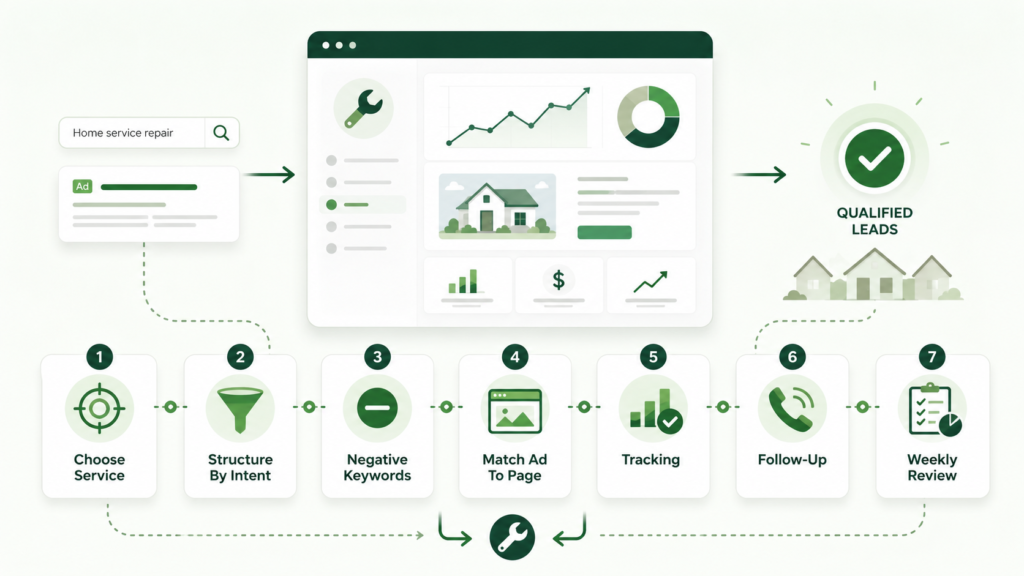
Fixing a home service Google Ads campaign does not start with spending more money. It starts with tightening the system.
Before you increase the budget, you need to look at the offer, keyword intent, location targeting, landing page, tracking, and follow-up process. Google’s Quality Score guidance makes this clear in a practical way: ad performance is connected to expected clickthrough rate, ad relevance, and landing page experience. In other words, the keyword, ad, and page cannot be treated like separate pieces. They need to support the same buyer intent.
Here is where to start.
1. Choose The Service You Want To Sell First
Do not launch one campaign for every service you offer.
Start with a service that is profitable, in demand, and easy to explain. For a plumber, that might be water heater replacement. For an HVAC company, it might be AC repair. For a roofer, it might be roof repair. For a countertop shop, it might be quartz countertop installation or countertop replacement.
This makes the campaign easier to control because the keyword, ad, landing page, offer, and call to action can all focus on one clear service.
2. Separate Campaigns Or Ad Groups By Service And Intent
Emergency plumbing, drain cleaning, bathroom remodeling, and water heater replacement should not all sit inside the same loose campaign structure.
They have different buyers, different urgency levels, different price points, and different landing page needs.
A person searching for “emergency plumber near me” wants fast help. A person searching for “bathroom remodeling contractor” may need proof, photos, reviews, process details, and a consultation path. If both searches are treated the same way, the campaign becomes harder to optimize.
Better structure makes it easier to see which services are producing good leads and which ones are wasting spend.
3. Use Negative Keywords Aggressively
A strong negative keyword list helps protect your budget. Google explains that negative keywords let you exclude search terms from campaigns and focus on the keywords that matter to your customers. For home service PPC, this can be the difference between paying for buyers and paying for people who were never a fit.
Depending on the service, you may need to exclude terms like:
- jobs
- salary
- training
- DIY
- free
- cheap
- parts
- wholesale
- course
- template
- used
The exact list depends on the business. A remodeling company may not want the same negative keywords as an emergency plumber. But the principle is the same: stop paying for searches that do not match the kind of lead you want.
4. Match The Ad To The Landing Page
The ad and landing page should feel like one continuous conversation.
If the ad says “water heater replacement in Dallas,” the landing page should not send the visitor to a general homepage with every service listed. The page should confirm the service, the location, the problem, the proof, and the next step.
That means the page should include a clear headline, relevant service details, trust signals, reviews, project proof where possible, and a simple call or quote path.
This is also part of campaign optimization. Google includes landing page experience as one of the components of Quality Score, which reinforces the point that the page experience is not separate from ad performance.
5. Improve Tracking Before Increasing Budget
Do not spend more until you know what is actually working. At a basic level, you should track:
- Phone calls
- Form submissions
- Quote requests
- Booking requests
- Service requested
- Lead location
- Lead quality
- Estimates created
- Jobs booked
- Revenue from booked jobs
A campaign can look good inside Google Ads and still perform poorly for the business. It may generate clicks and calls, but those calls may be outside your service area, too small, wrong-fit, or not turning into estimates.
The goal is not just lower cost per lead. The goal is better lead quality and more booked work.
6. Create A Follow-Up Process
A paid lead should not disappear into someone’s inbox.
Before you spend more on Google Ads leads, decide who answers calls, who receives form submissions, how fast they respond, how missed calls are handled, and where leads are recorded.
For home service businesses, speed and clarity matter. If a homeowner contacts three contractors and your business responds last, the campaign may lose even when the ad did its job.
Your follow-up process should answer simple questions:
- Who receives the lead?
- How quickly should they respond?
- What happens if the call is missed?
- How many follow-up attempts should happen?
- Where is the lead recorded?
- How do you know whether it became an estimate or a booked job?
7. Review Search Terms And Lead Quality Every Week
Do not optimize only for clicks.
Review the actual search terms people used before clicking your ads. Look for irrelevant searches, weak intent, service mismatches, location problems, and new negative keyword opportunities.
Then review lead quality. Ask which calls became estimates, which forms were serious, which cities produced better jobs, and which services brought the best opportunities.
That is how you fix a failing Google Ads campaign. You do not just raise the budget and hope. You improve the targeting, clean up the keywords, strengthen the landing page, track the real outcomes, and build a follow-up process that can turn paid traffic into real work.
Tracking Matters Because Not Every Lead Is Equal
A home service business does not only need more leads. It needs to know which leads are actually worth paying for.
A campaign may produce calls and form submissions, but that does not mean the campaign is working. Some leads may be outside your service area. Some may ask for services you do not offer. Some may be too small, too price-focused, spammy, or not ready to book. Others may turn into estimates but never become paid work.
That is why Google Ads conversion tracking matters.
Google explains that conversion tracking helps advertisers see whether ad clicks lead to valuable actions, including website actions and phone calls. For service-based businesses, those actions usually include calls, form submissions, quote requests, booking requests, and consultation requests.
Google also explains that phone call conversion tracking can show how ad clicks lead to calls, and that Google forwarding numbers are used for certain call conversion tracking setups.
But tracking should not stop at “call received” or “form submitted.”
A campaign can look successful inside Google Ads and still fail inside the business. If nobody knows whether those calls became estimates, whether the estimates became jobs, or which jobs were actually profitable, the business is still guessing.
At a practical level, you should know:
- Which keyword produced the lead
- Which ad produced the lead
- Which landing page produced the lead
- Whether the lead came through a call or form
- What service the person requested
- What city or service area the lead came from
- Whether the lead became an estimate
- Whether the estimate became a booked job
- What the job was worth
This is where many home service PPC campaigns become misleading. A campaign may have a low cost per lead, but if the leads are weak, the ROI is weak too. Another campaign may look more expensive at first, but if it produces better-fit projects, higher-value estimates, and more booked work, it may be the better campaign.
That is why lead quality matters more than lead volume.
There is also a timing issue. Not every valuable action happens immediately after the click. Advertising research on conversion probability has discussed the problem of delayed conversions, where the value of an ad interaction may not be fully visible right away. That matters for home service businesses because a form submission today may become a quote next week and a booked project later.
So before you increase your Google Ads budget, make sure you can follow the lead beyond the first click. Track the call. Track the form. Track the estimate. Track the booked job. Track the revenue.
Clicks, calls, and forms are useful signals, but they are not the final goal. The real goal is to understand which campaigns are producing quote-ready leads, booked work, and revenue your business can actually measure.
Fast Follow-Up Can Be The Difference Between A Paid Lead And A Lost Job
Campaign performance does not end when the lead arrives. For many home service businesses, the lead is time-sensitive. Someone looking for plumbing repair, roof repair, HVAC service, water heater replacement, or urgent electrical help may not wait hours for a response.
Even for planned services like bathroom remodeling, kitchen remodeling, or countertop installation, the buyer may contact more than one business before deciding who to trust.
That means a slow response can waste a good paid lead.
InsideSales’ ResponseAudit research found that only 7.7% of leads received a response within five minutes. That matters because the first few minutes after a form submission or call request are often when the buyer is still paying attention and still looking for help. (InsideSales)
This is why Google Ads should not be launched without a follow-up process. The campaign may produce the opportunity, but the business can still leak that opportunity after the click.
Before spending more on paid leads, a home service business should know:
- Who answers the phone
- Who receives form submissions
- How fast the team responds
- What happens after a missed call
- How many follow-up attempts happen
- Where each lead is logged
- How estimate requests are tracked
- How booked jobs are connected back to the ad source
This is not just a sales issue. It is part of campaign performance.
A Google Ads campaign may look like it is failing when the real problem is that leads are not being handled well after they arrive. Calls are missed. Forms sit too long. Quote requests are not followed up. No one records what happened. No one knows which paid leads became estimates or booked jobs.
That makes it easy to blame the ads when the full system has not been checked.
Fast follow-up does not mean pressuring the buyer. It means responding while the need is still active, answering questions clearly, and making the next step easy. For service-based businesses, that next step may be scheduling an inspection, booking a consultation, sending project photos, requesting an estimate, or confirming service availability.
The campaign can bring the lead in. But the follow-up process is what gives that lead a real chance to become booked work.
What A Successful Google Ads System Should Look Like
A successful Google Ads campaign for home service businesses is not just a campaign inside Google Ads. It is a complete lead-generation system.
The campaign needs to attract the right searcher, send that person to the right page, make the next step clear, track what happens, and help the business follow up fast enough to turn interest into booked work.
That is why benchmarks should be used carefully. LocaliQ’s home services search advertising benchmarks discuss metrics like conversion rate and cost per lead, but those numbers only become useful when your own tracking is solid. A benchmark can tell you what other advertisers are seeing. It cannot tell you whether your leads are quote-ready, whether your team followed up, or whether those leads became real jobs. (LocaliQ)
A strong Google Ads system for home service lead generation should include:
1. Clear Service Focus
Start with the services that matter most to the business. Do not advertise everything at once just because you offer everything.
A roofing company may start with roof repair. A plumber may start with water heater replacement. A countertop shop may start with countertop replacement or quartz countertop installation. The clearer the service focus, the easier it becomes to build the keywords, ads, landing page, and offer around the same buyer intent.
2. Strong Keyword Intent
The campaign should be built around searches that suggest real commercial intent.
There is a difference between someone searching “how to fix a leaking pipe” and someone searching “emergency plumber near me.” There is a difference between “kitchen ideas” and “kitchen remodeling contractor.” A strong home service PPC strategy separates research searches from quote-ready searches so the budget is not wasted on the wrong intent.
3. Clean Location Targeting
Home service businesses need location targeting that matches where they actually want work.
If the campaign brings leads from cities you do not serve, jobs that are too far away, or areas that do not make sense for your pricing and crew schedule, the campaign may create activity without producing profitable work.
4. Negative Keywords
A successful Google Ads campaign also needs a negative keyword list.
Google explains that negative keywords help prevent ads from showing on searches with excluded terms. For paid ads for contractors and home service businesses, this can help reduce wasted ad spend from searches related to jobs, salaries, DIY help, free advice, training, parts, or other low-fit terms. (Google Ads Help)
5. Service-Specific Landing Pages
The landing page and ads need to match.
If the ad is about roof repair, the landing page should be about roof repair. If the ad is about countertop installation, the page should explain countertop installation. Sending every paid click to the homepage usually creates more friction than clarity.
This is also why the website matters before ads. A stronger service page, quote path, and buyer-focused page structure can make the paid campaign easier to trust and easier to act on. For countertop shops, this connects directly to the wider marketing system explained in the guide on how to market a countertop business.
6. A Clear Offer
The visitor should know what to do next.
That next step may be calling for emergency service, requesting an estimate, booking a consultation, scheduling a showroom visit, or submitting project details. A vague “contact us” button may not be enough if the buyer is unsure what happens after they reach out.
7. Reviews And Trust Proof
Paid traffic still needs trust.
The landing page should include reviews, testimonials, project photos, service-area proof, license or insurance details where relevant, and anything else that helps the buyer feel safer contacting the business.
This is especially important for higher-consideration services like remodeling, cabinetry, countertop installation, roofing, and major home repairs. Buyers are not only comparing prices. They are comparing trust.
8. Mobile-Friendly Page Experience
Many home service searches happen when people are ready to act. If the page is slow, difficult to read, hard to tap, or confusing on mobile, the campaign can lose leads before the buyer even understands the offer.
A good Google Ads system needs a mobile-friendly page with a clear headline, visible phone number, simple form, strong proof, and an obvious next step.
9. Call And Form Tracking
Campaign tracking should show more than clicks.
The business should know which campaign, keyword, ad, and landing page produced each call or form submission. Google Ads conversion tracking can help advertisers measure valuable actions, including calls and website conversions, instead of guessing what happened after the click. (Google Ads Help)
10. A CRM Or Lead Log
A lead should not disappear into a phone call, inbox, or notebook.
Even a simple lead log can help the business track the service requested, city, lead source, estimate status, job status, and job value. This is where Google Ads management becomes more connected to the real business, not just the ad account.
11. Fast Follow-Up
Paid leads need a response process.
Who answers the phone? Who receives the form? What happens after a missed call? How fast should the team respond? How many follow-up attempts should happen before the lead is marked inactive?
Without follow-up, even a good campaign can lose good opportunities.
12. Weekly Search Term And Lead Quality Review
A Google Ads system should be reviewed regularly.
That means checking search terms, adding negative keywords, reviewing lead quality, comparing landing pages, and looking beyond cost per lead. The goal is not only cheaper leads. The goal is better-fit leads that can turn into estimates and booked jobs.
13. A Closed-Job Feedback Loop
The strongest campaigns eventually connect ads to revenue.
That means the business should know which leads became estimates, which estimates became jobs, and which jobs were worth the spend. Without that feedback loop, campaign optimization stays incomplete.
A campaign that produces more form submissions is not always better. A campaign that produces fewer but better jobs may be more valuable.
So the real goal is not just to “run Google Ads.” The goal is to build a Google Ads system that connects targeting, landing pages, tracking, follow-up, and sales outcomes.
If your home service business is paying for clicks but not getting enough calls, quote requests, or booked jobs, request a digital marketing review from 95 Green Shark.