
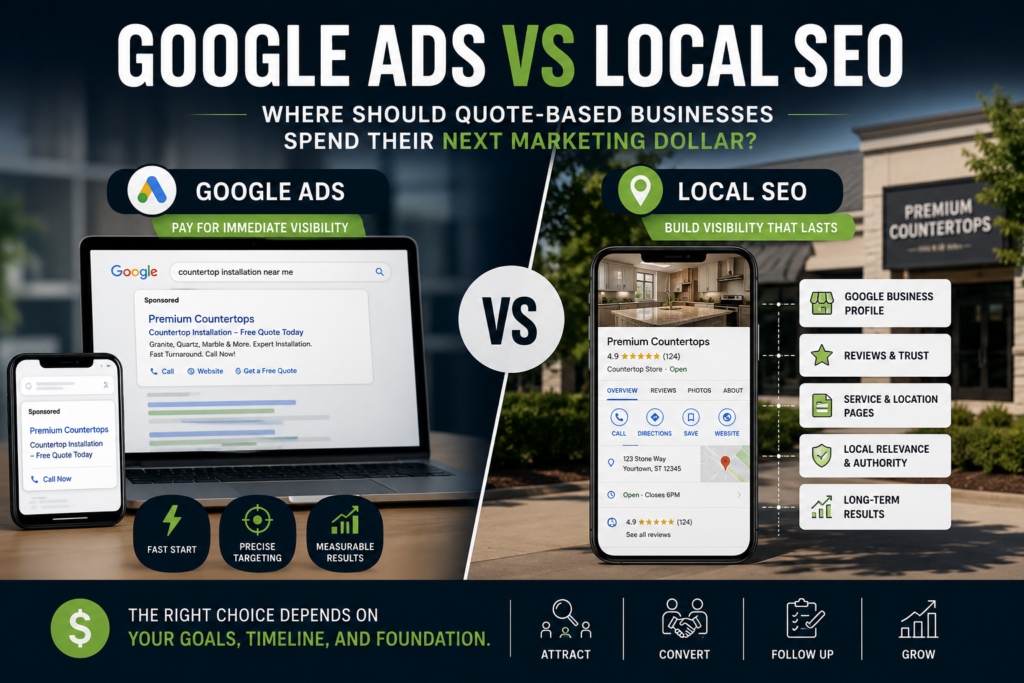
Google Ads vs. Local SEO For Quote-Based Businesses: Where Should You Spend First?
The debate about Google Ads vs. local SEO is usually framed badly.
You are told SEO is the “long-term investment,” and Google Ads is the “fast way to get leads.” Technically true. Practically useless.
A quote-based business does not need the channel with the nicest marketing argument. It needs the channel most likely to produce qualified opportunities at the stage the business is in right now.
If your phone is quiet and your crews need work next week, waiting for organic rankings to improve may be a terrible decision.
If you are already spending thousands every month buying clicks while competitors keep owning Maps, local search results, reviews, and high-intent service pages, pouring more money into Google Ads may be just as foolish.
Google Ads can put your business in front of existing demand quickly. Local SEO can build visibility, trust, and search assets that continue working without charging you for every click.
Neither automatically wins. The real question is much more useful:
Given your website, reputation, market, budget, and need for leads today, where should your next marketing dollar actually go?
Google Ads vs. Local SEO: What Is The Real Difference?
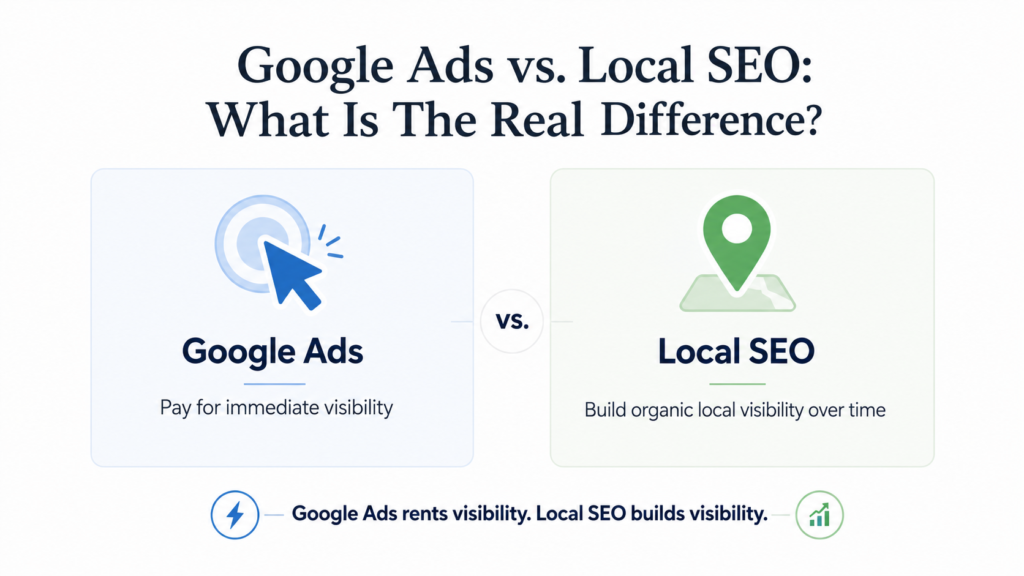
Google Ads and local SEO can both put a quote-based business in front of people already looking for a service. The difference is how you earn that visibility and how long it lasts.
Google Ads: You Pay For Immediate Access To Demand
With Google Ads, you pay to appear for selected searches.
A roofer might target “roof replacement near me.” A countertop shop might target “quartz countertops in Dallas.”
Once the campaign is running, the business can potentially appear almost immediately. That speed is the biggest advantage.
The trade-off is simple: when the ad spend stops, the paid visibility stops too.
Local SEO: You Build Visibility Over Time
Local SEO works differently.
Instead of paying for each click, you improve the parts of your online presence that help Google understand when and where your business should appear, including:
- Your website
- Google Business Profile
- Reviews
- Service pages
- Location pages
- Local relevance and authority
Google explains that SEO helps search engines understand your content and helps people find your site through search. For local results specifically, Google says visibility is primarily influenced by relevance, distance, and prominence. (Google SEO Starter Guide) (Google Business Profile Help)
The Simplest Way To Think About It
Google Ads rents visibility. Local SEO builds visibility.
That does not mean SEO is free.
You may still spend money on content, technical fixes, website improvements, review generation, local pages, and ongoing optimization. Google also notes that some SEO changes can take weeks or even months to show their full effect. (Google SEO Starter Guide)
A plumbing company that needs calls this month may lean on Google Ads first. That same business can also work on local SEO so it becomes less dependent on paying for every future click.
Neither channel should sit on its own. As we explain in our guide on how to market a countertop business, visibility works best when it connects to trust, conversion, and follow-up.
What Does Google Ads Give A Quote-Based Business That SEO Cannot Give Immediately?
The biggest advantage of Google Ads is speed with control.
If your business needs leads now, you may not have the luxury of waiting for stronger organic rankings to develop. That is especially true if you are:
- launching a new business
- entering a new service area
- trying to fill an empty installation calendar
- approaching a seasonal rush
- promoting a high-margin service
- starting from almost no organic visibility
A countertop shop expanding into a new city, for example, could run ads for searches such as “quartz countertops near me” while its new location pages are still gaining organic visibility.
You Can Decide What Demand You Want To Chase
Google Ads gives you much tighter control over where your money goes.
You can choose the services and searches you want to target, define geographic areas, control your budget, send visitors to specific landing pages, test different offers, and measure what happens afterward.
That makes paid search particularly useful when you already know what type of work you want more of.
A remodeler that wants more kitchen projects does not have to advertise every service it provides. It can build a campaign around kitchen remodeling and direct those searches to a page specifically designed for that service.
But getting the click is only the beginning.
A Lead Is Not The Finish Line
For quote-based businesses, the real journey looks more like this:
Search → Click → Inquiry → Qualified Opportunity → Quote → Booked Job → Revenue
That distinction matters.
A campaign that generates 30 form submissions is not necessarily performing better than one that generates 12. If most of those 30 inquiries are outside your service area, looking for services you do not provide, or never respond after the first call, they have limited business value.
Google’s conversion measurement tools allow advertisers to define valuable actions such as website inquiries and phone calls and then see which campaigns, ads, and keywords are driving them. Google specifically recommends conversion measurement for understanding ROI and making better-informed advertising decisions. (Google Ads Help)
Google’s Smart Bidding options can then optimize campaigns around conversion goals. For businesses focused on leads, Google lists strategies such as Maximize Conversions and Target CPA, rather than simply optimizing around generating more clicks. (Google Ads Help)
The Better Question Is: Which Ads Produced Booked Work?
This is where quote-based businesses should eventually become more sophisticated.
Suppose a roofing company generates two leads:
- Lead A: requests a quote but never answers again.
- Lead B: receives an estimate and signs a $15,000 roofing contract.
Both may initially appear as one conversion inside an advertising report.
They clearly are not worth the same thing.
Google supports importing offline conversions so businesses can connect later sales activity back to the advertising interaction that originally generated the lead. (Google Ads Help)
That means a countertop shop, roofer, remodeler, HVAC company, or other quote-based business should eventually be able to answer something more valuable than: How many leads did Google Ads generate?
It should be working toward: Which campaigns generated qualified opportunities, quotes, booked jobs, and actual revenue?
That is one of the strongest advantages Google Ads can offer when the tracking behind it is built properly.
What Does Local SEO Give You That Google Ads Cannot?
Google Ads can buy immediate visibility. Local SEO can create multiple ways for buyers to keep finding your business without paying for every visit.
That is its biggest advantage.
Local SEO Creates More Than One Door Into Your Business
A local customer may discover you through:
- Google Maps
- your Google Business Profile
- an organic service page
- a city or service-area page
- a material or product page
- an educational article
- a branded search
- reviews while comparing several businesses
Consider a countertop shop serving several cities. A well-developed page targeting countertop installation in one of those markets could continue attracting relevant searches long after the page was published. You are investing in the asset rather than purchasing each individual click.
That does not mean the traffic is free. Building and maintaining those assets still costs time and money. The difference is that there is no direct charge every time somebody clicks an organic result.
Local Visibility Can Compound
SEO assets can also support one another.
A useful service page strengthens the website. Location pages expand your relevance across genuine service areas. Project pages provide evidence of completed work. Reviews strengthen trust when buyers compare businesses.
And those assets are not valuable only when someone arrives organically.
A homeowner might click a Google Ad, recognize the company’s strong review profile, visit its project gallery, read a service page, and then request a quote.
So the SEO investment can make your paid traffic more convincing too.
Google says its local results are primarily based on three factors: relevance, distance, and prominence. Relevance is how well a business matches the search, distance considers how far the business is from the searcher or specified location, and prominence reflects how well known the business is. Google also specifically points to information completeness, reviews, and links among the factors that can influence local visibility. (Google Business Profile Help)
And unlike paid ads, businesses cannot simply pay Google for a better organic local ranking. Google explicitly says there is no way to request or pay for a better local ranking. (Google Business Profile Help)
Reviews Make That Visibility More Valuable
Ranking is only useful if the person who finds you believes you are worth contacting.
BrightLocal’s Local Consumer Review Survey continues to show how deeply reviews are built into the way consumers research and evaluate local businesses. (BrightLocal Local Consumer Review Survey)
That means the real value of local SEO is not simply: “We rank on Google.”
It is: “People can find us, verify that we serve what they need, see evidence that other customers trust us, and move toward requesting a quote.”
Local discovery also extends beyond one website listing. BrightLocal’s research into business listings shows that consumers encounter local business information across search engines, directories, maps, and other platforms, making accurate and visible business information part of the larger discovery process. (BrightLocal Business Listings Visibility Study)
For a quote-based business, that creates something Google Ads alone cannot provide: a growing local presence that can continue influencing buyers before, during, and even after the initial search.
Which One Produces Better Leads: Google Ads Or Local SEO?
Neither channel automatically produces better leads.
Lead quality depends on what the person searched for, how well the campaign or page matched that intent, how credible the business looked, how strong the offer was, and what happened after the inquiry came in.
That means the better question is not: Which channel gets more leads?
It is: Which channel produces more qualified opportunities and booked work?
Google Ads vs. Local SEO For Lead Quality
| Factor | Google Ads | Local SEO |
| Speed to visibility | Faster | Usually slower |
| Control over keywords | High | Lower |
| Geographic control | High | Influenced by local relevance and proximity |
| Cost per visit | Direct | No charge per organic click |
| Long-term compounding | Limited when spend stops | Stronger potential |
| Testing offers | Excellent | Slower |
| Dependence on reviews and trust | High | High |
| Landing-page quality matters | Very high | Very high |
| Measurement | Highly configurable | Requires Search Console, analytics, and lead tracking |
Google Ads gives you more immediate control over who you try to reach. Local SEO gives you broader opportunities to be discovered across Maps, service pages, location pages, and other organic results.
But neither channel can rescue a poor buying experience.
Both Can Fail For The Same Reason: A Weak Website
A homeowner clicks your ad.
Or finds you organically.
They still land on the same business.
If the website has vague service descriptions, weak project proof, unclear service areas, poor reviews, no obvious quote CTA, or a bad mobile experience, the traffic source is not the real problem.
Google’s own Ads guidance emphasizes the connection between relevant ads, landing pages, and clear calls to action when trying to improve conversion performance. (Google Ads Help)
For local businesses, Google also recommends clearly providing business details through structured information such as location, hours, and other LocalBusiness data so search engines can better understand the business. (Google Search Central)
This is why traffic acquisition should never be treated as the whole strategy.
As we explain in our guide on how to market a countertop business, the stronger system is:
Visibility → Trust → Conversion → Follow-Up
Google Ads and local SEO mainly solve the first part.
Whether that visibility turns into revenue depends on everything that happens next.
Local SEO Vs. Google Ads: Where Should You Spend First?
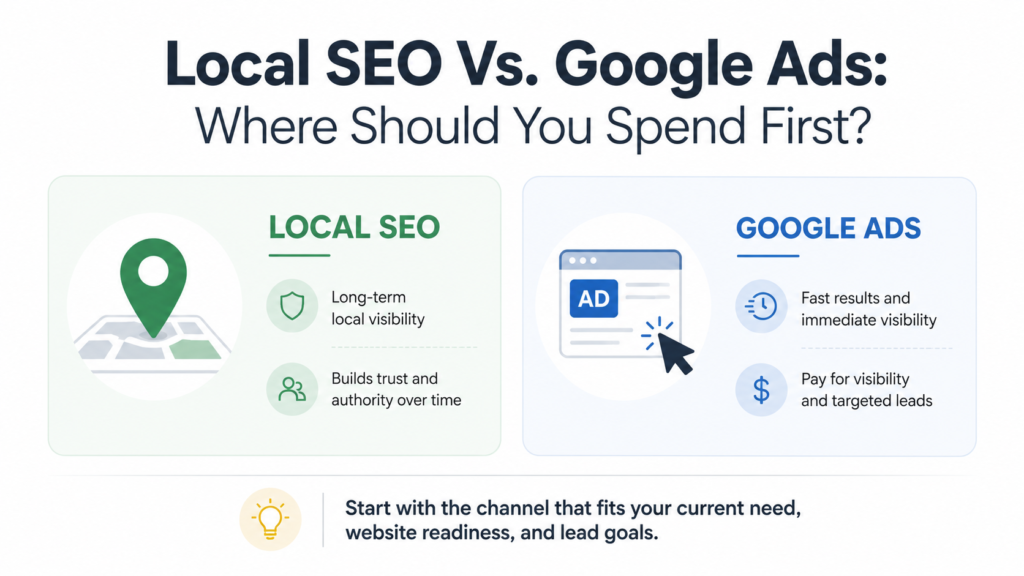
This is where the answer has to become practical.
There is no universal winner between Google Ads and local SEO. The right first investment depends on what your business already has, how quickly you need leads, and where the biggest weakness currently sits.
Start With Google Ads First When
Google Ads makes more sense as the first move when:
- You need qualified inquiries quickly
- Your website already has strong service or landing pages
- You have enough reviews, project proof, and credibility to support the click
- You know which services or locations you most want to sell
- You can afford to test without expecting every click to become a customer
- Your conversion tracking is reliable
- Your team can respond quickly when leads come in
A remodeling company with a strong kitchen remodeling page, solid reviews, and an empty project calendar next month may be in a good position to use paid search aggressively.
The important part is that the traffic has somewhere strong to go.
Google’s own guidance emphasizes that relevant landing pages and clear calls to action are central to improving conversion performance. (Google Ads Help)
Start With Local SEO First When
Local SEO deserves priority when:
- Your website barely appears for valuable local searches
- Your Google Business Profile is weak or incomplete
- You lack proper service or location pages
- Your reviews significantly trail the businesses you compete with
- You can invest patiently in long-term visibility
- Your business relies heavily on a specific local service area
- You want to reduce how dependent you are on paying for every visit
For example, a countertop shop serving five cities but having only one generic service page may have a bigger structural SEO problem than an advertising problem.
Reviews matter here too. BrightLocal’s consumer research continues to show that reviews play a major role in how people evaluate local businesses before choosing whom to contact. (BrightLocal Local Consumer Review Survey)
Fix Your Website First When
Sometimes the right answer is neither.
Do not pour more money into traffic if the website:
- does not clearly explain what you do
- looks untrustworthy
- has little or no project proof
- makes contact information difficult to find
- performs badly on mobile
- sends every visitor to one generic homepage
More traffic does not repair those problems.
It simply sends more people into them.
A roofer could double its ad budget tomorrow, but if visitors land on a weak page with no reviews, no recent projects, no clear service area, and no obvious way to request an estimate, the campaign may simply make the weakness more expensive.
That leads to a useful rule: Spend first on the bottleneck closest to the customer.
- If the problem is visibility, invest in Ads or SEO.
- If the problem is trust or conversion, fix the website and reputation first.
- If the problem is follow-up, generating even more leads may be the wrong investment entirely.
Should Quote-Based Businesses Eventually Use Google Ads And Local SEO Together?
Yes. In many cases, that is the stronger long-term strategy. The important thing is understanding how the two channels help each other.
Use Google Ads To Capture And Test Demand
Suppose a countertop shop runs ads for: “quartz countertops near me”
That campaign can quickly show:
- Whether the search produces inquiries
- Which cities respond
- Which ad messages get attention
- Which services generate better leads
- Which landing pages convert better
Google Ads conversion measurement can then help the business connect those campaigns to actual actions such as calls and form submissions rather than judging performance by clicks alone. (Google Ads Help)
That information can shape the SEO strategy that follows.
Use SEO To Build Around What You Learn
If quartz searches repeatedly produce strong inquiries, the business now has a clearer reason to invest in:
- a stronger quartz service or material page
- relevant city and location pages
- project examples
- supporting FAQs
- stronger Google Business Profile content
- more reviews connected to that type of work
Google Search Console can then show which organic queries, pages, clicks, and impressions are growing over time. (Google Search Console)
Eventually, the same business may appear in both paid and organic results for searches that matter most.
The Better Strategy Is Not “Pick One Forever”
A useful principle is: Use paid search to capture and test demand. Use SEO to build the infrastructure that keeps you visible around that demand.
For a countertop shop, that could mean using Google Ads to generate opportunities now while local SEO steadily strengthens the pages, reviews, project proof, and local relevance that can support future visibility.
As we explain in our broader guide on how to market a countertop business, the strongest marketing systems connect visibility with trust, conversion, and follow-up rather than treating one channel as the whole strategy.
That same idea sits behind our digital marketing services for countertop shops: paid media, SEO, website structure, and lead generation work better when they support the same commercial goals rather than operating as separate campaigns.
Where Should Your Next Marketing Dollar Go?
Google Ads and local SEO solve different problems. If you need visibility and qualified inquiries quickly, Google Ads can give you faster access to existing demand.
If your business barely appears in local search, lacks strong service and location pages, or depends too heavily on paid traffic, local SEO may deserve the bigger share of your attention.
And if your website is weak, neither channel should be your first priority. The better approach is to identify the real bottleneck:
- Visibility problem? Invest in Google Ads or local SEO.
- Trust problem? Strengthen reviews, project proof, and credibility.
- Conversion problem? Fix the website and landing pages.
- Follow-up problem? Improve how leads are handled before generating more of them.
For many established quote-based businesses, the strongest long-term strategy is not choosing Google Ads or local SEO permanently.
It is using paid search to capture and test demand now while SEO builds the visibility, authority, and local assets that can keep producing opportunities over time.
Not Sure Which One Your Business Needs First?
95 Green Shark helps quote-based businesses figure out where their marketing is actually breaking down before they spend more trying to fix the wrong thing.
Whether the problem is paid media, local SEO, website conversion, or the way your lead-generation system fits together, we can help you find the gap and build around it.