
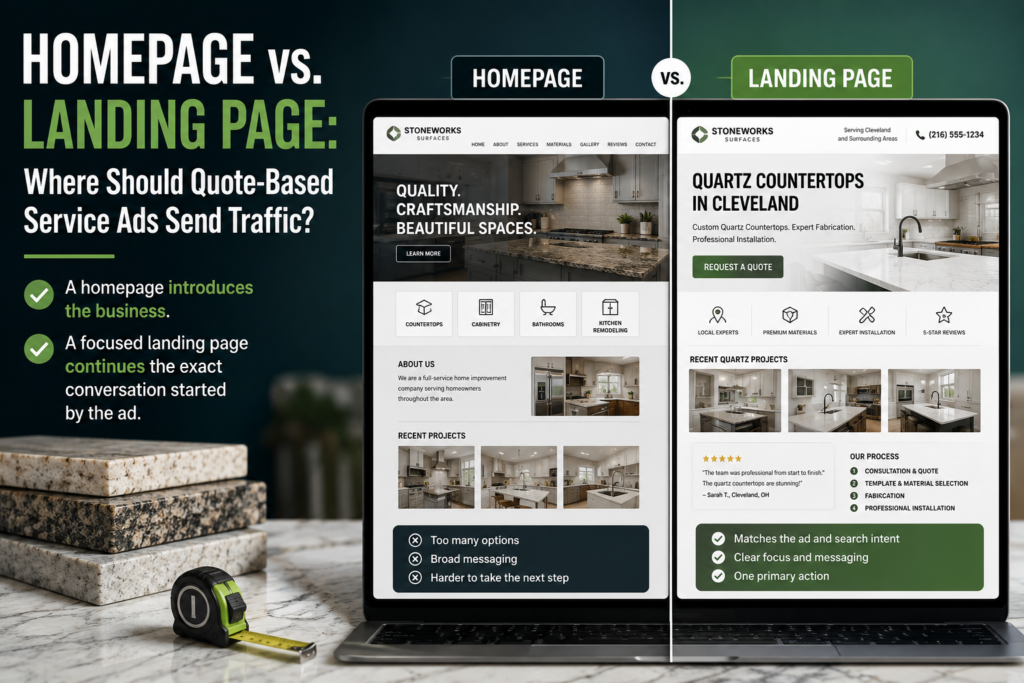
Homepage vs. Landing Page: Where Should Home-Service Ads Send Traffic?
Most paid-search mistakes do not happen in the ad account. They happen after the click.
A homeowner searches for “roof replacement in Dallas,” “AC repair near me,” or “quartz countertops in Cleveland.” The ad matches the need, earns the click, and then sends that person to a homepage built to explain the entire business.
That creates a disconnect.
A homepage is designed to serve many visitors with many intents. A landing page is designed to continue one specific conversation and move one buyer toward one action.
For quote-based service businesses, that distinction matters because every paid click has a cost. The more specific the search, service, location, or offer, the stronger the case for sending that traffic to a page that matches it directly.
Homepage vs. Landing Page: What Is The Real Difference?
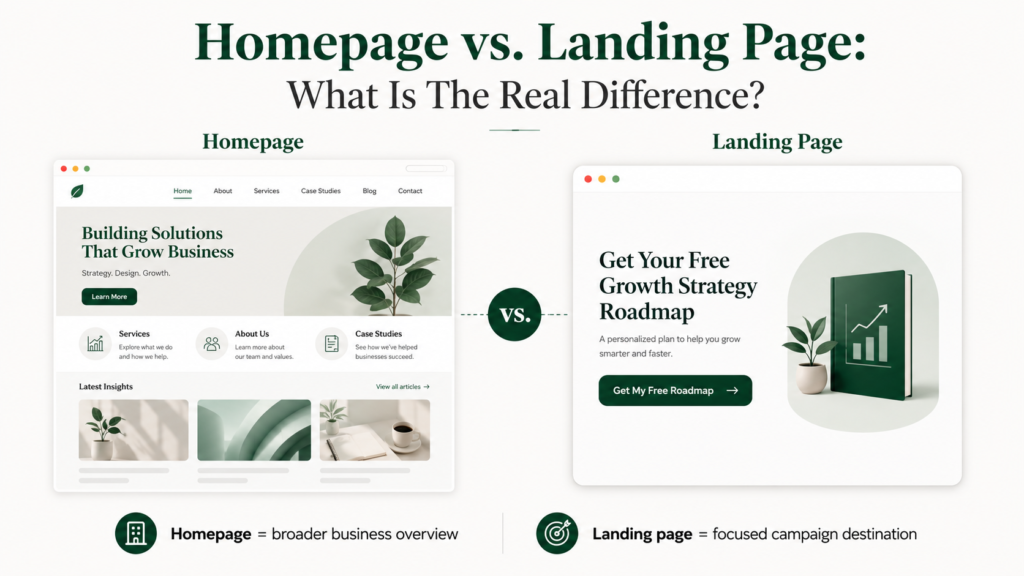
The difference is primarily purpose. A homepage is built to introduce the business as a whole. A landing page is built around a narrower visitor intent and a clearer next action.
A Homepage Has To Serve Many Different Visitors
Your homepage may need to explain:
- What services you provide
- Which areas you serve
- What makes the business credible
- Reviews and project examples
- Company information
- Several ways to contact or explore the site
That breadth makes sense for someone trying to understand the business.
But it can also create unnecessary work for somebody who has already told you exactly what they want through their search.
A Landing Page Continues A More Specific Conversation
A strong landing page focuses much more closely on the reason someone clicked.
For example:
Ad: Roof Replacement In Dallas
Landing page: Dallas roof replacement services, relevant project proof, reviews, financing or estimate information, and a clear quote CTA.
Or:
Ad: Quartz Countertops In Cleveland
Landing page: Quartz options, local project examples, installation information, reviews, and a request-a-quote CTA.
Google recommends keeping your landing page closely aligned with the keyword, ad, and call to action so visitors find what they expected after clicking. (Google Ads Help)
That gives us the simplest distinction:
- A homepage answers, “Who are we and what do we do?”
- A strong landing page answers, “Can you solve the specific problem I just searched for?”
Unbounce makes a similar distinction: homepages typically encourage visitors to explore multiple parts of a business, while campaign landing pages are designed around a much more focused goal and CTA.
A Landing Page Does Not Have To Be A Separate Funnel Website
This is where businesses sometimes overcomplicate things. You do not necessarily need to build a completely separate page outside your main website for every ad.
A strong existing service page or location page can function as the landing page if it closely matches the search and ad.
An HVAC company advertising AC replacement in Phoenix, for example, may already have a strong Phoenix AC replacement page with reviews, service details, proof, and a quote form.
That page may be the right destination.
The real question is not whether the URL is technically called a “landing page.”
It is whether the page is relevant, useful, easy to navigate, and consistent with what the visitor expected when they clicked—the same qualities Google emphasizes when discussing landing-page experience. (Google Ads Help)
Why Sending Every Service Ad To The Homepage Can Waste Good Traffic
“We already have a website, so just send the ads to the homepage.” That is convenient but not always smart.
The problem is that paid-search visitors usually arrive with a much narrower intent than the average homepage visitor.
Someone searches: granite countertops near me, then lands on a homepage talking about:
- Kitchen remodeling
- Cabinetry
- Bathrooms
- Countertops
- Several materials
- The company story
- Multiple navigation options
The business has already paid for the click, but the visitor still has to work to find the answer they came for.
That is unnecessary friction.
Google specifically recommends aligning the keyword, ad, landing page, and CTA so the destination matches what the visitor expected when they clicked. (Google Ads Help)
The More Specific The Search, The More Specific The Destination Should Be
For example:
- Search: Quartz countertops in Denver
- Weak destination: Generic homepage
- Stronger destination: Quartz countertop page built for Denver-area buyers
OR
- Search: Emergency AC repair near me
- Weak destination: Homepage covering installations, maintenance, indoor air quality, and commercial HVAC
- Stronger destination: Emergency AC repair page with service-area details and a call CTA
OR
- Search: Roof replacement financing
- Weak destination: About page
- Stronger destination: Roof replacement page that explains financing and estimate options
Google’s Quality Score guidance reinforces this same principle by recommending consistent messaging from the ad through to the landing page. (Google Ads Help)
The point is not that homepages are bad. It is that a broad page can be a poor response to a specific search, and when you are paying for the visit, that mismatch matters even more.
As we explained in our guide to Google Ads vs. Local SEO for quote-based businesses, buying visibility is only useful when the page receiving that traffic is capable of turning the right visitors into real inquiries.
When Is The Homepage Actually The Right Place To Send An Ad?
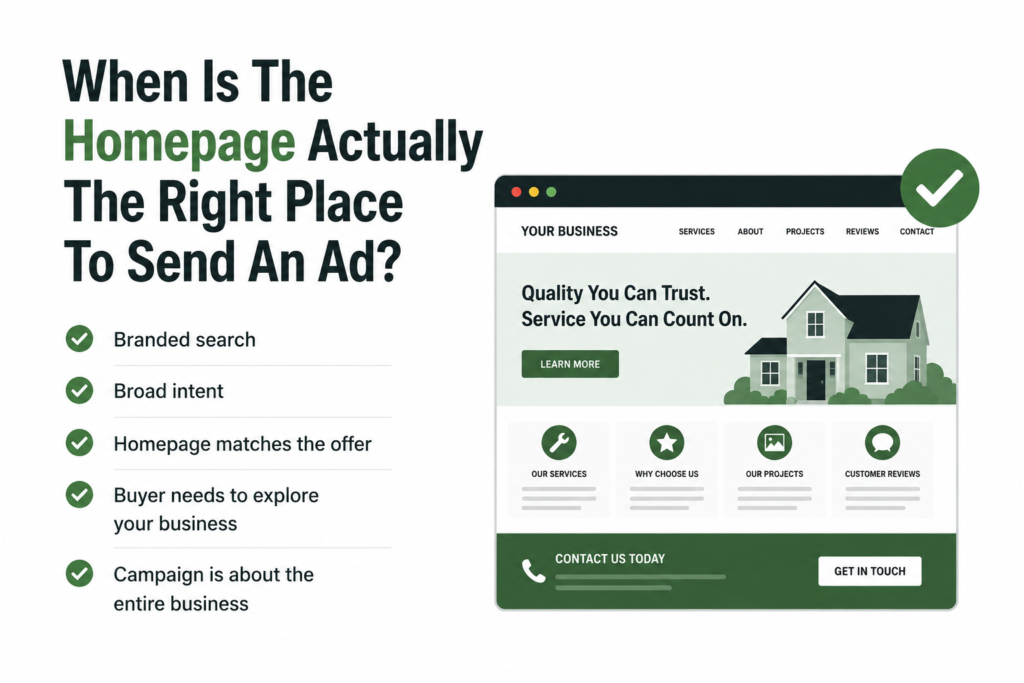
The homepage is not automatically the wrong destination. It can be the right choice when the visitor’s intent is still broad.
Use The Homepage When The Search Is About The Business Itself
Someone searching for your company name is often trying to understand the business as a whole.
They may want to see:
- What you offer
- Where you work
- What your projects look like
- What customers say
- How established the company is
- How to contact you
In that case, the homepage can be exactly the right destination.
It Can Also Work When The Business Is Very Focused
A small countertop fabricator whose homepage already centers almost entirely on fabrication and installation may not need a separate ad page for every campaign.
The same applies to a roofer that offers one core service or an HVAC company running a broad brand-awareness campaign.
If the homepage already matches the ad closely, forcing a separate landing page may add complexity without adding much value.
Broad Intent Gives The Homepage More Room
HubSpot’s comparison of websites and landing pages makes the distinction clearly: a website is designed to help people explore a business more broadly, while a landing page is usually tied to a more specific campaign or conversion goal. (HubSpot)
That leads to a useful rule:
- The broader the search intent, the more acceptable the homepage becomes.
- The more specific the search intent, the stronger the case for a focused landing page.
A branded search can reasonably go to the homepage. A search for “24-hour emergency plumber in Atlanta” probably should not.
What Should A Home-Service Business Landing Page Actually Include?
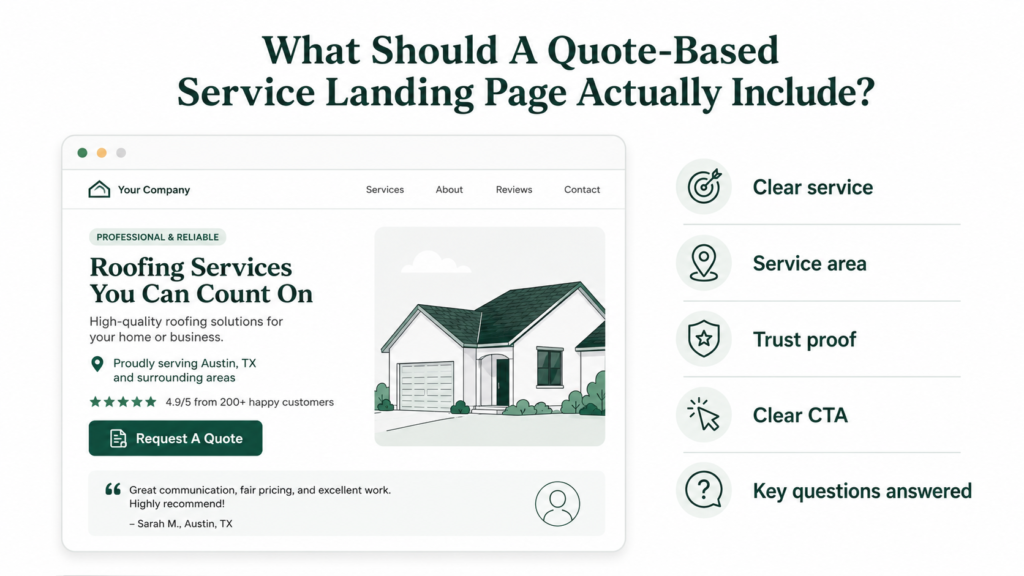
A focused landing page should not be confused with a thin page.
For a homeowner considering a roof replacement, countertop installation, landscaping project, flooring job, or major remodel, a headline and oversized form are rarely enough. The page still has to answer the questions that determine whether that visitor trusts you enough to request a quote.
Make The Service Immediately Clear
The visitor should not have to figure out whether you provide what they searched for. If the ad promotes “Roof Replacement In Denver,” the page should immediately continue that conversation, not lead with a generic message about “quality home services.”
The same applies to AC replacement, kitchen remodeling, quartz countertops, hardwood flooring, or landscape design.
Google’s advertising policies require destinations to be functional and useful, while its Quality Score guidance considers how relevant and useful the landing-page experience is to people who click the ad. (Google Ads Destination Requirements) (Google Ads Help)
Tell Them Where You Actually Work
Quote-based services are usually location-dependent, so make the service area clear. A homeowner should not reach the bottom of the page before discovering that you do not serve their city.
This can be as simple as clearly stating the primary city, surrounding service areas, or the radius in which the business accepts projects.
Give Them A Reason To Trust You
The click gets the visitor onto the page. Proof helps move them toward the inquiry.
Depending on the business, that can include:
- Real completed projects
- Customer reviews
- Years of experience
- Licenses or relevant credentials
- Showroom, workshop, or team photos
- Before-and-after examples
- Warranties or guarantees where applicable
A countertop shop might show an installed quartz kitchen. A roofer might show recent replacements. A landscaper might show finished outdoor projects. Use real evidence, not just claims like “trusted,” “experienced,” or “high quality.”
Make The Next Step Obvious
The visitor should know what to do when they are ready.
Depending on the service, that could be:
- Request A Quote
- Call Now
- Schedule An Estimate
- Book A Consultation
- Send Your Project Details
You do not need five competing CTAs. You need a clear primary action that matches what the ad promised.
Answer Enough Questions To Reduce Hesitation
The page may also need to explain:
- How the service works
- What options are available
- What happens after the inquiry
- Common buyer questions
- Project or scheduling expectations
- Financing, where relevant
- What information the customer needs before requesting an estimate
The exact content will depend on the size and complexity of the purchase.
That is why the idea that a landing page should always be “headline + three bullets + giant form” is too simplistic for quote-based services.
A $15,000 roof, kitchen remodel, or countertop project requires more confidence than an impulse purchase.
As we explain in our guide on how to market a countertop business, visibility is only the beginning of the journey:
Visibility → Trust → Conversion → Follow-Up
The ad handles much of the visibility.
The landing page has to earn the trust and make the conversion feel like the logical next step.
Should Every Ad Campaign Get Its Own Landing Page?
No. Creating a separate landing page for every keyword usually creates more maintenance than value. The better approach is to group ads by meaningful intent.
Build Pages Around What The Buyer Actually Wants
For example:
Material intent
- Quartz countertops
- Granite countertops
- Quartzite countertops
Service intent
- Countertop installation
- Countertop replacement
- Stone fabrication
Location intent
- Countertops in Cleveland
- Countertops in Akron
- Countertops in Columbus
The page should change when the service, location, offer, or buyer intent changes enough to justify a different experience.
A useful rule is: One meaningful intent = one strong destination.
Not: One keyword = one landing page.
That keeps campaigns easier to manage and avoids creating dozens of thin pages that say almost the same thing.
Existing SEO Pages Can Often Do Double Duty
A strong service or material page may already be able to support:
- Organic search
- Google Ads
- Internal linking
- AI search visibility
- Buyer education
A well-built quartz page, for example, can rank organically, receive paid traffic from quartz campaigns, answer buyer questions, show project proof, and move visitors toward a quote.
That is far more efficient than building throwaway pages that exist only because an ad campaign needs somewhere to send traffic.
This is also where paid and organic strategy should start working together. As we explain in our guide on Google Ads vs. Local SEO for quote-based businesses, paid search can help test demand while SEO builds the pages and visibility around the searches that matter most.
And in our broader guide on how to market a countertop business, the same principle applies: the strongest marketing assets should support more than one stage of the buyer journey whenever possible.
A good landing page should not feel disposable.
It should be useful enough to support paid traffic today and valuable enough to strengthen the rest of the website over time.
How Much Can A Weak Landing Page Cost You?
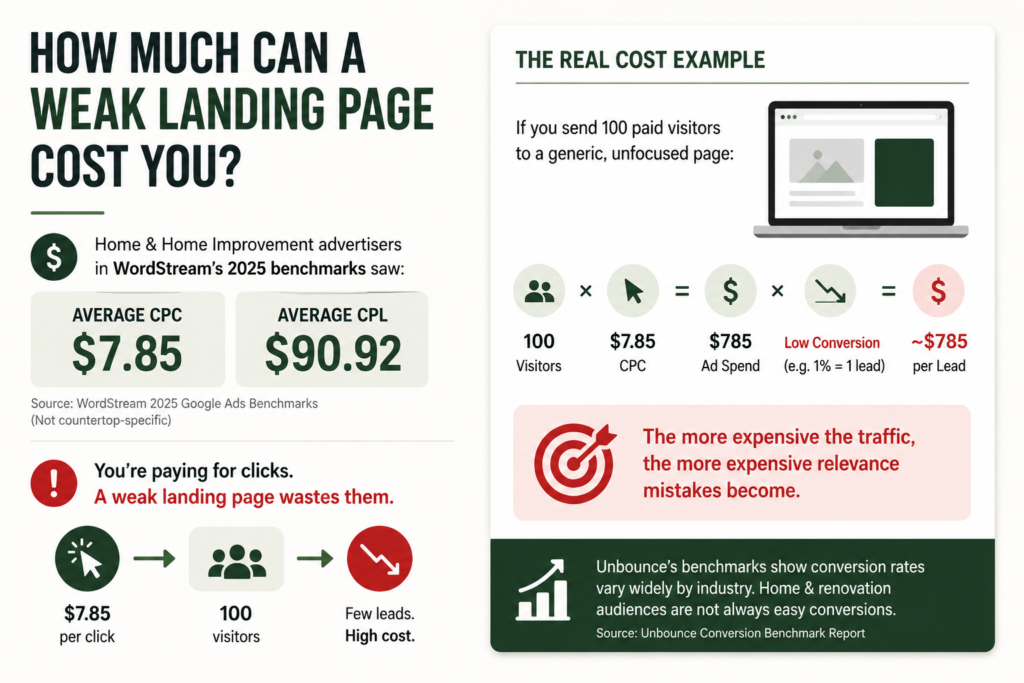
This is where the argument stops being about design and starts being about money.
WordStream’s 2025 Google Ads benchmark data reported an average $7.85 cost per click and $90.92 cost per lead for advertisers in the Home & Home Improvement category. These figures are not countertop-specific, but they show how expensive paid traffic can become in quote-based home services.
So imagine you are paying several dollars for every click and sending 100 visitors to a generic page that only loosely matches what they searched for.
That is not just a website problem.
It is a media-spend problem.
The More Expensive The Click, The More Expensive The Mismatch
A roofer paying for “roof replacement in Denver” does not want visitors landing on a homepage where they still have to find the roof replacement service.
An HVAC company paying for “AC installation near me” does not want the user buried inside pages about maintenance, heating, commercial HVAC, and indoor air quality.
Every unnecessary step gives the visitor another chance to leave after you have already paid to get them there.
This does not mean every landing page will convert at some guaranteed rate.
Unbounce’s benchmark data shows exactly why we should avoid that claim. Its commercial and professional services dataset had a median landing-page conversion rate of 6.1%, but performance varied significantly by subindustry. Repair and maintenance pages converted almost three times better than home and renovation pages in its data.
That difference makes sense: someone with a broken AC may need help today, while someone considering a kitchen remodel may spend weeks comparing options.
The useful takeaway is simpler: The more expensive the traffic, the more expensive relevance mistakes become.
A landing page does not need to be magical. It needs to give the paid visitor a clearer, more relevant path to becoming a qualified inquiry.
Where Should Your Ads Actually Send Traffic?
The right destination depends on how specific the search is and what the visitor needs to do next.
Send Traffic To The Homepage When:
- The search is branded
- The intent is broad
- The homepage already closely matches the offer
- The visitor genuinely needs to understand the wider business
- The campaign is introducing the company rather than promoting one specific service
Someone searching your company name, for example, may reasonably want to see your services, reviews, projects, locations, and company information before deciding what to do next.
Send Traffic To A Focused Landing Page When:
- The search is service-specific
- The campaign targets one location
- The offer is specific
- The visitor is looking for one particular solution
- You want one clear conversion action
- The homepage would force them to hunt for the relevant information
A search for “water damage restoration in Atlanta” should probably lead somewhere very different from a broad restoration-company homepage.
The same applies to roof replacement, AC installation, kitchen remodeling, quartz countertops, or landscape design campaigns.
Fix The Page Before Increasing The Ad Budget When:
Sometimes the destination itself is the bottleneck.
Pause before spending more if the page:
- Loads slowly
- Performs poorly on mobile
- Lacks reviews or project proof
- Has an unclear CTA
- Does not clearly explain the service area
- Barely matches the ad
- Makes calling or requesting a quote difficult
- Does not properly track calls and forms
Increasing the budget will not solve those problems. It will simply send more paid traffic into them.
Track What Happens After The Click
For many quote-based service businesses, phone calls are just as important as form submissions.
Google supports website call conversion tracking, allowing advertisers to identify calls generated after someone interacts with an ad and connect those inquiries back to campaigns and keywords. (Google Ads Help)
Forms should be tracked too.
Because the real question is not: Which page received more traffic?
It is: Which page produced more qualified inquiries, estimates, and booked work?
Ultimately: The best destination is not necessarily the prettiest page or the shortest page. It is the page that most closely continues the conversation started by the search and the ad.
Are Your Google Ads Sending Expensive Traffic To The Wrong Page?
95 Green Shark can review your campaigns, landing pages, website structure, and quote path to identify where paid clicks may be leaking before you simply increase the budget.