
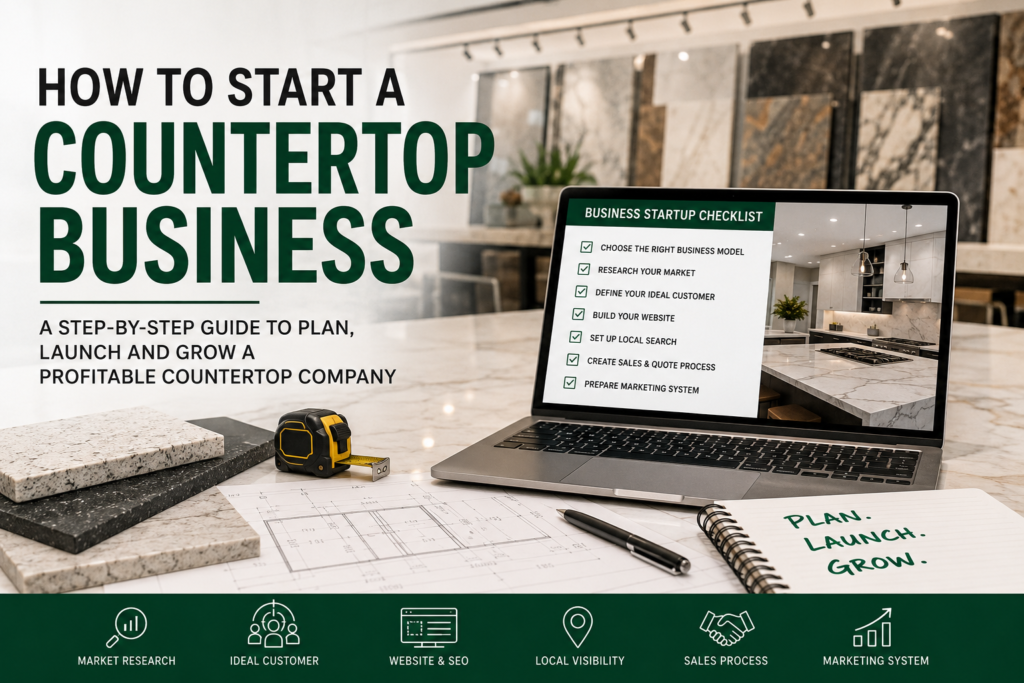
How To Start A Countertop Business With Marketing Built In From Day One
Starting a countertop business is not just about buying equipment, renting a shop, or finding slabs to sell. Those decisions are important to the success of your business, but they will not make the business successful on their own.
To start a countertop business properly, you need to choose the right business model, understand your local market, define the customers you want, plan your website early, set up local search visibility, document your projects from the beginning, and create a quote process that turns interest into real opportunities.
This guide is for people who are entering the countertop industry with the will to build seriously from day one. You are not just trying to open a shop. You are trying to build a business that homeowners, builders, designers, and contractors can find, trust, and contact online.
Decide What Kind Of Countertop Business You Want To Build
Before you buy equipment, rent a shop, build a showroom, or choose a company name, decide what type of countertop business you want to build.
You must start with this decision because your business model will affect your startup cost, equipment, staff, facility, marketing message, website pages, sales process, and profit potential.
Here are the main countertop business models to consider.
1. Installer-Only Countertop Business
An installer-only countertop business focuses on measuring, delivering, and installing countertops without owning a full fabrication shop.
This model can be easier to start because you may not need expensive fabrication equipment, a large facility, or slab inventory. You may work with fabricators, dealers, builders, remodelers, or homeowners who already have materials arranged.
The marketing challenge is that homeowners may not always search for “countertop installer only.” Many buyers search for a complete countertop company that can supply, fabricate, and install. So your website and Google Business Profile must make your role clear.
2. Countertop Dealer Or Reseller
This model can work well if you are strong at sales, showroom presentation, customer education, and supplier relationships. You may not need to own a full fabrication operation at the beginning, but you still need reliable partners because your reputation depends on the final result.
The marketing advantage is that this model can be easy to present online if you have a showroom or a strong material selection process. The marketing challenge is trust. Since you may not fabricate everything yourself, your website must explain who handles the work, how quality is controlled, and why the buyer should trust your process.
3. Small Countertop Fabrication Shop
A small fabrication shop handles selected fabrication work, usually with a tighter service area, smaller team, and more controlled project volume.
This model can be profitable when the shop avoids taking every type of job and focuses on projects it can complete efficiently.
The advantage is control. You can own more of the customer experience, manage fabrication quality, and build a reputation around real completed work.
The marketing challenge is capacity. If your website or ads generate more leads than your team can handle, service quality may suffer. Your marketing should not promise the scale of a large fabricator if your operation is built for careful, limited-volume work.
4. Full Fabrication And Installation Shop
A full fabrication and installation shop supplies, fabricates, and installs countertops. This is the model many people imagine when they think about starting a countertop business.
The advantage is that this model is easy to position clearly online. You can say you help customers choose, fabricate, and install countertops.
The marketing challenge is competition. Established fabricators may already have reviews, search rankings, showroom visibility, and builder relationships. As a new full-service shop, you must invest early in website quality, local SEO, project documentation, Google Business Profile optimization, reviews, and lead tracking.
5. Trade-Focused Fabricator
A trade-focused fabricator serves builders, remodelers, kitchen and bath dealers, interior designers, contractors, and other professionals.
This model can be profitable because trade relationships can produce repeat work. Instead of chasing one homeowner at a time, the business may receive steady projects from partners who need reliable countertop support.
The marketing advantage is that many competitors focus mostly on homeowners. A trade-focused shop can stand out by creating specific pages for builders, remodelers, designers, and contractors.
The marketing challenge is that trade buyers may not convert from a simple quote form. Your website should help start that trust, but your sales process must carry it forward.
Which Model Should You Choose?
The best model is not always the largest one. The best model is the one that matches your capital, market demand, operational capacity, and customer strategy.
Before you choose, ask:
- Who do we want to serve first: homeowners, trade partners, or commercial clients?
- Which projects can we complete profitably and consistently?
- Do we need a showroom, fabrication shop, installation team, or partner network?
- Which service areas can we realistically support?
- What proof will buyers need before they trust us?
- What website pages will this business model require?
- How will we generate leads after launch?
- How will we track quote requests, estimates, and sales?
Handle Licensing, Insurance, And Safety Properly

Before you open a countertop business, get the legal and safety side right. This is not the most exciting part of the startup process, but it protects the business, the team, and the customers.
Start with the basics: business registration, local contractor requirements, insurance, workers’ compensation, contracts, deposits, change orders, and written project terms. The exact requirements will depend on your state, city, business model, and the type of work you perform, so speak with a local attorney, accountant, insurance agent, and licensing authority before launch.
Safety also needs serious attention. Countertop fabrication and installation can expose workers to respirable crystalline silica, especially when cutting, grinding, polishing, or finishing stone and engineered surfaces. OSHA says employers covered by its silica standards must use required engineering controls, work practices, and respiratory protection where applicable. OSHA also notes that applying water to saw blades can substantially reduce dust when cutting materials that contain crystalline silica.
Your safety plan may need to include wet cutting, dust control, ventilation, HEPA-filtered cleanup methods, respiratory protection, employee training, exposure monitoring, and clear shop procedures. OSHA and NIOSH have also updated hazard guidance specifically around silica exposure during countertop manufacturing, finishing, and installation.
If you are starting with serious capital, do not treat compliance as something to fix later. Build the business correctly from the beginning. A countertop shop that ignores safety, insurance, contracts, and licensing may grow fast for a short time, but one serious accident, claim, or compliance issue can damage the entire business.
Research The Market Before You Spend Heavily
Before you spend heavily on equipment, showroom space, vehicles, staff, or inventory, study the market you are about to enter.
A large budget can help you launch faster, but it can also make the wrong decisions more expensive. You don’t want to build a showroom in the wrong area, buy equipment for the wrong type of work, or create a website around services buyers are not actively searching for.
Start by studying local search. Look at the countertop shops that appear for searches like countertop installers near me, quartz countertops in your city, granite countertop fabricator, countertop showroom near me, and kitchen countertop replacement. Pay attention to the companies that keep showing up in Google Search and Google Maps.
Then look beyond rankings. Study their websites, reviews, service areas, materials, project galleries, and calls to action.
Are they targeting homeowners, builders, designers, or commercial clients? Are their websites modern and useful, or do they look outdated and unclear? Do they have strong Google reviews, or are customers complaining about communication, delays, pricing, or installation issues?
A well-funded countertop startup should treat Google, Maps, competitor websites, reviews, and service-area demand as part of its market research. This is also where your future countertop marketing strategy begins, because your research will shape your SEO, service pages, location pages, ads, and positioning.
For a deeper breakdown, read our complete guide on how to market a countertop business.
Choose A Position Before You Choose A Logo
After you decide what type of countertop business you want to build, the next step is positioning.
Positioning comes before branding. Your logo, colors, name, and website design will define your business, but they should come after you know what the business is supposed to mean in the market.
A countertop business with money behind it can still fail online if it looks and sounds like every other shop. If your website says the same things everyone says, buyers have no clear reason to remember you, trust you, or choose you.
Before you build the brand, answer these questions:
- Are you serving homeowners, trade partners, or both?
- Are you competing on speed, premium materials, design guidance, production capacity, convenience, or project communication?
- Are you focusing on kitchen remodels, luxury stone, builder work, commercial projects, or broad residential service?
- Will you operate from a showroom, fabrication facility, service-area model, or hybrid setup?
- Should your company feel premium, affordable, trade-focused, design-led, production-led, or highly personal?
These decisions affect how your website is written, what pages you need, what photos you should collect, what your Google Business Profile should emphasize, and what kind of customers your marketing should attract.
A simple positioning statement can help:
We help [specific buyer] complete [specific countertop project] with [meaningful advantage], so they can [desired outcome].
For example:
We help homeowners complete kitchen countertop replacements with material guidance, in-house fabrication, and clear project communication, so they can move from selection to installation with less uncertainty.
That one sentence already gives your future marketing some direction. It tells you who the business serves, what work it wants, what makes the offer stronger, and what outcome the buyer should expect.
Write A Countertop Business Plan That Includes Marketing

Your countertop business plan does not need to be academic. It needs to help you make better decisions before money starts moving.
At minimum, the plan should clarify your business model, ideal customers, priority materials, service areas, startup costs, facility needs, equipment, suppliers, staffing, pricing, and sales process.
But for a serious countertop startup, the plan should also include the digital side of the business. That means your website plan, SEO plan, Google Business Profile setup, paid advertising budget, review strategy, lead tracking, and CRM process.
Most startup business plans mention marketing as one line item. That is not enough. Your marketing plan should not begin after the shop opens. It should influence how the shop is named, positioned, photographed, staffed, tracked, and sold.
For example, if you want to win homeowners online, your plan should include material pages, project photos, Google reviews, a simple quote form, and local search visibility. If you want builders and designers, your plan should include trade-focused pages, a clear estimating process, production proof, and a follow-up system.
The goal is simple: build the business and the marketing system together, not one after the other.
Plan Startup Costs Around The Operation You Actually Want
There is no single startup cost for a countertop business. The amount depends on the model you choose, the market you enter, the equipment you need, the facility you lease or buy, and the type of customer you want to serve.
Your budget may include shop or showroom space, fabrication equipment, installation tools, material handling equipment, vehicles, software, safety systems, insurance, licensing, supplier deposits, initial inventory, and working capital.
But a well-funded founder can still make one major mistake: budgeting for saws, vehicles, slabs, and showroom buildout while underbudgeting for the digital assets that will help buyers find and trust the business.
If your future customers will find and compare you online, your website and marketing foundation are not optional extras. You should also budget for professional website design, brand identity, project photography, local SEO setup, service and material pages, location pages, quote forms, call tracking, CRM setup, Google Ads testing, retargeting, and a review system.
Build The Website Before You Need Leads
Do not wait until launch week to throw together a website. If you are starting a countertop business with growth in mind, the website should be planned while the business is still being built.
A website is not only a brochure. It is where buyers confirm whether the business is credible enough to contact. It should explain what you do, who you serve, where you work, what materials you offer, and how someone can request a quote.
At minimum, plan for a homepage, About page, service pages, material pages, location or service-area pages, project gallery, quote request page, contact page, reviews section, and FAQs.
If you will have a showroom, add a showroom page that explains what visitors can see and whether appointments are needed. If you want builders, remodelers, designers, or contractors, add a trade partner page that speaks directly to them.
Each page has a job. Service pages help buyers understand what you offer. Material pages help them compare quartz, granite, quartzite, porcelain, marble, and other surfaces. Location pages help you show relevance in the areas you serve. A project gallery builds trust. A quote page turns interest into an inquiry.
If you are planning the website and search foundation for a new shop, explore our digital marketing services for countertop shops.
Set Up Local Search Before Launch
Before you try to win every nearby city, focus on conquering your primary business location first.
Your first local market should be the area your shop can serve best, respond to fastest, photograph most easily, and support profitably. Once that location starts producing reviews, project examples, local search visibility, and steady inquiries, you can expand into nearby cities or suburbs with stronger proof behind you.
This is the foundation of local SEO for a countertop business. You are not just adding city names to a website. You are building local trust one market at a time.
Start with your Google Business Profile. Keep your business name consistent, choose the right primary category, add the correct address or service area, list accurate hours, use a working phone number, connect the right website page, describe your services clearly, and upload real photos of your showroom, team, materials, and completed projects.
A new countertop business has no review history and little brand recognition, so trust must be built deliberately. Set up a review request process before the first customers arrive. Add your business to relevant local directories, Bing Places, and Apple Business Connect. Make sure your website links clearly to your main service pages, material pages, quote page, and location or service-area pages.
Local visibility is easier to build when your website, Google Business Profile, photos, services, and service areas all tell the same story from the beginning. Start with the market you can truly own, then expand location by location as your reputation and capacity grow.
Build A Sales And Quote Process Before Running Ads

Paid ads and local SEO can bring people to your countertop business, but they cannot fix a weak sales process.
Before you spend money driving traffic, decide who answers calls, who receives form submissions, what information is needed before a quote, and how quickly each inquiry should be followed up. If customers need to upload measurements, drawings, or photos, make that process simple. If a showroom visit is the next step, explain when it should happen and what the customer should bring.
You should also know how estimates will be tracked, how lost leads will be recorded, and how each sale will be connected back to its original source. Without that, you may know that leads are coming in, but not which ads, pages, keywords, or local SEO efforts are producing real business.
A good marketing campaign can still fail if quote requests are slow, confusing, or poorly tracked. Paid ads should not be the first move unless the landing page, offer, tracking, and follow-up process are ready. Local SEO may bring slower results, but even those organic leads need the same organized quote path if they are going to become consultations, estimates, and sales.
What brings this all together is the right content marketing strategy for countertop businesses.
Launch With A Marketing System, Not Random Promotion
When the business is ready to open, do not launch with a random promotion. Launch with a simple marketing system.
Before you start pushing traffic, make sure the basics are in place: your website is published, core service pages are live, material pages are ready, your Google Business Profile is completed, Bing Places is submitted, your sitemap is submitted, tracking is installed, quote forms are tested, phone tracking works, first project photos are uploaded, social profiles are branded, internal links are checked, and your review request process is ready.
Random promotion looks like posting photos occasionally, boosting social posts, running ads without proper landing pages, or creating service pages only after competitors have started ranking.
A marketing system is different. It starts with a defined customer, a clear offer, a useful website, a local search setup, a content plan, lead capture, follow-up, and performance tracking.
This matters because a new countertop business needs more than attention. It needs a repeatable path from visibility to trust, quote request, estimate, and sale.
For the full marketing system, use our guide on countertop business marketing.
Avoid Expensive Startup Mistakes
A large budget can help you move faster, but it can also hide weak decisions for a while.
Do not buy expensive equipment before validating demand. Do not choose a generic brand position, launch with a weak website, ignore Google Business Profile, or try to serve too many locations too soon.
Also, avoid trying to appeal to every type of buyer. A startup that speaks to homeowners, builders, designers, contractors, and commercial clients in the same vague voice may fail to stand out to any of them.
The other costly mistakes are operational: not collecting project photos, underestimating follow-up, running ads before tracking is ready, failing to ask early customers for reviews, and ignoring safety, insurance, and compliance.
A large budget can open the door, but it cannot fix a weak business model, unclear positioning, poor sales process, or invisible online presence.
How Much Does It Cost To Start A Countertop Business?
The cost to start a countertop business depends on the business model. An installer-only business may need tools, vehicles, insurance, and working capital. A showroom-based business may need display space, samples, branding, and a stronger local marketing budget. A full countertop fabrication business usually requires more capital because it may need shop space, fabrication equipment, material handling systems, software, vehicles, staff, safety systems, and supplier relationships.
Do not plan startup costs around a generic number. Plan around the operation you actually want to build. Your budget should also include digital assets such as a professional website, project photography, local SEO setup, quote forms, call tracking, CRM, and a Google Ads testing budget.
What Equipment Is Needed To Start A Countertop Fabrication Business?
The equipment needed to start a countertop fabrication business depends on the materials you will work with and the scale of your operation. A fabrication shop may need cutting equipment, polishing tools, material handling systems, installation tools, measuring tools, vehicles, shop software, safety equipment, dust control systems, and respiratory protection.
You should not buy equipment only because a larger shop uses it. Start with the services, materials, and project volume you want to support. A quartz-focused residential shop may need a different setup from a commercial stone fabrication business or a trade-focused fabricator. Your equipment plan should match your business model, safety requirements, staffing, and expected demand.
How Do You Get Customers For A Countertop Business?
You get customers for a countertop business by building visibility, trust, and a clear path to request a quote. That usually starts with a strong website, optimized Google Business Profile, local SEO, material pages, service pages, project photos, reviews, and a simple quote process.
Paid ads can also help, but they should not be your first move unless your landing pages, offer, tracking, and follow-up system are ready. A good countertop marketing strategy should help buyers find you, compare your work, trust your process, and contact you with confidence.
What Should A Countertop Fabrication Business Plan Include?
A countertop fabrication business plan should include your business model, ideal customers, priority materials, service areas, startup costs, facility needs, equipment, suppliers, staffing, pricing structure, sales process, safety plan, and working capital.
It should also include your marketing system. That means your website plan, SEO plan, Google Business Profile plan, paid advertising budget, review generation process, quote request flow, lead tracking, and CRM setup. Marketing should not be treated as one small line item at the end. It should influence how the business is named, positioned, photographed, staffed, tracked, and sold.
How Do You Grow A Countertop Business?
You grow a countertop business by improving both operations and marketing. On the operations side, you need reliable estimating, scheduling, fabrication, installation, communication, follow-up, and customer service. On the marketing side, you need stronger local visibility, better service pages, material pages, location pages, project galleries, reviews, and lead tracking.
Growth should not mean chasing every buyer in every location. Start with the market you can serve well, build proof there, then expand location by location. The best growth comes from a system: clear positioning, useful website content, local SEO, project documentation, reviews, paid campaigns when ready, and a sales process that turns inquiries into estimates and completed jobs.