
How To Get More Leads For A Home Service Business
You can spend money on ads, publish new service pages, collect reviews, post before-and-after photos, and still wonder why the phone is not ringing enough.
The mistake is assuming you just need more of one thing: more SEO, more ads, more content, more social posts.
In reality, digital marketing for home service businesses works best when the whole lead-generation system connects.
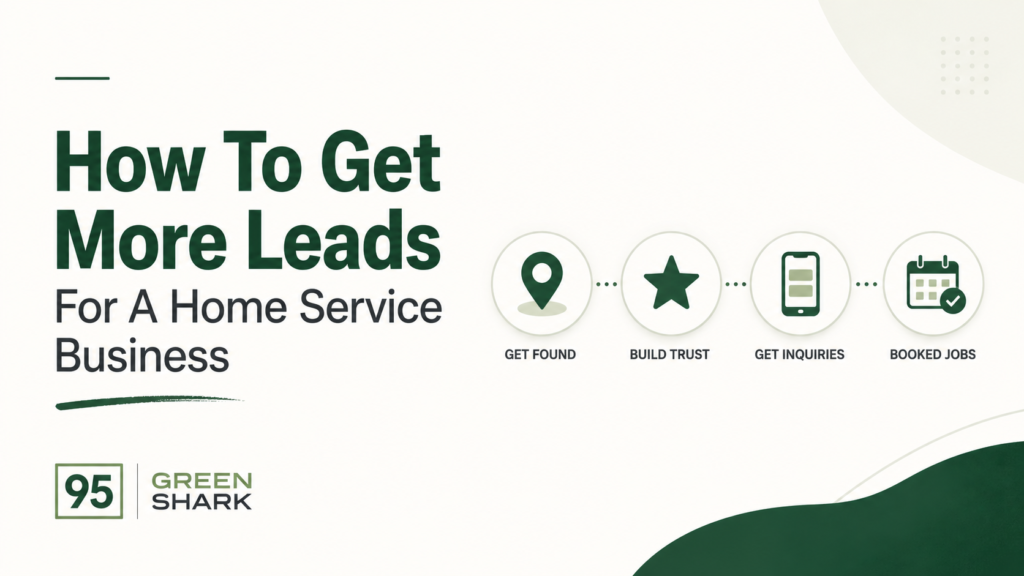
People have to find you, trust you, take action, hear back quickly, and then be tracked through to the job.
Visibility → Trust → Conversion → Follow-Up → Tracking
If any one of those stages is weak, good leads can disappear before they ever become booked work.
Get In Front Of People Who Are Already Looking For The Service
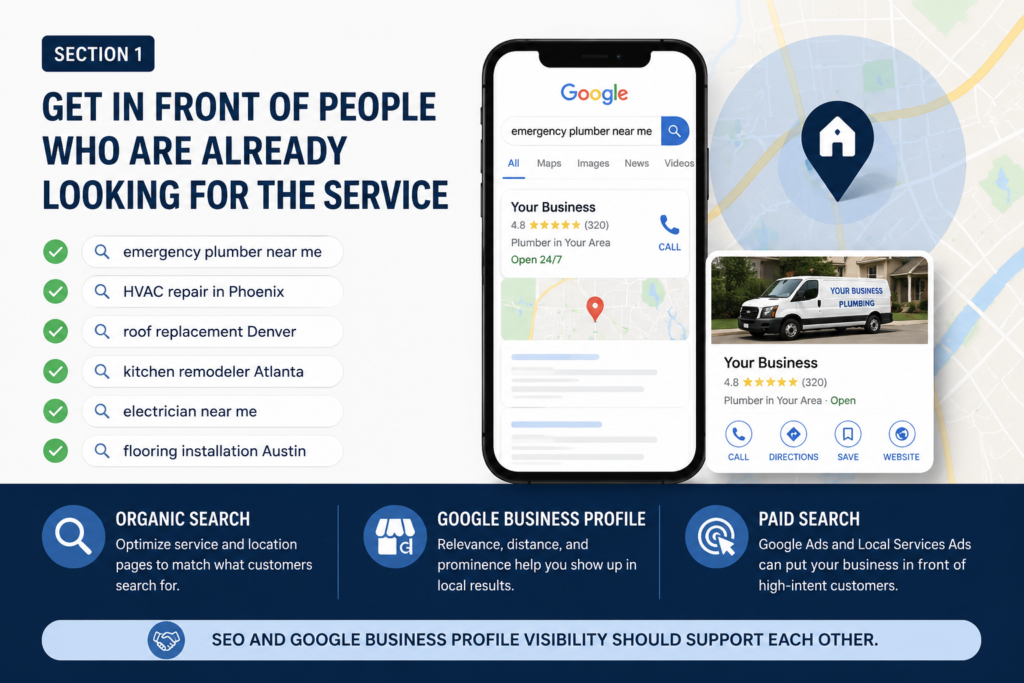
You do not need everyone in your city to see your business. You need the right local people to find you when they actually need the service.
That might be someone searching for:
- emergency plumber near me
- HVAC repair in Phoenix
- roof replacement Denver
- kitchen remodeler Atlanta
- electrician near me
- flooring installation Austin
Organic Search Helps You Match Real Service Demand
Your website should make it obvious what you do, where you do it, and which problems you solve.
That usually means having clear service pages, useful location pages, and supporting content built around the way real customers search.
Google recommends using the words people would actually use to find your content and making important internal links crawlable so search engines can understand how related pages connect. (Google Search Essentials)
If SEO is one of your weaker channels, our guide to SEO for home service businesses goes deeper into how to build visibility around higher-intent searches.
Your Google Business Profile Supports Local Discovery
Your website is only one part of local visibility.
Google says local results are mainly influenced by relevance, distance, and prominence. Accurate business information, reviews, photos, services, and other profile details can help Google understand when your business is a useful local result. (Google Local Ranking Guidance)
That is why local SEO for home service businesses should connect your website, Google Business Profile, reviews, service areas, and local content rather than treating them as separate projects.
Paid Search Can Reach People With Immediate Intent
Google Ads can help your business appear when someone is already searching for the service. Local Services Ads can provide another route in eligible categories and markets. The important point is that no single channel has to carry the entire lead-generation strategy.
SEO can build organic visibility. Your Business Profile can strengthen local discovery. Paid search can create faster access to high-intent searches.
That is also why the question is rarely simply Google Ads vs. local SEO. The better question is: which combination helps the right customers find you when they are ready to act?
Give People Enough Reason To Trust You Before They Contact You
Getting found is only the first step.
A homeowner can search for a plumber, roofer, remodeler, or HVAC company and find several options within minutes. The next question is simple:
Why should they contact you instead of one of the others?
Before reaching out, they may look at:
- Reviews
- Project photos
- Service explanations
- Warranties
- Credentials
- Years in business
- Financing options
- Service areas
- How quickly you respond
- Whether the website actually feels current and trustworthy
This matters because home services come with risk.
If someone is about to let a contractor into their home or spend thousands of dollars on a project, they want evidence that your business can actually do what it says.
For a roofer, that may mean completed roof projects, warranty details, and recent customer reviews.
For a kitchen remodeler, it may be project galleries, clear process explanations, and examples of finished work.
For an HVAC company, it may be service coverage, emergency availability, technician information, and reviews from local customers.
Google’s guidance on helpful content also emphasizes creating useful information for real people rather than content designed mainly to influence rankings. (Google People-First Content Guidance)
Reviews matter too. For Local Services Ads, Google says ratings and review volume can affect how providers rank and stand out to potential customers. (Google Local Services Reviews Guidance)
Your website and Business Profile should therefore answer one question before the customer ever calls:
“Can I trust this business with my home, my money, and this project?”
That is also why website design for home service businesses should be about more than appearance. The site has to reduce doubt and give people enough confidence to take the next step.
Turn More Website Visitors Into Calls And Quote Requests
More traffic does not automatically mean more leads.
A home service business can rank well, pay for clicks, and still lose potential customers because the website makes the next step harder than it needs to be.
The basics matter:
- A phone number that is easy to find
- Click-to-call on mobile
- Clear quote or estimate buttons
- Short, useful forms
- Service area information
- Booking or appointment options where they make sense
- Clear expectations about what happens after someone reaches out
The form is especially important.
You want enough information to understand the inquiry, but not so much that the customer feels like they are filling out paperwork before they are even allowed to talk to someone.
For many home service businesses, asking for the name, contact information, service needed, location, and a few project details is enough to start the conversation.
Paid Traffic Needs A Clearer Path
If someone clicks an ad for “Emergency Plumbing In Dallas,” the page they land on should continue that exact conversation.
They should immediately see that you offer emergency plumbing in Dallas, what kinds of problems you handle, how quickly they can contact you, and what they need to do next.
Sending that visitor to a generic homepage and expecting them to find the right service, location, and contact option creates unnecessary friction.
That is why the choice between a homepage and a landing page matters so much for quote-based service campaigns.
The goal is not to make the website more complicated.
It is to make the path from “I need this service” to “I am contacting this business” as clear as possible.
Use Paid Lead Generation Without Paying For Every Possible Click
Paid search can help home service businesses reach people who are already looking for the service. But paying for traffic only makes sense if the campaign is built around the kinds of leads you actually want.
For Google Ads, that means controlling things like:
- Which services you target
- Which locations you serve
- Which search terms trigger your ads
- Where the click lands
- What counts as a conversion
- Whether those conversions become qualified leads
A cheap click is not the goal.
A qualified call, estimate request, or booked appointment is.
Google recommends stronger conversion measurement when advertisers want to optimize toward better lead quality, including distinguishing qualified or converted leads instead of treating every form submission as equally valuable. (Google Ads Lead Quality Guidance)
Local Services Ads Can Add Another Lead Source
For eligible home service categories and markets, Local Services Ads can generate calls and messages directly from potential customers. Google also provides reporting that can help businesses track leads and whether those leads later become bookings. (Google Local Services Ads Getting Started) (Google Local Services Reporting)
But eligibility varies by category, location, and market. Not every home service business will have access to the same setup or requirements.
That is why the better question is not simply, “Should we run ads?”
It is:
Which paid channel can reach the right local customers, and can we track whether those leads actually turn into work?
If you are comparing the two platforms, our guide to Google Ads vs. Local Services Ads breaks down how they differ.
And if Local Services Ads are available to your business, this Local Services Ads setup guide explains the process in more detail.
The goal is not to buy as many clicks or leads as possible. It is to spend where the path to qualified work is strongest.
Stop Losing Leads After They Contact You
A lot of home service businesses do not actually have a lead generation problem.
They have a follow-up problem.
Someone submits a form at 10:15 a.m. Nobody responds until the next afternoon. By then, that homeowner may already have spoken to two other contractors and booked an estimate with one of them.
Getting the lead is only the beginning. What happens next matters just as much.
Your business should have a clear process for:
- Missed calls
- Form submissions
- Text inquiries
- Estimate requests
- Appointment confirmations
- Estimate follow-up
- Leads that were interested but did not book immediately
That does not mean bombarding people with automated texts and emails.
It means making sure genuine inquiries do not disappear because someone forgot to call back, a form notification went unnoticed, or an estimate sat without follow-up for a week.
Automation can help with simple things like sending an immediate confirmation, alerting the right person, or reminding the team to follow up. But the goal is still a better human sales process, not more messages for the sake of it.
This is especially important for quote-based home services because customers often contact more than one provider.
You may not need twice as many leads.
You may need to stop losing half of the ones you already generate.
Before increasing ad spend or publishing more content, look closely at what happens after someone reaches out. If good inquiries are going cold because responses are slow or inconsistent, fixing that process may do more for booked work than adding another marketing channel.
Track Which Leads Actually Become Booked Work
A home service company should not call a campaign successful just because it generated forms.
The real path is longer:
Search / Ad / Referral → Website → Lead → Qualified Lead → Appointment → Estimate → Booked Job → Revenue
That is the part many businesses miss.
If you only measure the top of the funnel, you can end up spending more money on a channel that looks busy but produces very little actual work.
Useful numbers to track include:
- Total leads
- Qualified leads
- Appointments
- Estimates
- Booked jobs
- Lead-to-job close rate
- Cost per qualified lead
- Cost per booked job
- Revenue by source, where practical
Here is a simple example:
Channel A
- 50 leads
- 5 booked jobs
Channel B
- 20 leads
- 9 booked jobs
If you only looked at lead volume, Channel A would look better. But Channel B may be far more valuable because more of those leads actually turned into work.
That is why raw lead volume is not enough.
Google’s offline conversion tools can help advertisers connect ad clicks or calls with actions that happen later in the sales process, such as qualified leads or completed sales. (Google Offline Conversion Imports)
Google also supports enhanced conversions for leads, which can improve the connection between online lead activity and later offline outcomes. (Google Enhanced Conversions For Leads)
The goal is not to collect as many form submissions as possible.
It is to understand which channels, campaigns, pages, and searches are producing the kinds of customers your business actually wants.
That same distinction matters when judging SEO too. Our guide on rankings vs. visibility explains why impressive-looking marketing metrics are only useful when they connect to real business outcomes.
Frequently Asked Questions
What Is The Best Way To Get More Leads For A Home Service Business?
There is no single channel that works best for every business. Strong home service lead generation usually comes from combining local visibility, trust, clear conversion paths, fast follow-up, and accurate tracking.
Is SEO Good For Home Service Lead Generation?
Yes. SEO can help home service businesses appear when local customers search for specific services and locations. Its value depends on targeting relevant searches and sending visitors to pages that can actually turn interest into calls, quote requests, or appointments.
Should Home Service Businesses Use Google Ads?
Google Ads can be effective for reaching people with immediate service intent. The campaigns still need relevant targeting, strong landing pages, conversion tracking, and regular lead-quality review to avoid paying for traffic that never becomes useful work.
Are Local Services Ads Better Than Google Ads?
Not necessarily. They work differently, and eligibility varies by service category and market. Some businesses may benefit more from Google Ads, others from Local Services Ads, and some may use both as part of a broader lead-generation strategy.
Why Am I Getting Website Traffic But No Leads?
Traffic can fail to turn into leads for several reasons: the wrong search intent, weak messaging, poor trust signals, unclear calls to action, confusing forms, slow pages, or weak follow-up after someone reaches out.
More Leads Will Not Help If The Rest Of The System Is Broken
95 Green Shark helps home service businesses connect SEO, local visibility, paid campaigns, website conversion, content, lead tracking, and follow-up so more of their marketing activity has a clear path toward booked work.