

Website Design For Home Service Businesses: What Your Site Needs Before You Spend On Ads
You may already be spending money on ads, SEO, social media, and lead generation. People may even be landing on your website. But if they leave without calling, requesting a quote, booking a visit, or sending a message, your ads are not the real problem.
The problem may be what they find after they click.
Your website is not just a place to look professional. It is where buyers decide whether your business feels real, clear, safe, and trustworthy enough to contact.
If the site is hard to navigate, slow, vague, outdated, confusing, or missing proof, even a well-targeted ad can send good prospects into a weak experience.
Before you spend more on traffic, your website needs to be ready to convert it. This is also why SEO for home service businesses and paid campaigns work better when the website can actually support the buyer’s decision.
Your Website Is Where Buyers Decide If You Are Worth Contacting
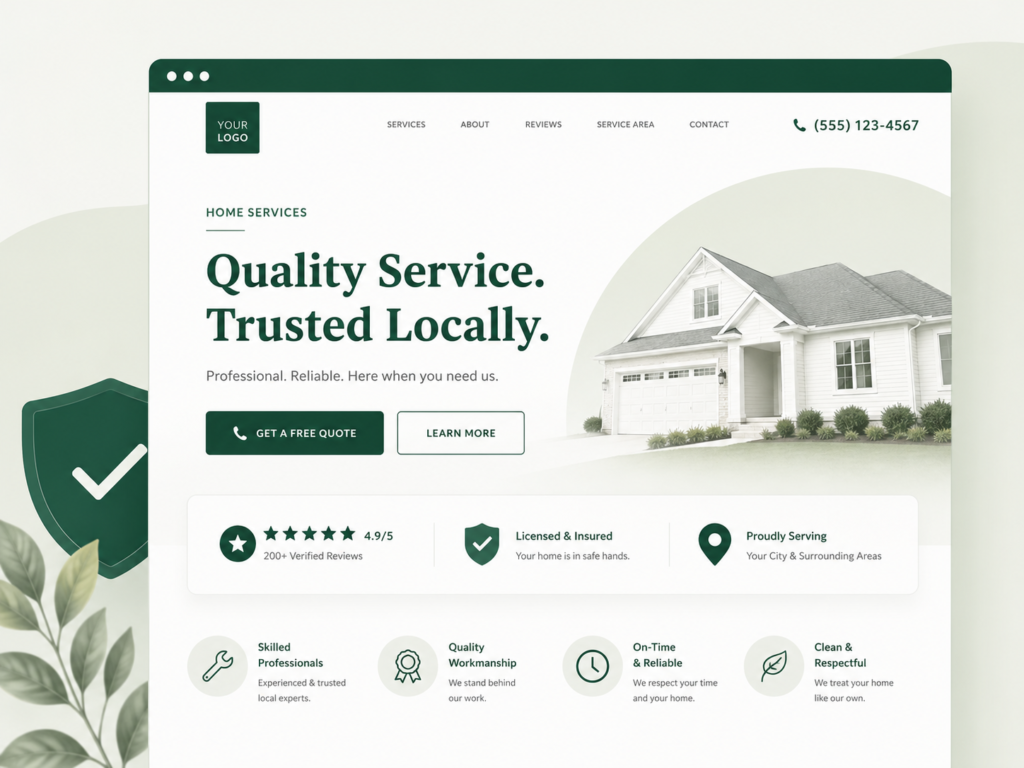
A home service buyer may find you through Google, ads, social media, referrals, or your Google Business Profile. But in many cases, your website is where they pause and ask, “Does this business look serious enough to contact?”
That is why website design for home service businesses should not be judged only by how attractive the homepage looks. Buyers are not just judging the design. They are judging the business behind it.
Your website should quickly answer three things:
- What do you do?
- Where do you work?
- Why should someone trust you?
If those answers are not clear, the buyer may leave, even if your ad, SEO, or referral brought them there.
Stanford’s Web Credibility Guidelines explain that a website can improve credibility by making contact information clear and by using a design that looks professional or appropriate for the site’s purpose. That matters for home service businesses because buyers need to know the business is real, reachable, and organized before they take the next step.
A beautiful website can still fail if it does not reduce uncertainty. If the phone number is hard to find, the service area is unclear, the photos feel generic, the pages are vague, or the quote button is buried, the site may look nice, but still fail to create confidence.
This is one reason rankings and visibility are not enough on their own. A buyer still has to land on a page that gives them enough confidence to call, request a quote, or keep moving through the site.
Your website should make the next step feel safe and simple. If it does not help someone call, request a quote, book a consultation, or visit a showroom, it is not doing its job.
Before Ads, Your Website Must Match The Buyer’s Intent
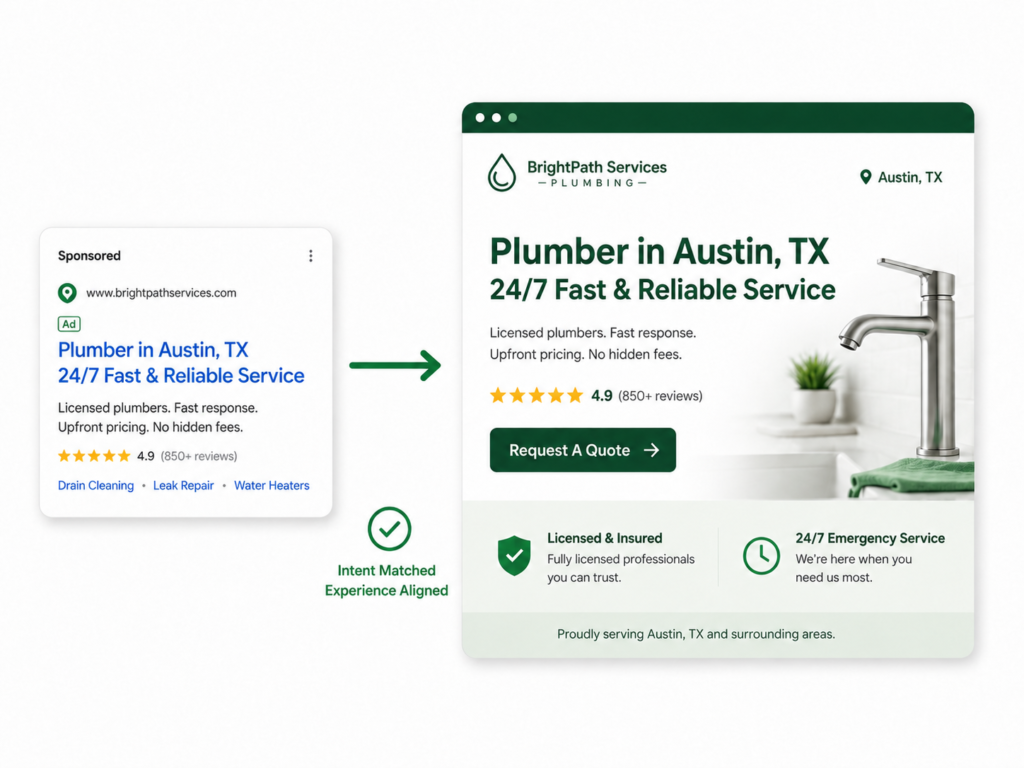
Paid ads do not fix a weak website. They only send more people to it.
If someone clicks an ad for “water heater replacement,” “roof repair,” “bathroom remodeling,” or “countertop installation,” the page they land on should immediately confirm that they are in the right place. The service should match. The location should make sense. The problem should feel understood. The next step should be obvious.
This is where many home service websites lose good leads. The ad is specific, but the website is too broad. The buyer clicks with one clear need, then lands on a homepage trying to talk about every service, every audience, and every possible message at once.
CXL explains that strong landing pages should match the message to the visitor’s intent, prove value quickly, reduce friction, and make the next step feel obvious. That is exactly what a home service page has to do before you spend money driving traffic to it. (CXL)
For a home service business, that means the landing page should show:
- The specific service the buyer clicked for
- The area you serve
- Real proof, such as reviews or project photos
- A clear reason to trust your business
- A simple call, quote, booking, or consultation path
Before you increase traffic, make sure the page can handle the decision. You do not just need clicks. You need the visitor to think, “This business handles my problem, serves my area, and looks safe to contact.”
If your business is already paying for traffic, your paid ads services should be connected to landing pages, tracking, and lead quality, not just clicks.
A Good Home Service Website Needs Service Pages, Not Just A Homepage
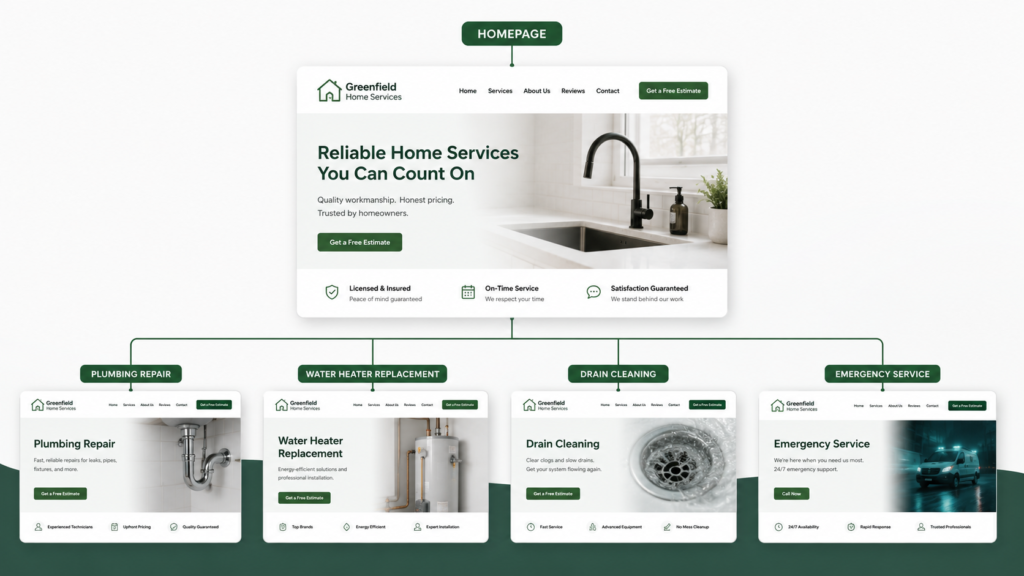
Your homepage introduces the business, but it cannot do all the work.
If you offer plumbing repair, water heater replacement, roof repair, kitchen remodeling, landscaping, countertop installation, HVAC maintenance, or any other home service, each important service needs its own clear page. That page should help the buyer understand the service before they call.
A strong service page should explain:
- The problem the service solves
- Who the service is for
- What the process looks like
- Where the service is available
- What proof supports the business
- What questions buyers usually ask
- What the visitor should do next
This matters because people do not read websites like books. Nielsen Norman Group’s writing-for-the-web guidance explains that online content should be short, scannable, and supported by meaningful headings that help users understand what each page or section is about. That is exactly how service pages should be built. (Nielsen Norman Group)
A service page is not just for SEO. It is a sales conversation in page form. It should answer the questions a buyer would normally ask before calling.
Internal links also matter here. Your service pages should connect to related location pages, project examples, FAQs, reviews, and quote pages. That structure helps search engines understand the website, but it also helps buyers move from interest to trust to action.
If your service pages are vague, thin, or disconnected from the way buyers make decisions, our SEO content strategy services can help you build pages that support search visibility, buyer education, and better quote requests.
This is especially important for quote-based businesses like countertop shops. In our guide on how to market a countertop business, we explain why service pages, material pages, location pages, project proof, and follow-up should work together as one marketing system.
Trust Signals Should Be Built Into The Page, Not Hidden Somewhere Else
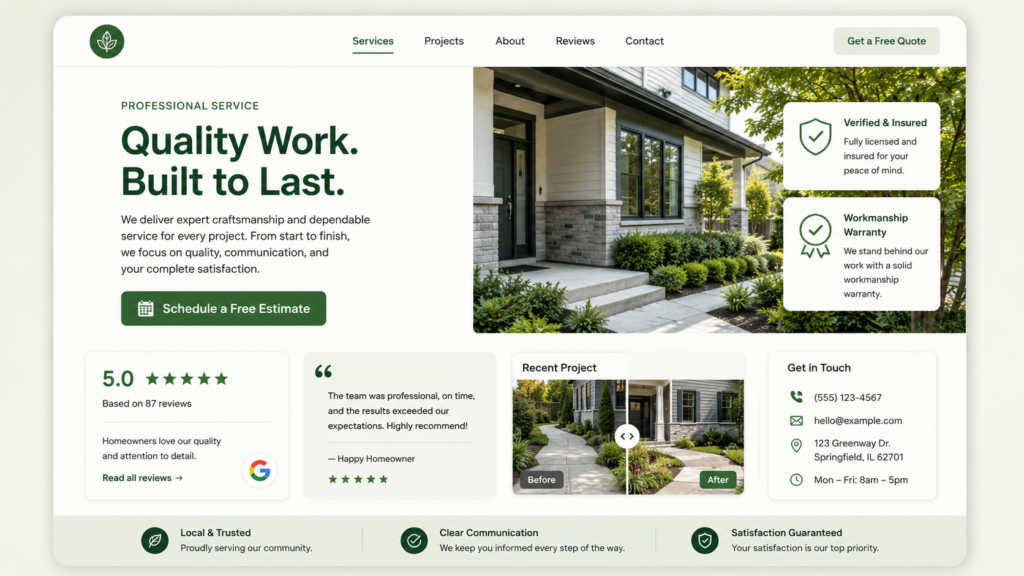
Home service buyers are not just buying a service. They are deciding whether to trust you with their home, property, repair, remodel, or project.
That is why trust signals should not be hidden on one separate testimonial page and forgotten. They should appear where the buyer is making a decision.
If a page says you offer roof repair, show reviews from roof repair customers. If a page promotes bathroom remodeling, show project photos or before-and-after examples. If you mention professional service, show the team, process, certifications, insurance, warranties, years in business, or service standards that support that claim.
Stanford’s Web Credibility Guidelines recommend using third-party support such as citations, references, and source material to support claims. They also point to clear contact information and professional design as credibility factors. That fits home service websites perfectly: the buyer should not have to hunt for proof that the business is real, reachable, and capable.
Interface design also affects trust. A 2022 review on trustworthy user interfaces found that interface design can influence how trustworthy a tool feels and whether people intend to use it. In plain terms, your website’s layout, clarity, and usability can affect whether someone feels safe enough to take the next step. (arXiv)
A home service website should not ask buyers to “just believe us.” It should stack proof beside the claims that matter. Trust should sit close to your calls to action, service descriptions, quote forms, and contact points, so the buyer feels more confident before they call or request a quote.
You can also see this idea in our post on local SEO for home service businesses, where we explain why reviews, photos, project proof, and local relevance all help buyers believe your business belongs in the market you want to win.
Your Website Content Must Be Easy To Scan And Hard To Misunderstand
Most people will not read your service page from top to bottom like a book. They scan first.
They are looking for quick signals that tell them whether your business handles their problem, serves their area, looks trustworthy, and gives them a clear next step. If your page is hard to scan, the buyer may leave before they ever understand what you offer.
That is why page hierarchy matters. Your headings should not be vague or overly clever. They should tell the visitor what each section is about. Your paragraphs should be short. Your service language should be specific. Your most important information should appear early, not buried halfway down the page.
The Office for National Statistics explains that people read online content differently from print and often scan headings and subheadings to decide what deserves attention. This is sometimes called a “layer cake” scanning pattern. (Office for National Statistics)
For a home service website, that means your page should make the basics easy to find:
- What service you offer
- Where you offer it
- Who the service is for
- What the process looks like
- Why someone should trust you
- How to call, request a quote, book, or schedule a consultation
Good website design is not about making people read everything. It is about helping the right buyer quickly understand enough to take the next step.
This is the same reason your business website content strategy matters. The words, headings, layout, proof, and calls to action all shape whether the buyer keeps moving or leaves.
Accessibility, Speed, And Mobile Experience Affect Whether Buyers Can Use The Site
A home service website can look good on a desktop screen and still fail real buyers.
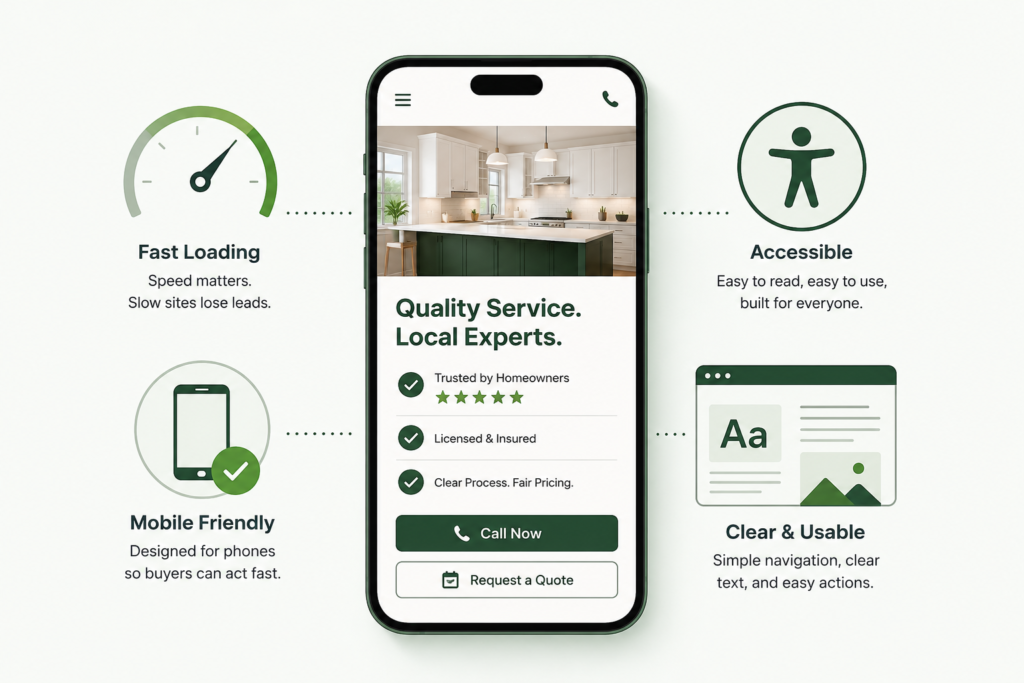
Someone may visit your site from a phone while comparing several contractors, standing in a damaged kitchen, dealing with a leaking pipe, or trying to book a consultation during a short break. If the site loads slowly, the buttons are hard to tap, the phone number is hidden, the form is confusing, or the text is difficult to read, the design is already working against you.
Accessibility is part of that. W3C’s WCAG 2.2 guidelines are built around four principles: content should be perceivable, operable, understandable, and robust. In plain language, people need to be able to see, use, understand, and interact with your website.
That is not just a technical concern. It affects whether someone can actually become a lead.
For a home service website, that means:
- Phone numbers should be easy to find and tap.
- Quote forms should be simple to complete.
- Buttons should be clear and usable on mobile.
- Text should have enough contrast to read comfortably.
- Images should have useful alt text where needed.
- Form labels should make sense.
- Pages should load quickly enough that buyers do not give up.
WebAIM’s 2026 Million report found notable increases in detected accessibility errors and pages with WCAG conformance failures across the top one million homepages, which shows how common these issues still are.
A home service website should not only look good in a portfolio screenshot. It should work when someone is on a phone, in a hurry, comparing options, and deciding who to call.
For countertop shops and similar home improvement businesses, this is why our website design for countertop shops focuses on buyer clarity, service structure, proof, and conversion instead of only visual appearance.
The Website Should Connect Traffic To Real Leads Before You Spend More
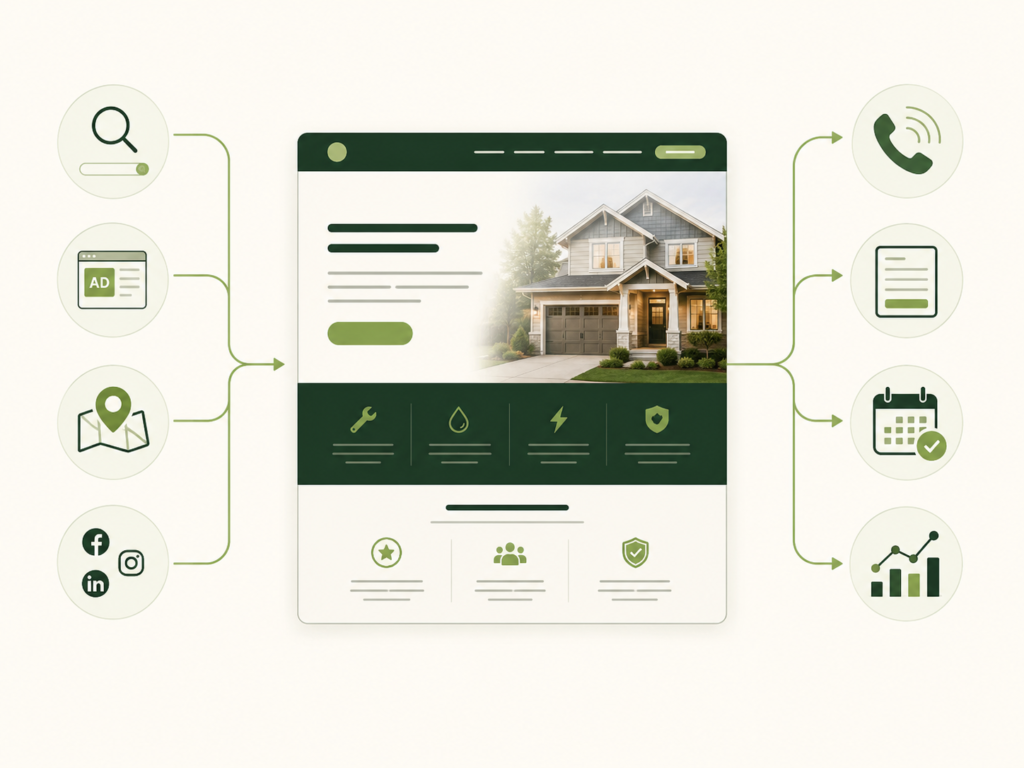
Before you spend more on ads, SEO, or content, your website should be ready to capture and track real opportunities.
Otherwise, you may bring more traffic into a system that cannot convert, qualify, or measure leads properly.
A good home service website should support calls, quote forms, booking paths, consultation requests, showroom visits, and lead capture. But it should also help you understand what happens after people land on the site.
Are visitors clicking the phone number? Are they starting the quote form but not finishing it? Are they landing on the wrong page? Are they coming from ads, SEO, social, referrals, or Google Business Profile? Are the best leads coming from a specific service or location?
Microsoft Clarity explains that user intent metrics can help you understand the quality of website traffic, and its tools include heatmaps and session recordings that show how visitors interact with pages. That matters because website performance should be observed, not guessed. (Microsoft Clarity)
For a home service business, the website should track the basics:
- Phone clicks
- Form submissions
- Service requested
- Location or service area
- Lead source
- Quote or booking requests
- Estimate value
- Closed jobs, where possible
SEO and ads work better when the website can convert and measure interest. If you are sending paid traffic to a page that cannot explain the offer, prove trust, capture the lead, or track the source, you are making the campaign harder than it needs to be.
Do not spend more money sending traffic to a website that cannot explain, prove, capture, and track demand. Fix the sales path before scaling traffic.
If your business is already investing in campaigns, our paid ads services can help connect landing pages, tracking, and lead quality before you spend more. If the bigger issue is search visibility and website structure, our SEO strategy services can help you build a clearer path from search to lead.
If your home service website is not turning visibility into calls, quote requests, and better leads, request a digital marketing review from 95 Green Shark.