How To Choose The Right Keywords For A Home Service Business
You may have already added service names, city pages, and the phrases an SEO tool told you to target, yet your website still brings little visibility and even fewer useful inquiries.
The problem may not be that you need more keywords. You may be targeting broad phrases, low-value searches, or terms that do not match the work you want. “Roof” says almost nothing. “Emergency roof repair in Denver” reveals the service, location, and urgency.
This guide will show you how to choose keywords that connect your services and locations with the customers most likely to call, request a quote, and book the work.
What Makes A Keyword Valuable To A Home Service Business?
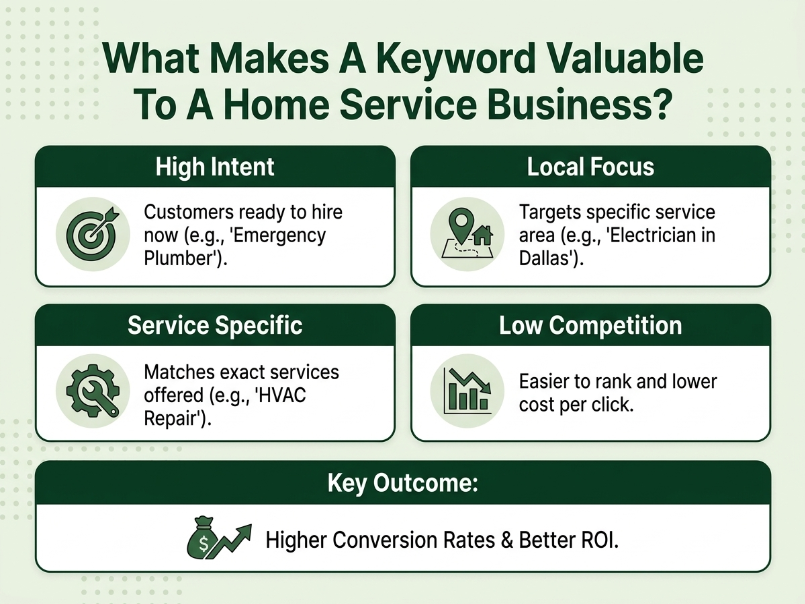
A valuable keyword does more than describe a service. It should reflect work you actually want, match a real customer need, fit a profitable service area, and lead somewhere useful on your website or in your campaign.
That is why search volume alone can mislead you.
A broad term like “plumbing” may attract a large audience, but it does not tell you whether the person needs residential repair, commercial maintenance, DIY advice, training, or a product.
Compare that with:
- “How to fix a leaking faucet” — informational and possibly DIY
- “Emergency plumber in Phoenix” — urgent, local, and closer to hiring
- “Commercial plumbing maintenance Phoenix” — specific service, audience, and location
A keyword should pass four tests:
| Test | Question |
| Relevance | Does it describe a service we genuinely provide? |
| Intent | Is the person researching, comparing, or ready to contact someone? |
| Geography | Is the search connected to an area we can serve profitably? |
| Business value | Is this the kind of job we actually want more of? |
Informational keywords are not useless. A homeowner researching whether to repair or replace an HVAC system may become a strong lead later. But that search should not be valued the same way as “AC replacement company in Austin.”
Google recommends using the words people would naturally use to find a page and placing them in meaningful areas such as titles, headings, links, and image descriptions. It also emphasizes creating helpful content for people rather than pages built only to manipulate rankings. (Google Search Essentials)
The goal is not to collect the biggest keyword list. It is to identify the searches most closely connected to the services, locations, and jobs your business wants to win.
How Should You Build The Initial Keyword List For Your Home Service Business?
Start with the work your business actually wants, not with whatever a keyword tool suggests first.
List your core services, then expand each one by adding the customer’s problem, urgency, audience, project type, and location.
A useful structure is: Core Service + Modifier + Location
For example:
- AC repair + emergency + Austin
- Roof replacement + financing + Denver
- Electrician + commercial + Atlanta
- Water damage restoration + 24-hour + Phoenix
- Hardwood flooring installation + residential + Columbus
This keeps the keyword list connected to the jobs you can actually deliver. From there, organize the terms into four groups.
High-intent service keywords show that someone is actively looking for a provider, such as “plumber near me,” “HVAC repair in Dallas,” or “roof replacement company.”
Problem and urgency keywords reflect what the customer is experiencing, such as “AC not cooling,” “burst pipe repair,” “roof leaking after storm,” or “electrical panel keeps tripping.”
Location keywords combine a service with a city, suburb, county, or metro area. Only target places your team can serve consistently and profitably. Creating pages for every nearby city may produce thin content and leads from areas you do not really want.
Research and comparison keywords capture buyers earlier in the process. Examples include “repair or replace an AC unit,” “how much does roof replacement cost,” and “hardwood vs. luxury vinyl flooring.”
Google Keyword Planner can help generate related ideas, estimate search activity and costs, and organize terms into useful groups. But the tool does not know your margins, crew capacity, preferred project size, or weakest sales periods. Every suggestion still needs to be checked against the business. (Google Ads Keyword Planner) (Refine Keyword Ideas)
A strong keyword list should look like a map of the work you want, not a download of every phrase people might search.
Want to learn more about how to market your home services business? Read this article on marketing your countertop business or any quote-based business.
How Do You Validate Keywords With Real Data For Home Service Businesses?
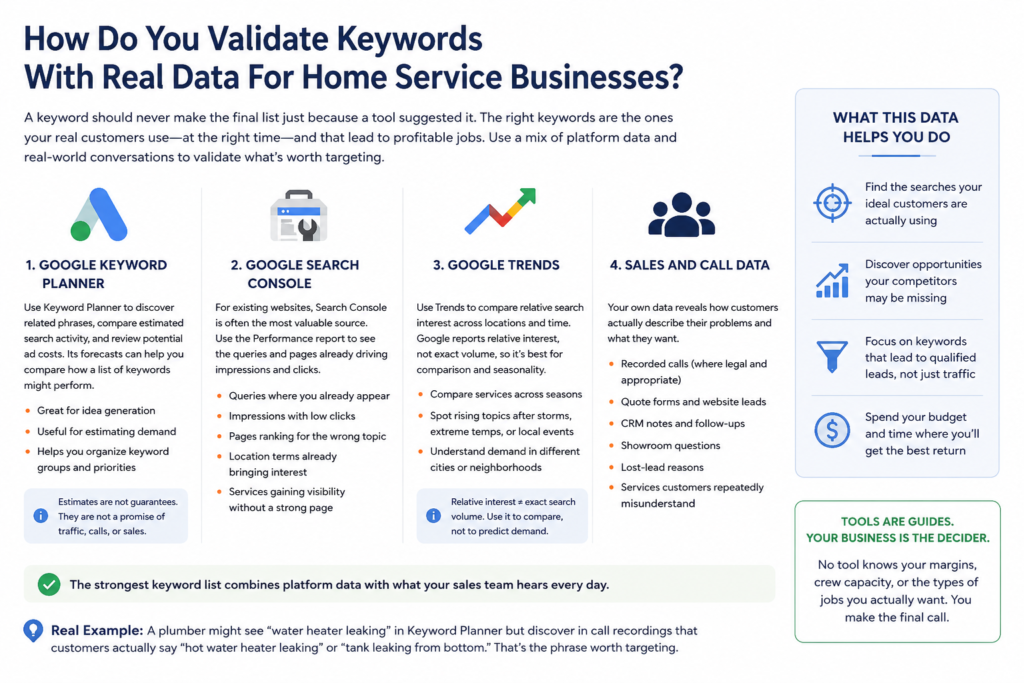
A keyword should not make the final list simply because a tool says people search for it.
Start with Google Keyword Planner to find related phrases, compare estimated demand, and review potential advertising costs. Its forecasts can help organize terms and estimate how a keyword group might perform, but they do not guarantee traffic, leads, or sales. (Google Keyword Planner Forecasts)
For an existing website, Google Search Console may be even more useful. Its Performance report shows the queries and pages already receiving impressions and clicks, along with click-through rate and average position.
Look for searches where the site already appears, queries with impressions but few clicks, location terms gaining interest, and services receiving visibility without a strong page behind them. (Search Console Performance Report)
Use Google Trends to compare relative interest across locations and time periods. It is especially useful for seasonality, but it does not show exact search volume. An HVAC company can compare heating and cooling demand across the year, while a restoration business can examine interest after storms. (Google Trends Data)
Finally, check your own calls, quote forms, CRM notes, showroom questions, and lost-lead reasons. Customers often use language that keyword tools miss.
The strongest keyword list combines platform data with what your sales team hears every day.
How Should You Prioritize Keywords For Quote-Based Businesses?
Trying to target every relevant phrase at once usually spreads your effort too thin. Prioritize the keywords most closely connected to the work your business wants and can handle.
Start with seven factors: customer intent, revenue potential, service priority, location fit, competition, current visibility, and operational capacity.
| Keyword | Intent | Job Value | Location Fit | Priority |
| Emergency AC repair Austin | High | Medium | Strong | High |
| Commercial HVAC maintenance Austin | High | High | Strong | High |
| How does air conditioning work? | Low | Indirect | Weak | Low |
| Cheap AC repair Austin | Unclear | Potentially low | Strong | Review |
A lower-volume commercial or replacement keyword may be worth more than a broad phrase with thousands of searches. Ten searches from facility managers needing ongoing HVAC maintenance could matter more than hundreds of general visitors researching how air conditioners work.
Separate keywords that represent different business goals. Residential and commercial customers should not automatically share the same campaign or page.
Repair, replacement, emergency service, and planned projects may also need different priorities because their values, urgency, and sales paths differ.
Geography needs the same discipline. Focus first on cities and service areas where your team can respond consistently and complete work profitably. A location keyword can strengthen relevance, but adding a city name does not guarantee local visibility.
Google says local results are mainly influenced by relevance, distance, and prominence. That means a well-optimized page may still face limits based on the searcher’s location and the strength of competing businesses. (Google Local Ranking Guidance)
Prioritize the keywords that connect search demand with real capacity, stronger margins, and the jobs your business is actively trying to win.
Where Should Each Keyword Be Used?
Every important keyword should have a destination that directly answers the search.
A common mistake is forcing one homepage to rank for every service, location, and customer type. A plumber offering emergency repairs, water-heater installation, drain cleaning, and commercial maintenance cannot explain all four services equally well on one general page.
Use this structure instead:
| Keyword Type | Best-Fit Destination |
| Main service | Dedicated service page |
| Service and city | Useful location or service-area page |
| Material or product | Material or product page |
| Cost or comparison | Guide or FAQ |
| High-intent paid keyword | Focused landing page |
| Brand search | Homepage or Business Profile |
For example:
- “Roof replacement in Denver” should lead to a Denver roof-replacement page.
- “Emergency plumber near me” should lead to an emergency plumbing page or closely matched ad landing page.
- “Quartz vs. granite countertops” belongs on a comparison guide.
- “Commercial electrician Atlanta” needs a commercial electrical page, not a generic residential homepage.
Google recommends clear site organization, descriptive pages, and crawlable internal links that help people and search engines understand how related content connects. It also advises using the language people search for in titles, headings, alt text, and link text. (Google SEO Starter Guide) (Google Search Essentials)
Do not create a separate page for every tiny wording variation. One strong roof-replacement page can naturally cover closely related searches without duplicating the same copy across several URLs. A clear business website content strategy helps determine which topics deserve individual pages and which belong together.
For paid campaigns, keyword match types influence how closely a search must relate to the chosen keyword. Broad, phrase, and exact match offer different levels of reach, while negative keywords help block searches that are irrelevant to the service or business. (Google Ads Keyword Matching) (Google Ads Negative Keywords)
The landing page must continue the conversation started by the search. Our guide to homepages versus landing pages for quote-based service ads explains why this matters.
For the pillar link, the strongest placement will likely be in the next section or conclusion, where we connect keyword selection to the wider system of SEO, local visibility, website trust, and lead generation through digital marketing services for home service businesses.
How Do You Know Whether The Keywords Are Working?
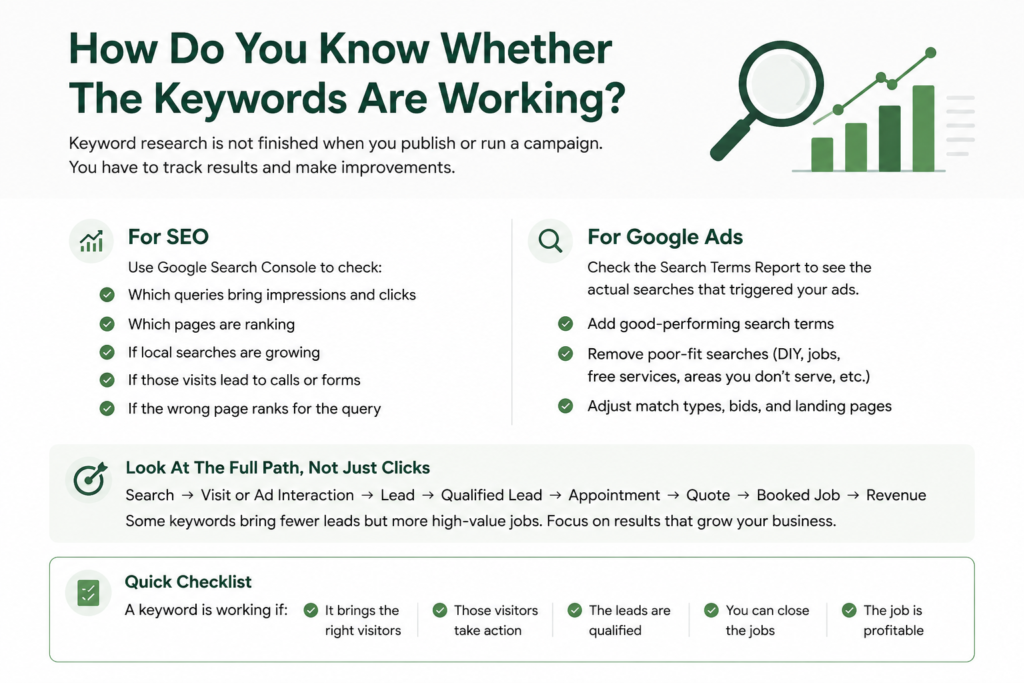
Keyword research is not finished when the phrases are added to a page or campaign. The real test is whether they attract the right people and move them toward profitable work.
For SEO, use Google Search Console to check which queries generate impressions and clicks, which pages appear for those searches, and whether relevant service and location terms are gaining visibility.
Also look for cases where the wrong page ranks. A homepage appearing for an important service query may signal that the website needs a stronger dedicated page.
For Google Ads, review the search terms report. This shows the actual phrases people used before seeing or clicking the ad, which may differ from the keywords added to the campaign.
Use that data to find useful new terms and exclude poor-fit searches involving jobs, DIY instructions, free services, training, products without installation, locations outside the service area, or services the business does not provide. (Google Ads Search Terms Report)
Do not judge a keyword only by rankings, clicks, or cost per click. Follow the complete path:
Search → Visit Or Ad Interaction → Lead → Qualified Lead → Appointment → Quote → Booked Job → Revenue
A keyword producing five qualified replacement projects may be more valuable than one producing twenty small or irrelevant inquiries.
Before continuing to target a keyword, confirm that it:
- Describes a real service
- Reflects a customer the business wants
- Matches a commercially sensible location
- Has a suitable page or campaign
- Can be measured beyond clicks
- Produces work the business can handle
Keyword performance should also be reviewed as part of the wider marketing system. Strong terms still need useful pages, local trust, clear calls to action, accurate tracking, and proper follow-up. That broader connection is explained in our guide to digital marketing services for home service businesses.
The right keyword is not the one that looks most impressive in a tool. It is the one that repeatedly connects the business with the right searcher, service, location, and outcome.
Frequently Asked Questions
What Are The Best Keywords For A Home Service Business?
The best keywords combine a real service, clear customer intent, a profitable location, and a suitable next step. There is no universal list that works for every contractor.
Should I Target “Near Me” Keywords?
They can reflect strong local intent, but your pages should still use natural service and location language. Do not force “near me” repeatedly into the copy.
Should I Choose Keywords With The Highest Search Volume?
Not automatically. A lower-volume phrase may bring fewer visitors but more qualified customers, higher-value jobs, or stronger close rates.
How Many Keywords Should One Page Target?
A page should focus on one clear topic while naturally covering closely related searches. You do not need a separate page for every small wording variation.
Are SEO Keywords And Google Ads Keywords The Same?
They may overlap, but they are used differently. SEO keywords shape useful pages and content. Paid keywords also require decisions about match types, bids, negative keywords, locations, and landing pages.
How Often Should Keyword Research Be Updated?
Review it when your services, locations, customer behavior, competition, or campaign data changes. Search Console and Google Ads search-term data can reveal new opportunities over time.
Are You Targeting The Keywords That Bring Work Or Just Traffic?
95 Green Shark helps home service businesses connect keyword research with service pages, local visibility, paid campaigns, landing pages, lead tracking, and booked work.
Request A Digital Marketing Review
About the author: Joseph Omosuvie is the founder of 95 Green Shark. He has years of agency-side experience creating SEO content, service pages, location pages, and practical marketing systems for home-improvement and service businesses.
See documented location-page SEO results and examples from 95 Green Shark.
Explore SEO strategy services for businesses that need a clearer search roadmap.